The frozen north is a fascinating place for young children. It is home to unique animals like polar bears, walruses, and puffins.
These creatures have adapted beautifully to survive in the cold. Children are naturally curious about how they live and hunt.
Our Arctic Animals for Preschool pack taps into this interest. It provides a structured, visual framework to explore the tundra.
This resource combines science, early math, and literacy on every page. Let’s explore how to use these templates successfully.
The Developmental Benefits of Habitat Themed Lessons
Themed units are highly beneficial for early cognitive growth. They help children connect different subjects under one exciting umbrella.
In this pack, kids do more than color. They practice letter tracing to build physical muscle memory.
They use visual discrimination to search for hidden words. They also practice descriptive reasoning by choosing adjectives for each animal.
This process expands their language and science skills naturally. It makes early vocabulary acquisition simple and memorable.
Designing an Academic Routine
Structured schedules help children feel secure and focused. You can easily schedule a dedicated morning learning hour.
Add focused table activities to your Morning Routine Chart for Kids. This establishes a consistent habit of quiet study.
Tracking progress keeps kids motivated over vacation breaks. A Summer Habit Tracker for Kids makes goal setting interactive. Use it to record completed worksheets and reading milestones.
The Arctic is famous for its snowy climate. This makes it an excellent bridge to daily weather science.
Observe the morning sky with our weather observation worksheet. You can also explore seasonal patterns using our Weather Worksheets for Kindergarten.
Compare colder climates to late winter transitions. Use our Groundhog Color By Number Printable to Build Early Skills to track the winter forecast.
Key Concepts in the Arctic Animals Pack
This printable pack uses diverse, kid friendly layouts to teach. It does not rely on heavy reading blocks. The worksheets cover several core developmental categories:
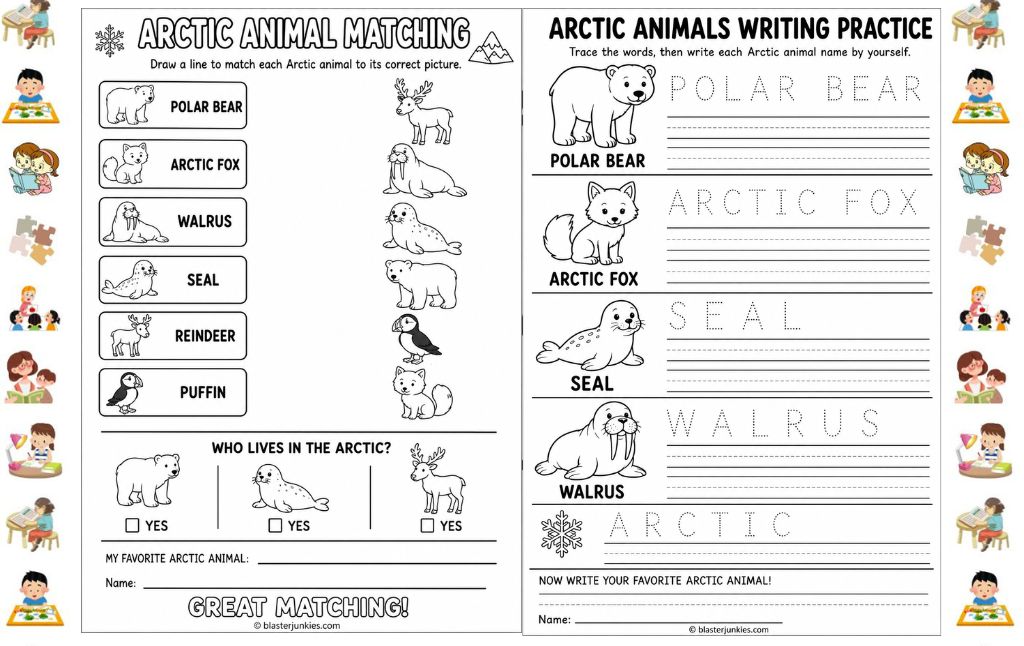
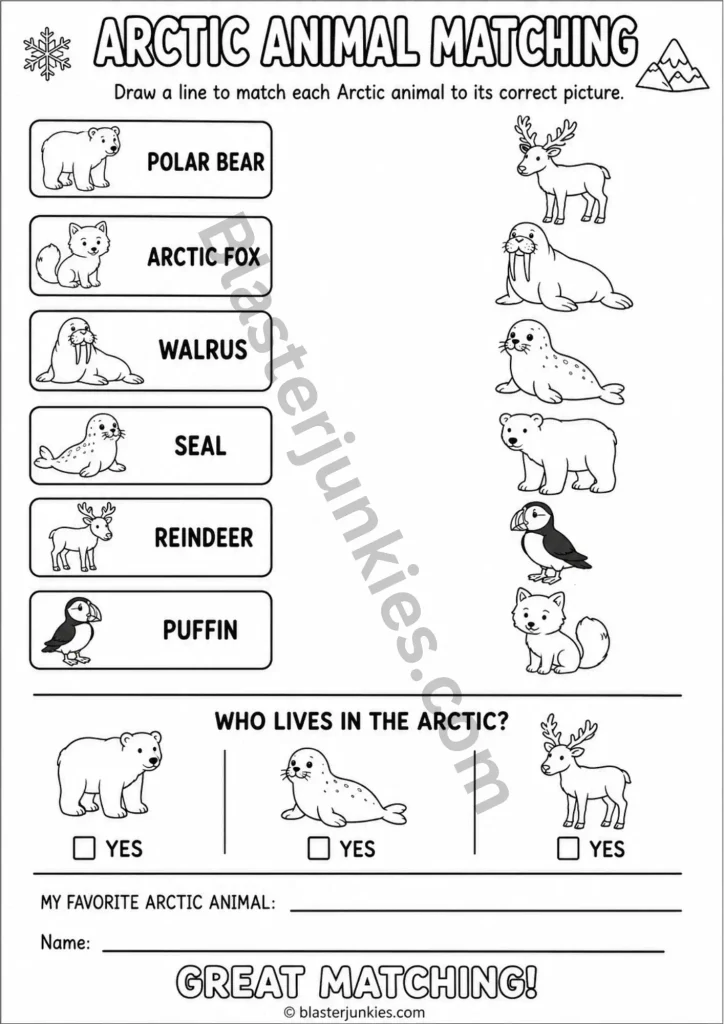
Visual Matching: Drawing lines to connect full color animal drawings to their correct names.
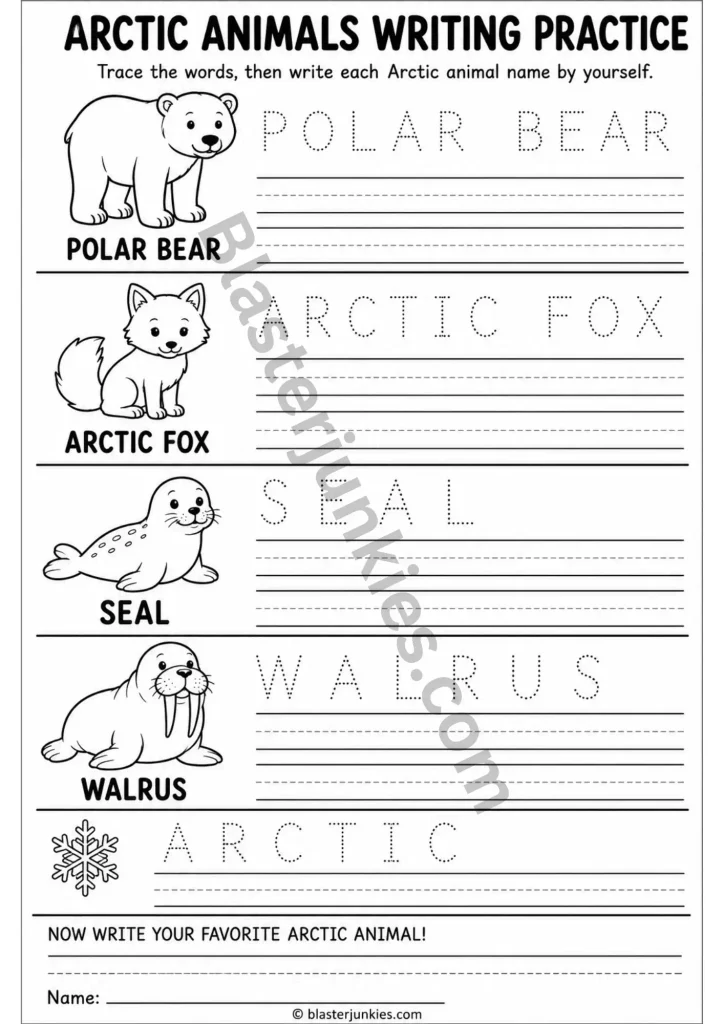
Pencil Control: Tracing large, dotted words like “POLAR BEAR” and “WALRUS” to practice handwriting.
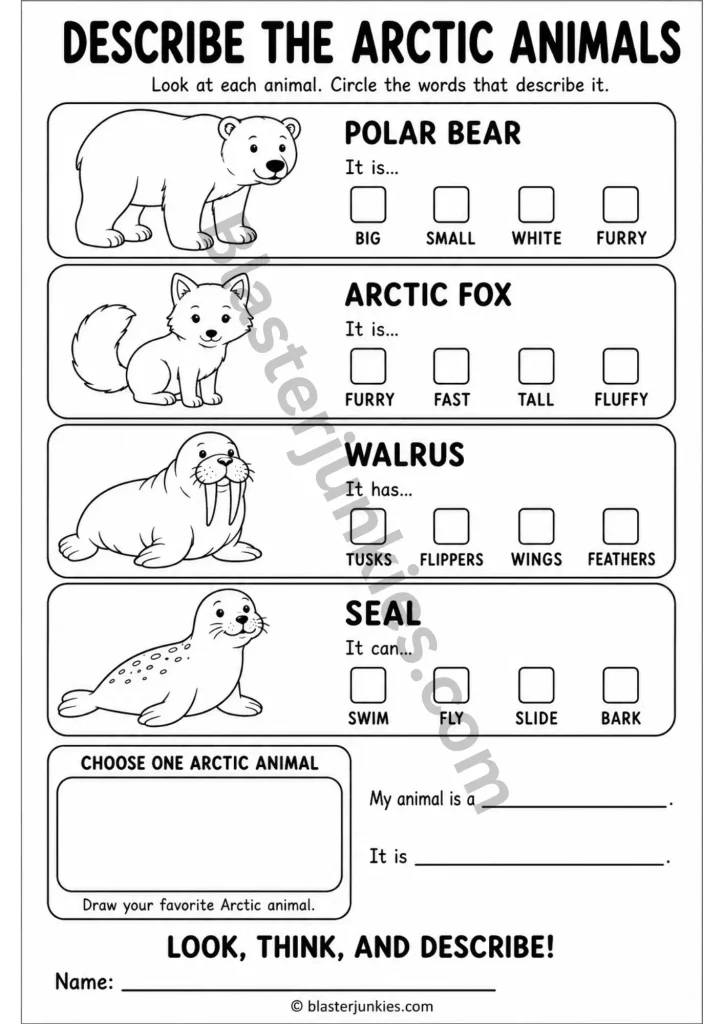
Descriptive Analysis: Checking boxes to determine if animals are big, white, furry, or have tusks.
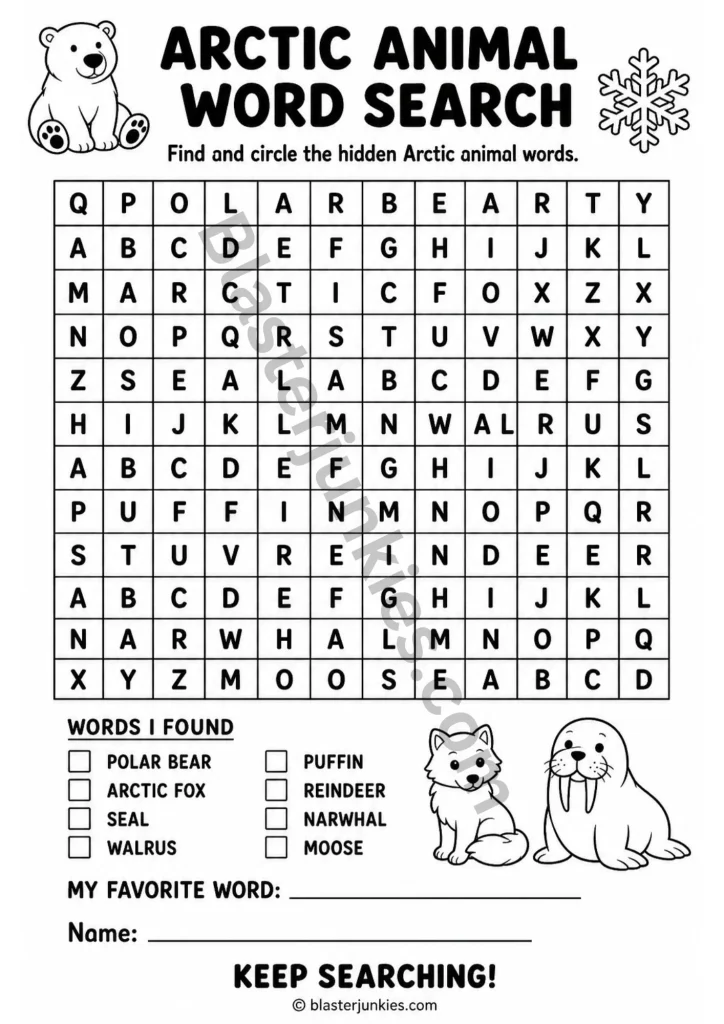
Grid Scanning: Finding hidden animal words horizontally or vertically in a word search.
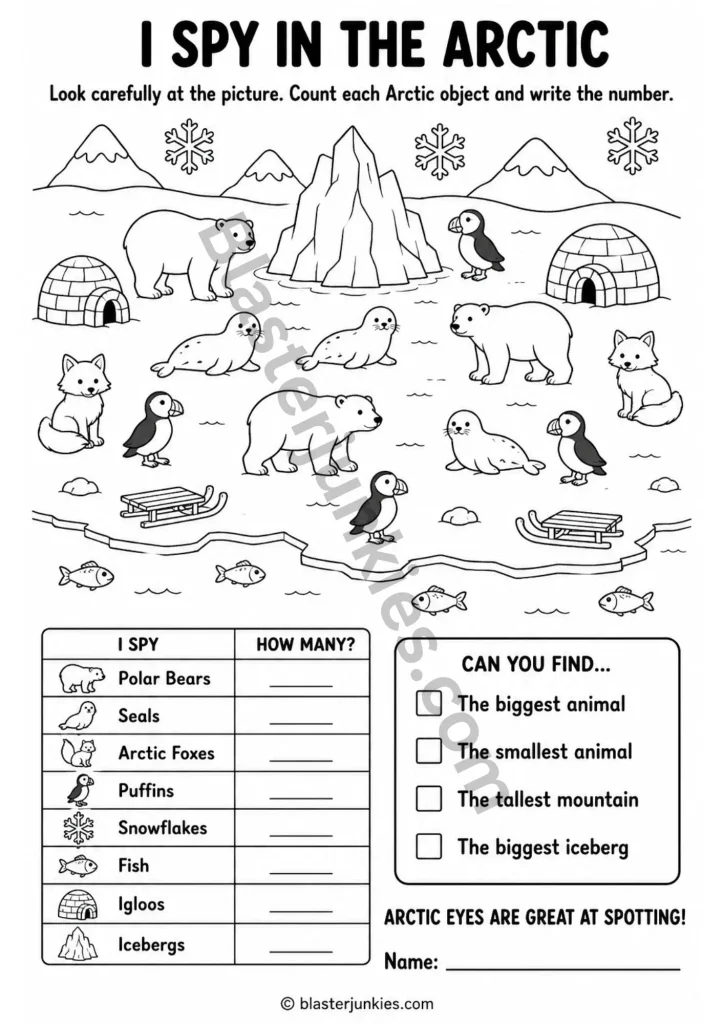
Visual Tallying: Searching, counting, and recording animals, snowflakes, and igloos in an I Spy scene.
These activities build bilateral coordination. One hand holds the paper steady.
The other hand writes, colors, or cuts. This dual hand coordination is essential for physical growth.
Creative Sensory Extensions
You can easily expand these paper based lessons. Combine the animal worksheets with other sensory toys.
Hide plastic polar bears in a sensory bin. Fill a container with shaving cream or fake snow. Let children search for the hidden animals. This tactile search keeps indoor play exciting.
You can also play active movement games. Have your children act out the animals they see. Can they waddle like a seal? Can they swim like a walrus? Can they run fast like an arctic fox?
This lets children burn off extra energy indoors. It also reinforces the biological concepts they learned.
How to Use These Worksheets
Using these worksheets is straightforward. Here is a practical guide to get started.
First, print the selected activity pages. We recommend printing on high quality paper. Thick cardstock stands up best to repeated handling and heavy coloring.
Have your child read the animal names aloud first. This builds pronunciation skills and initial sound recognition.
Next, let them trace the dotted lines with pencils or markers. Encourage them to hold the pen comfortably and move slowly.
To save paper, try laminating the sheets. Laminated pages work wonderfully with dry erase markers.
Kids can complete the word search and matching games repeatedly. This is perfect for classroom morning work. It is also ideal for quiet learning bins at home.
Supporting Cognitive and Fine Motor Growth
Crafting and writing build crucial cognitive skills. They encourage children to plan their steps. They must look closely at details before making a decision.
This logical thinking teaches them patience. It also helps build a longer attention span. They learn to work quietly and finish tasks.
Completing a project gives children a sense of success. They feel proud to show you their completed sheets.
This simple pride boosts their self esteem. It motivates them to tackle more complex learning tasks.
You can also use these worksheets to teach phonics. Ask your child: “What sound does the word ‘seal’ start with?”
This simple prompt turns a science lesson into a reading lesson. Phonics training is vital for early reading success.
Fun Classroom and Home Display Ideas
Do not let the learning stop on paper. Display their completed worksheets around your home or classroom.
Create a “Winter Wonderland” bulletin board. Hang their custom colored polar bears and foxes together.
You can add white cotton balls for snow accents. This collaborative art project keeps spirits high. It helps children feel like part of a community.
They love finding their own work on the wall. This reinforces their reading skills in a fun way.
At home, tape their best writing sheets to the refrigerator. This marks their learning progress with pride.
Customizing for Different Age Groups
These printable pages are highly adaptable. They suit children of varying developmental levels.
For toddlers (ages 2–3), focus on simple recognition. Point to the pictures of the animals on the page. Let them make animal sounds as they point.
For preschoolers (ages 3–4), focus on tracing and matching. Guide their hands as they trace the dotted letters. Help them draw lines to match the pictures.
For kindergarteners (ages 5–6), encourage independent work. Let them complete the word search entirely alone.
They can write a short sentence about their favorite animal on the back. This flexibility makes the pack great for families. Siblings of different ages can study together.
Conclusion
Learning about the polar regions is a wonderful journey. These printable arctic worksheets combine seasonal fun with education.
They help children practice essential childhood skills. Fine motor, math, and literacy are all supported.
You can easily download the complete pack today. It is ready to print and use immediately.
Enjoy watching your child discover science through play. Have fun exploring the frozen north together today!
The letter A is the perfect starting point for this study. “A is for Arctic” is a great phonics lesson. Pair your lessons with our letter a worksheets for preschool to practice uppercase and lowercase tracing.
For early math, try other nature themes. Practice counting with our count and color bugs worksheets or our bug do a dot pages preschool.
Sorting is another vital cognitive milestone. Use our tops and bottoms sorting activity printable to classify different animal habitats. Explore more water species using our Fun Ocean Animal Worksheets.
Matching games also build strong visual reasoning. Try our farm animal memory game to connect animals with their printed names.