
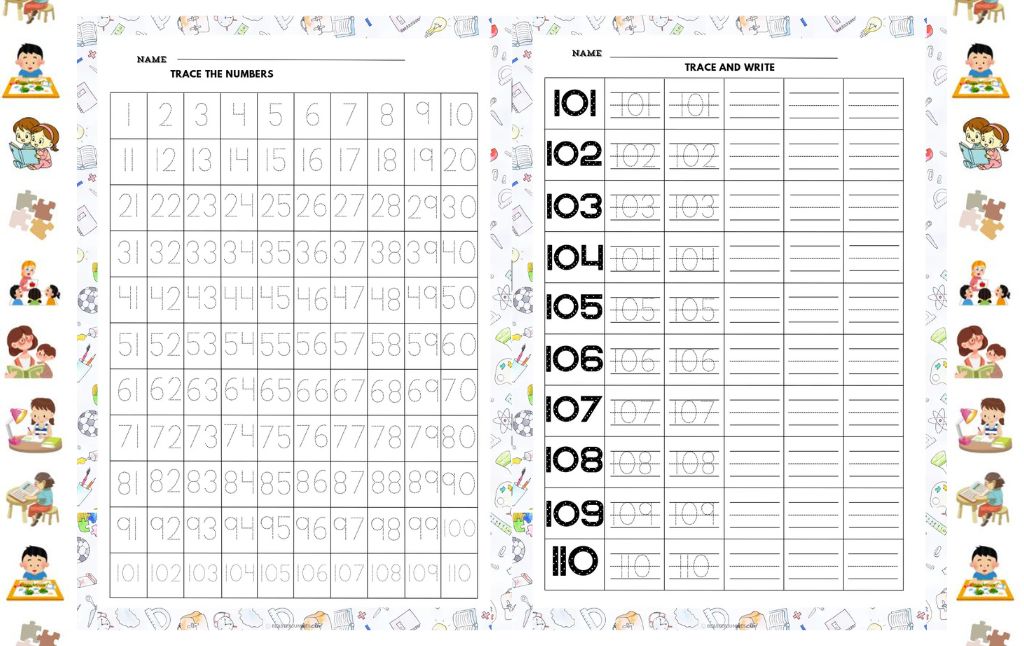
This Number Writing and Tracing Pack is a comprehensive 14-page educational resource designed to help young learners (preschool through 1st grade) master number recognition and handwriting. Sized perfectly for A4 printing, this pack takes a “scaffolded” approach meaning it moves from guided support to independent writing.
Below is a detailed explanation of the worksheets and a guide on how to use them effectively to build your child’s math confidence.
Detailed Breakdown of the Pack
The pack is structured to guide a child through the numbers 1 to 110.
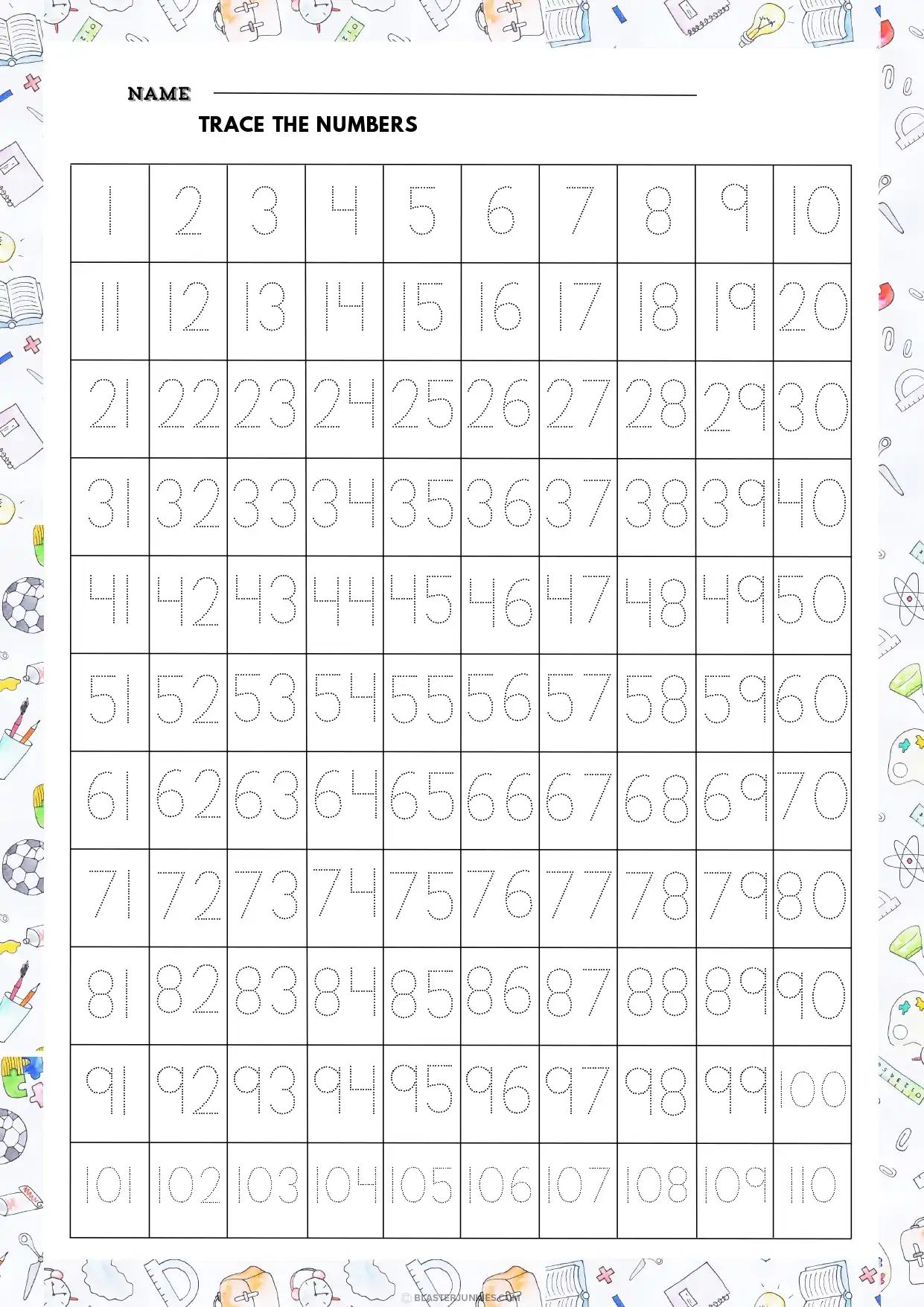
1. The Master Overview (Page 3)
The Task: A complete grid where every number from 1 to 110 is provided in a dotted “traceable” format.
Goal: This serves as a great “warm-up” or a review sheet to see if the child understands the sequential flow of numbers, especially the tricky transitions (like 19 to 20 or 99 to 100).
2. The Focused “Trace and Write” Sheets (Pages 4–14)
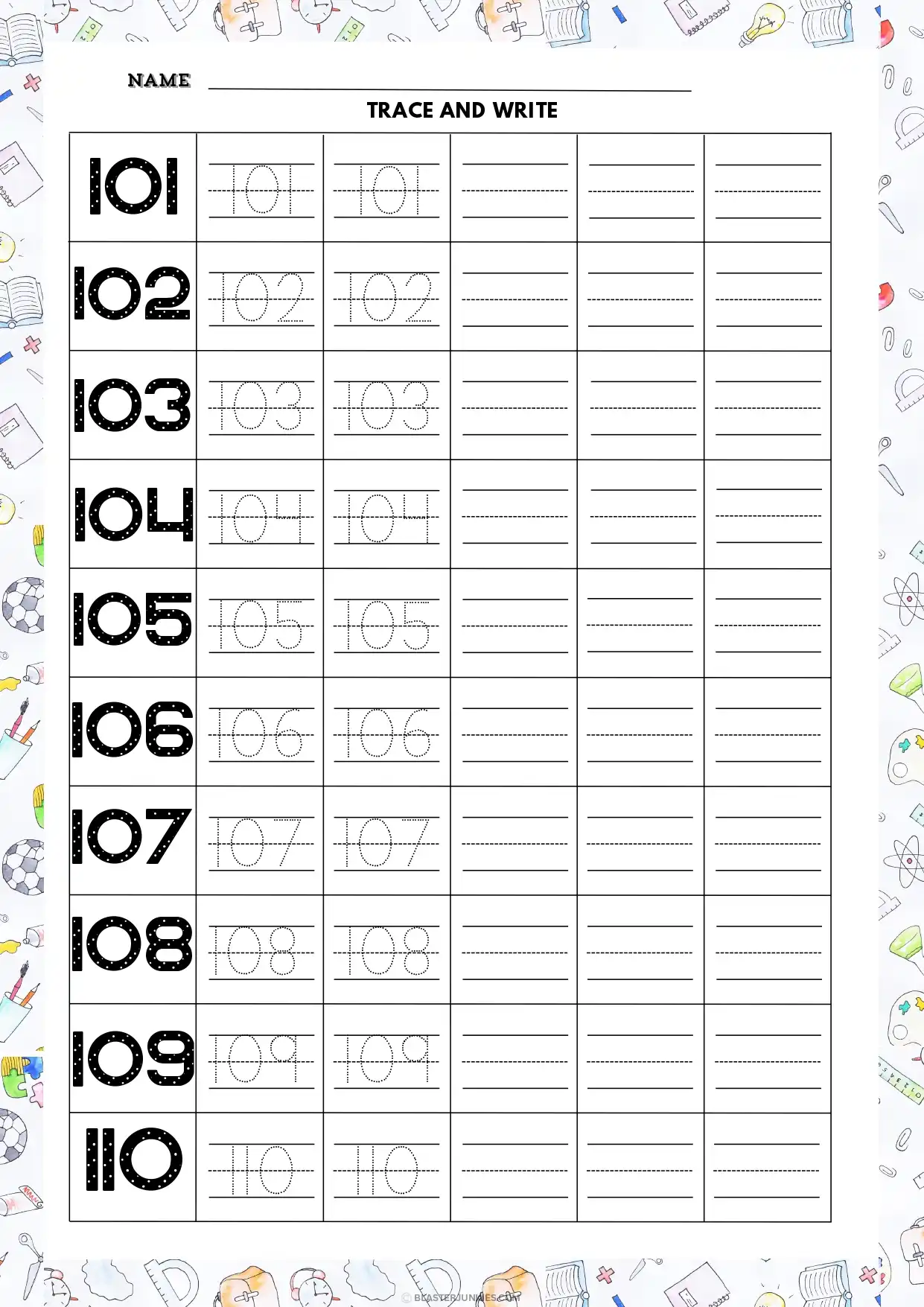
Each of these 11 pages focuses on a specific set of 10 numbers (e.g., 1–10, 11–20, etc.). The layout is designed for repetitive practice:
Column 1 (Bold Reference): Shows a large, bold version of the number (black with white polka dots) to give the child a clear visual “anchor.”
Columns 2 & 3 (Guided Tracing): Provides dotted lines for the child to trace the number twice. This builds the muscle memory for correct stroke order.
Columns 4 & 5 (Independent Writing): Features blank lines where the child must write the number on their own without the dotted guides.
How to Use This Pack with Kids
To get the most out of these worksheets, follow this four-step learning process:
Step 1: Finger Tracing (Tactile Start)
Before using a pencil, have the child use their index finger to trace the Bold Reference number in the first column. Say the number out loud together. This creates a sensory connection before they have to worry about “staying on the lines.”
Step 2: Rainbow Tracing
Instead of just tracing once with a pencil, encourage “Rainbow Writing.” Have the child trace the numbers in Columns 2 and 3 using three different colored crayons. This turns the repetition into a fun game and provides extra practice.
Step 3: The “Hide and Write” Challenge
Once the child has finished the tracing columns, cover them with a piece of paper. Ask the child to write the number in the final two blank columns from memory. This checks for true “internalization” of the shape of the number.
Step 4: Daily “Power 10”
Don’t try to do the whole pack at once! Focus on one page per day. Spending 10 focused minutes on the numbers 21–30 is much more effective for a kindergartner than trying to rush through 1–100 in one sitting.
Pro Tips for Success
The Lamination Hack: If your child is struggling with a specific set of numbers (like the teen numbers), laminate that page or place it in a plastic sheet protector. Let them use a dry erase marker. They can practice, erase, and try again until they feel confident.
Focus on the “Big Turns”: Pay special attention to the bottom of each page (numbers like 10, 20, 30…). Many children find the jump to the next “ten” the hardest part of counting.
Check Grip and Posture: Since these pages have multiple columns, it’s a great time to ensure the child is holding their pencil correctly (the tripod grip) and sitting comfortably.
Download this 14 page high resolution PDF bundle to turn “number work” into a rewarding daily habit for your little mathematician!
Free Printable Blank Maps for Kids: World, Continents, and USA Bundle.
ABC Letter Tracing Alphabet Activity Worksheets
Alphabet Letter Sound Activity Cards
Free A to Z Alphabet Hat Crafts: Printable Letter Learning Activities.
Zoo Animal Scavenger Hunt Worksheets
The Ultimate Shapes Bundle: Free Printables for Circle, Triangle, Square, and Rectangle.
Neighborhood Water Cycle Worksheet Pack
Educational Easter Activities Neighborhood Scavenger Hunt for Kindergarten & Elementary.

Leave a Reply