
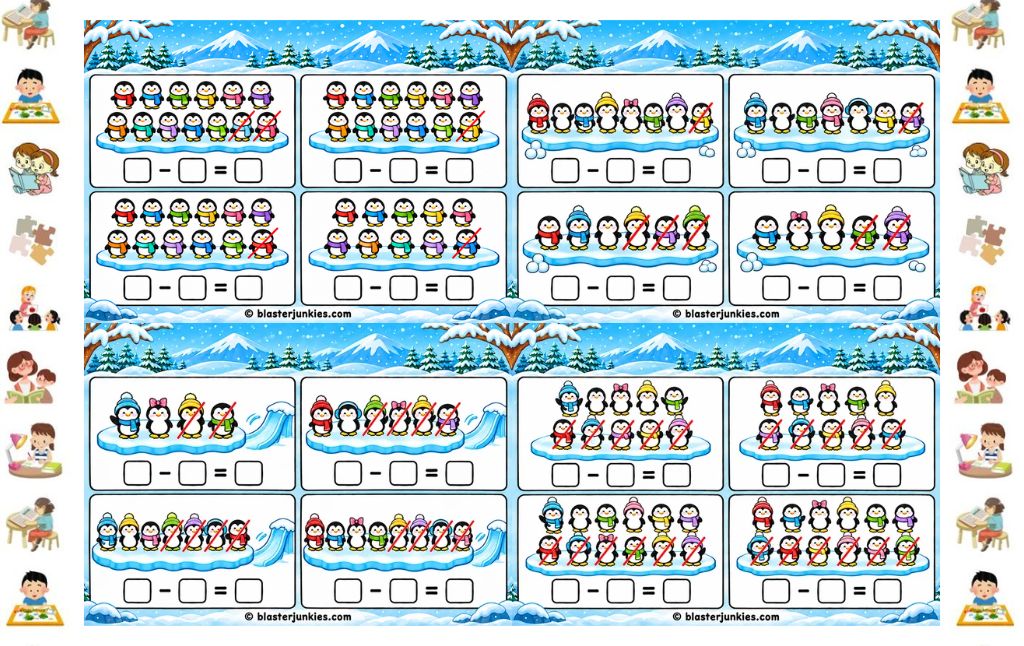
Subtraction can feel tricky for little learners. Taking away is a new idea. Penguins make it gentle and fun.
This pack has ten colourful pages. Each page has four penguin problems. That gives you forty chances to practise taking away.
Penguins sit on icy floes. Some are crossed out. Your child counts, subtracts, and writes the answer. Let’s see how it works.
Why Penguins Make Subtraction Easier
Children love penguins. They waddle, slide, and wear tiny hats. A cute character keeps young minds interested.
Pictures turn numbers into something real. A child can see the penguins that left. They can touch and count them.
The crossed penguins show the take away part clearly. Your child does not need to imagine anything. The picture does the hard work.
Short pages keep attention high. Four problems fit into a quick sitting. Most children finish a page in ten minutes.
What You Need Before You Start
Print the pages in colour for the best look. The snowy scenes and bright scarves are lovely. Plain white paper works well.
Keep a sharp pencil nearby. The answer boxes are small. A fine tip helps neat number writing.
Have a few crayons ready too. Your child can add colour to hats and scarves. This is optional, but many children enjoy it.
Choose a calm table with good light. Sit beside your child for the first page. Then step back as they grow confident.
How to Use These Printables
Begin with page one. It has the smallest numbers. Early success builds a happy attitude.
Read the problem aloud together. Say, “Five penguins stood on the ice.” Then say, “Two penguins went away.”
Ask your child to count all the penguins. Then ask them to count the crossed ones. Write each number in its box.
Show the minus sign and the equals sign. Explain that minus means take away. Equals means the answer comes next.
Count the penguins that are left. Write that number in the last box. Then check the answer together.
Praise careful counting. Say, “I love how you touched each penguin.” Children feel proud when effort is noticed.
Try one page a day. Short, happy sessions work better than long ones. Stop when your child feels tired.
The 10 Printable Pages Explained
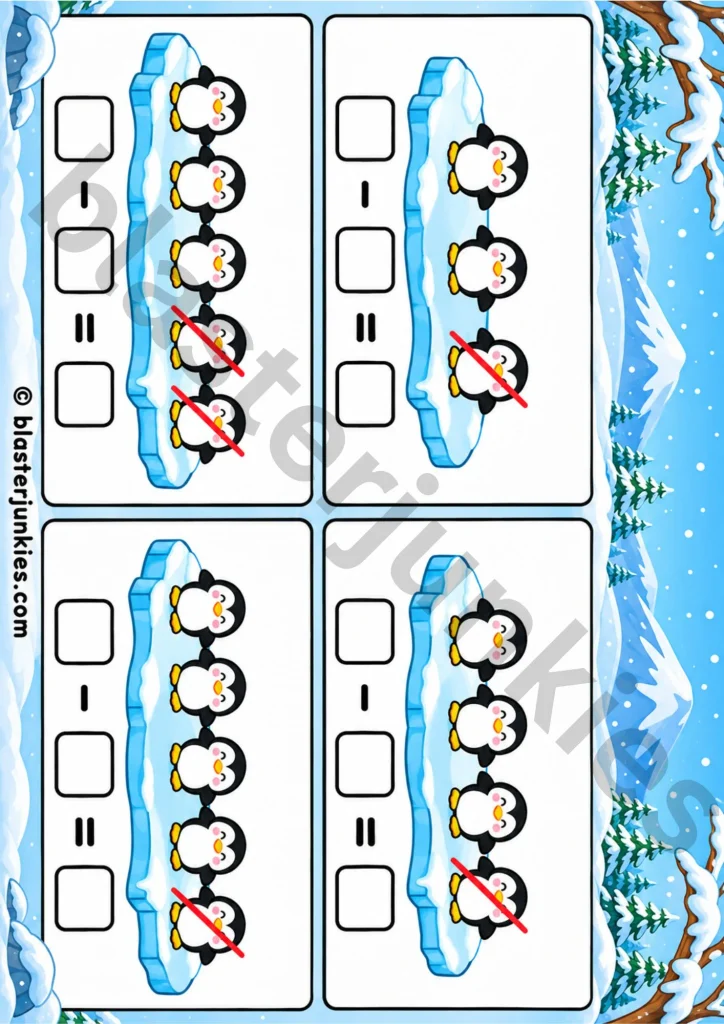
1. Penguin Subtraction Page One
Start here with up to five penguins. Count all, count the crossed ones, then write numbers in boxes using pencil.
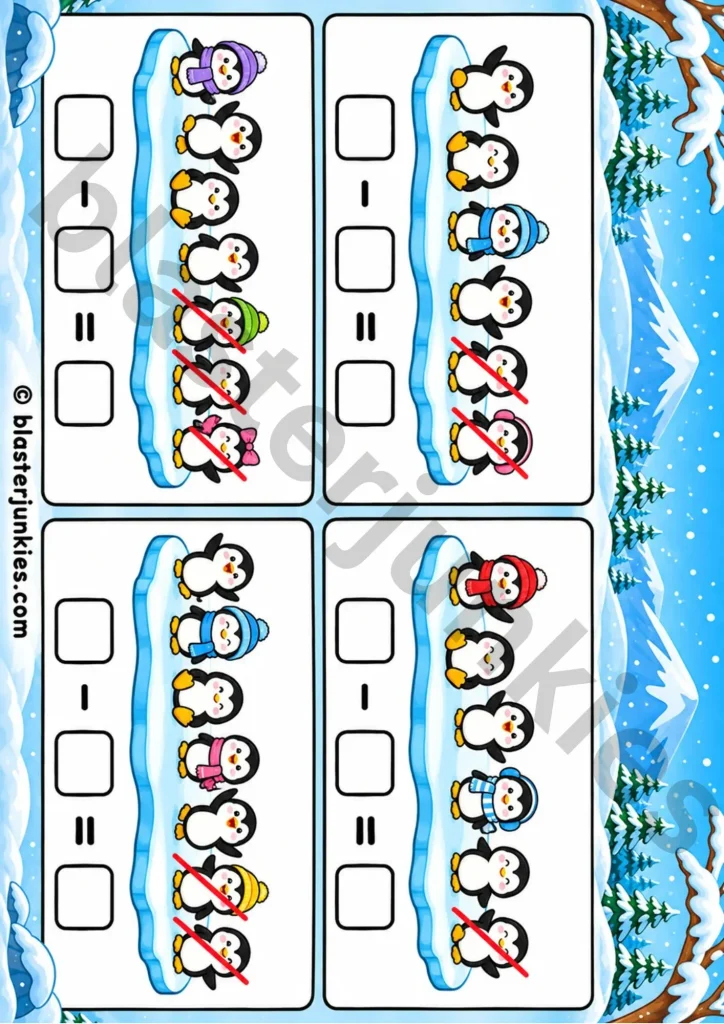
2. Penguin Subtraction Page Two
Up to seven penguins wear hats. Count crossed ones, subtract them, and write the answer. Colour hats if you wish.
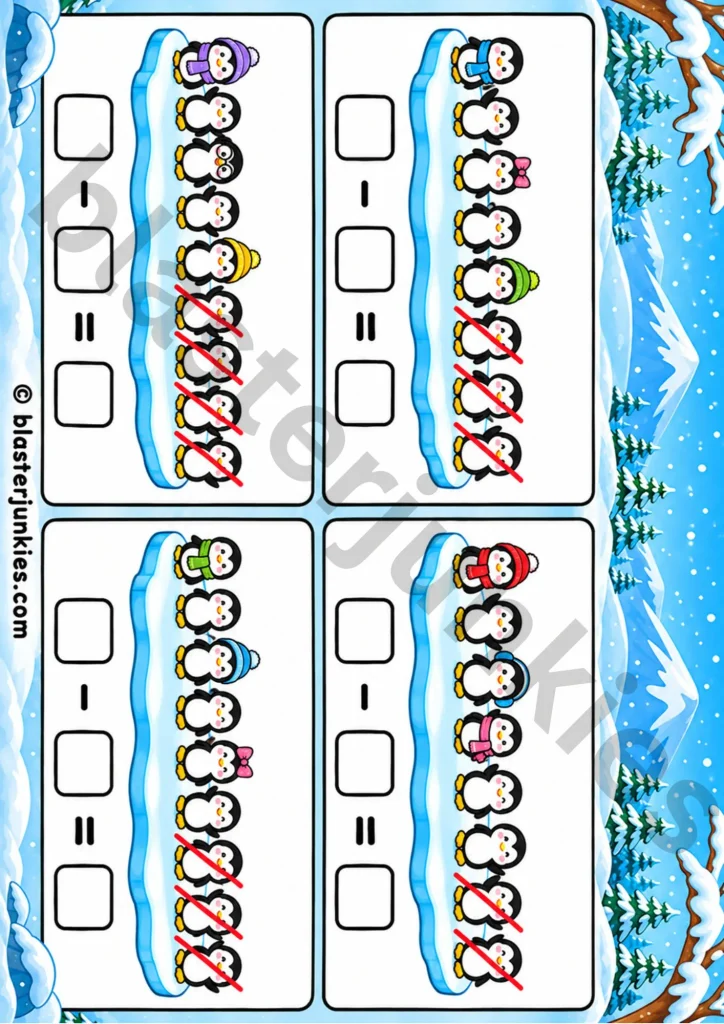
3. Penguin Subtraction Page Three
Rows grow to nine or ten penguins. Count slowly, touch each one, then write the answer. Write in blue.
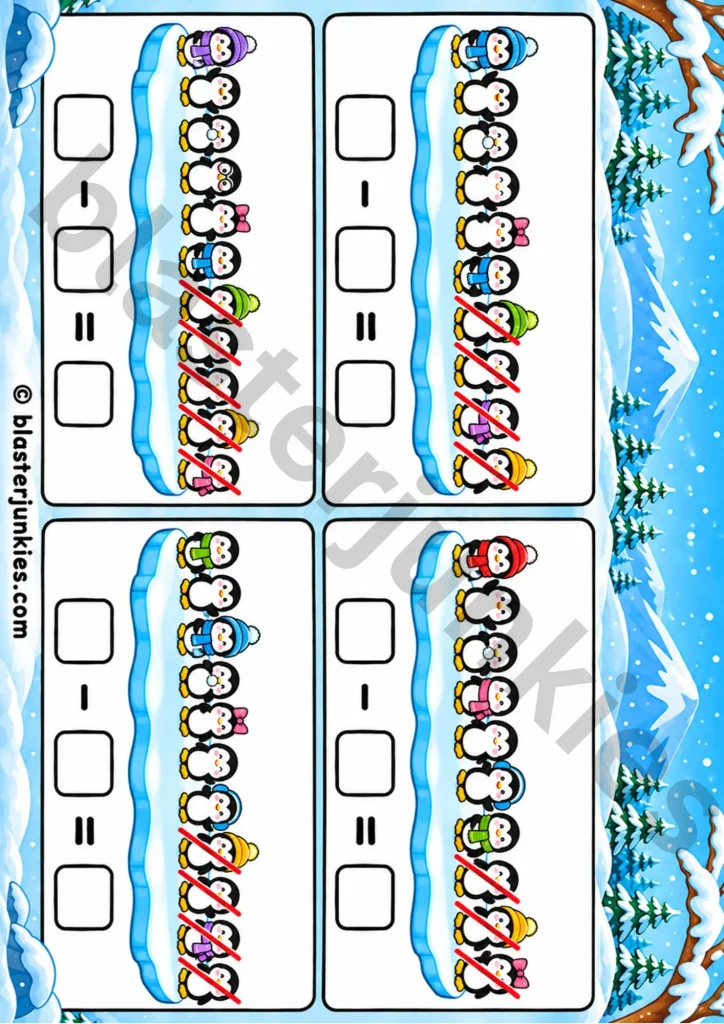
4. Penguin Subtraction Page Four
Penguins now reach ten or more. Count in groups of two, subtract the crossed ones, and write each answer neatly.
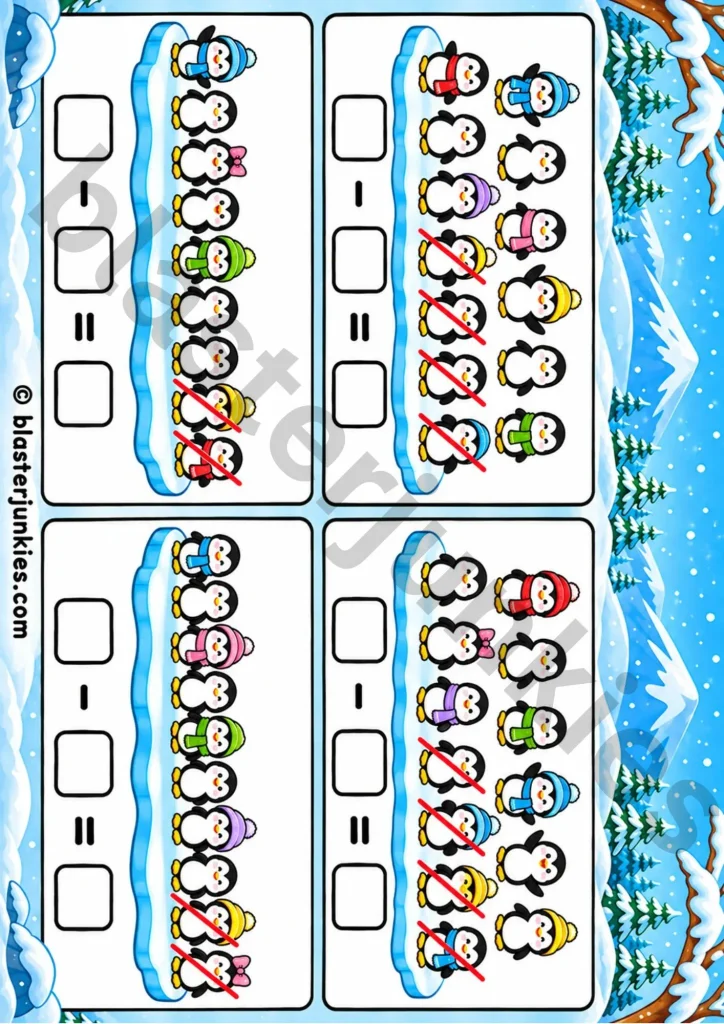
5. Penguin Subtraction Page Five
Some penguins stand in two columns. Count both columns, subtract the crossed ones, and write the answer. Use green pencil.
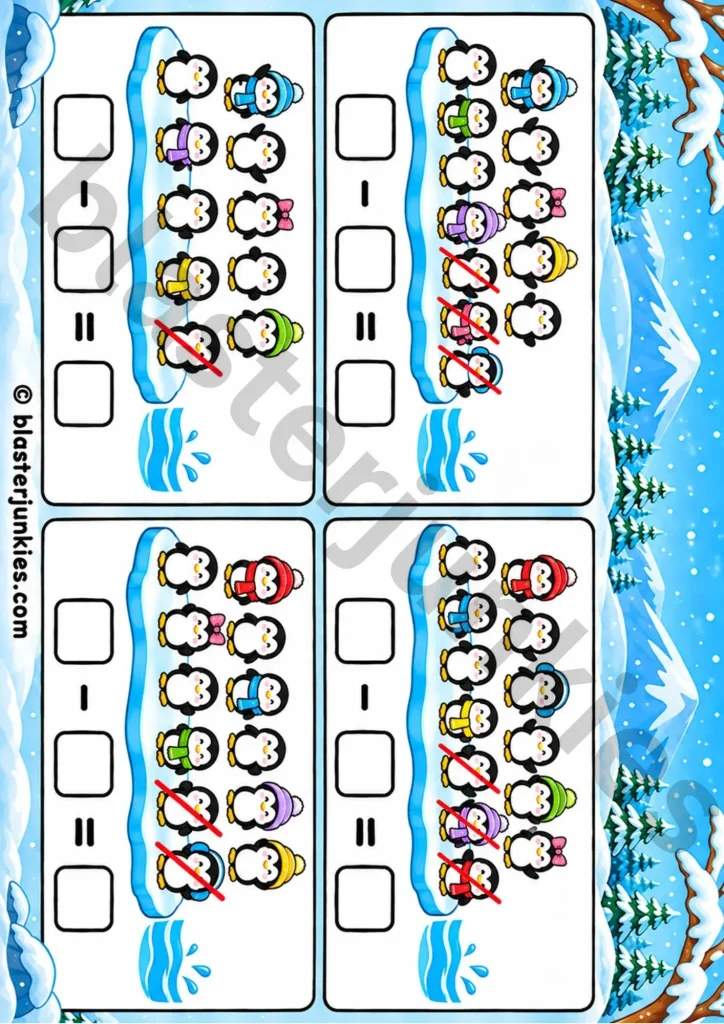
6. Penguin Subtraction Page Six
Two columns and a splash of water. Count every penguin, subtract the crossed ones, then write the answer in pencil.
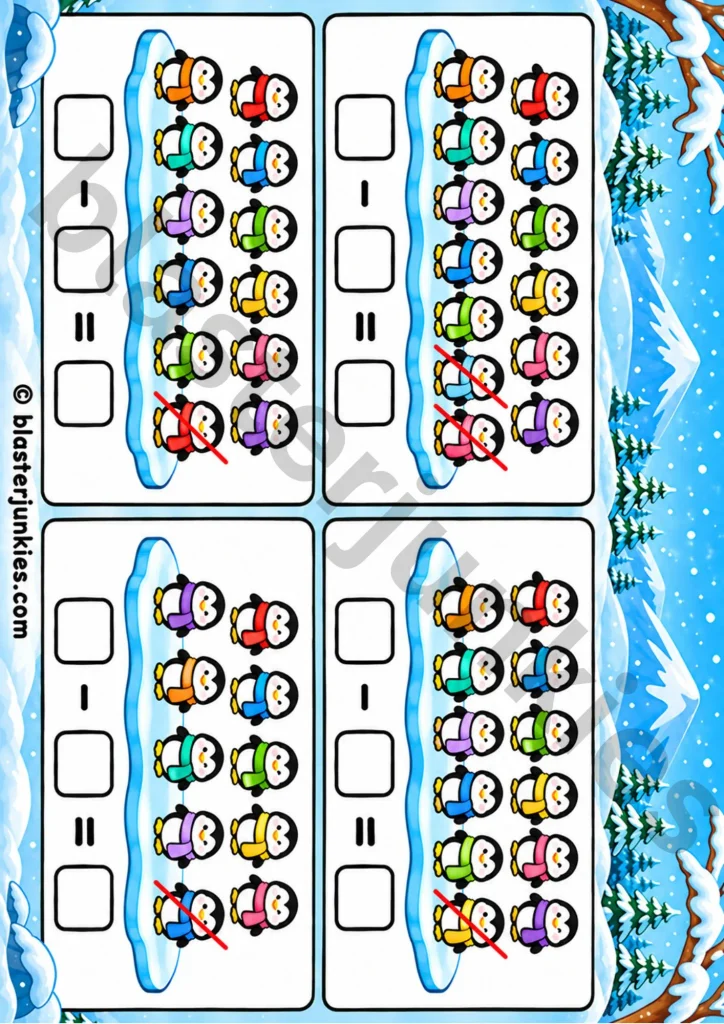
7. Penguin Subtraction Page Seven
Penguins wear rainbow scarves. Count each one, subtract the crossed ones, and write the answer in purple pencil.
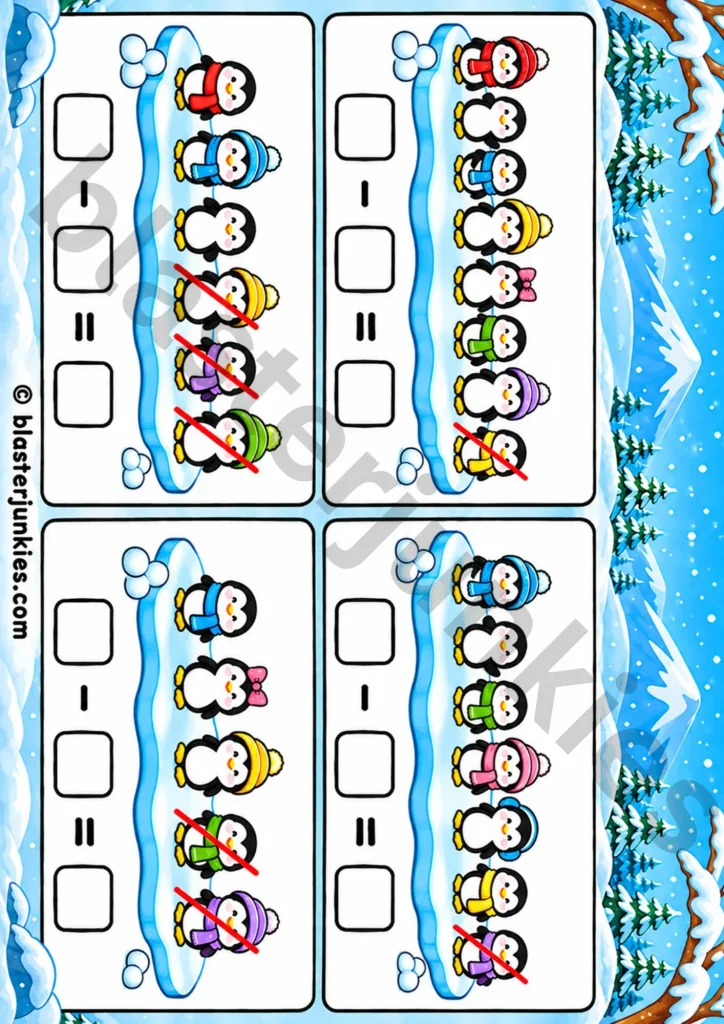
8. Penguin Subtraction Page Eight
Snowballs sit beside the ice. Count penguins, count crossed ones, subtract, and write the answer. Colour snowballs light blue.
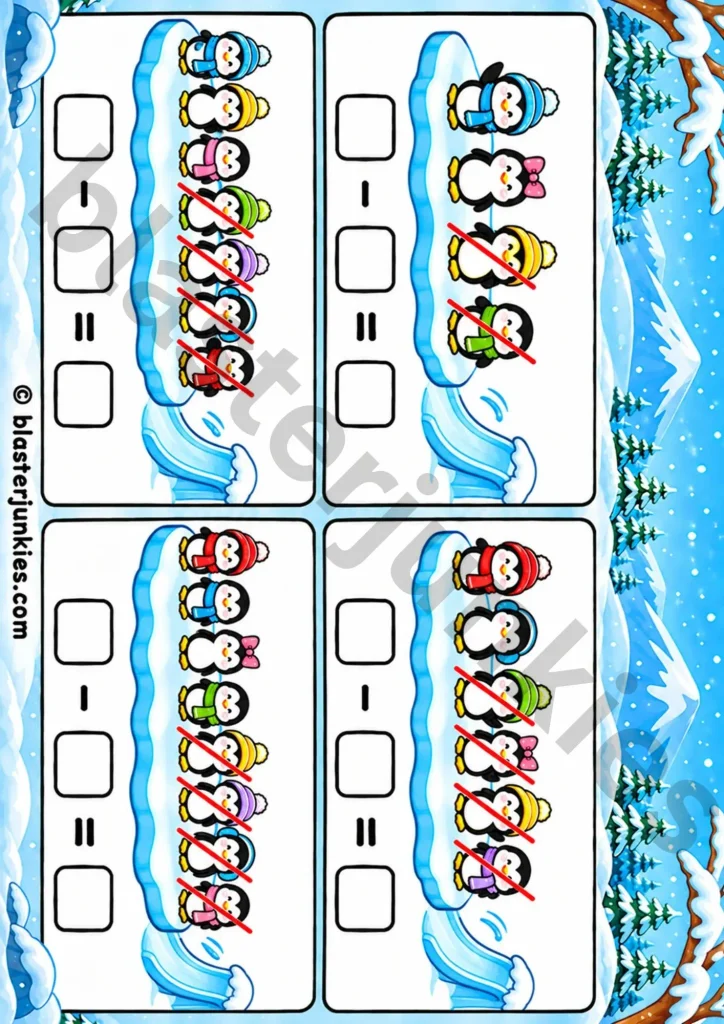
9. Penguin Subtraction Page Nine
An ice slide waits at the edge. Count, subtract the crossed penguins, and write the answer. Colour slide pale blue.
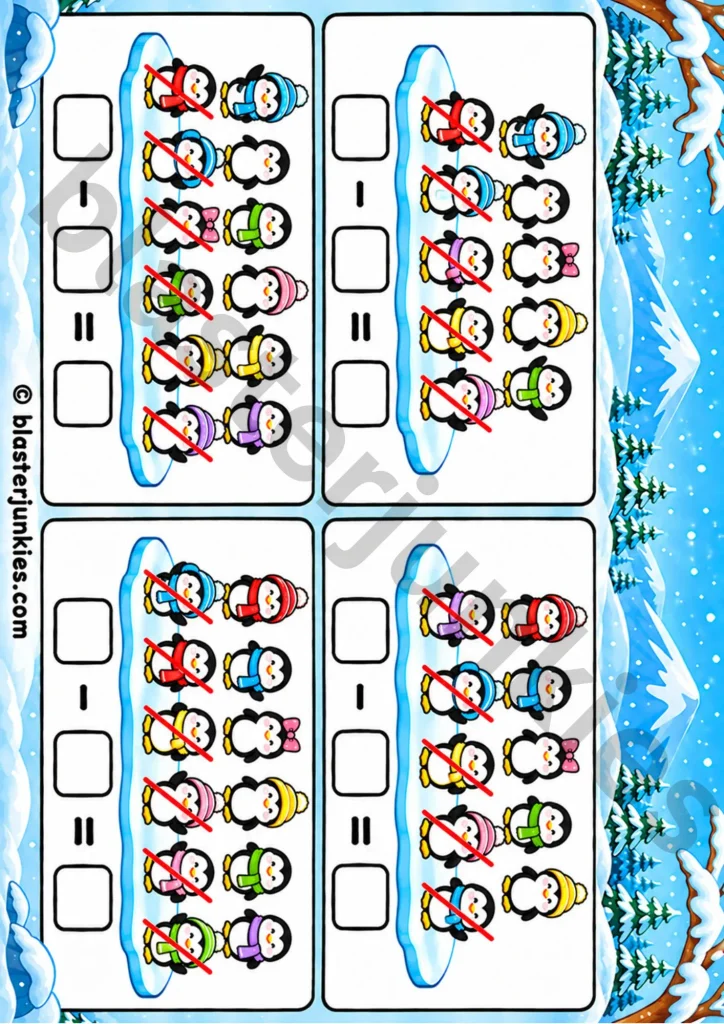
10. Penguin Subtraction Page Ten
Half of each group is crossed out. Count all, subtract the crossed ones, and write the answer. Use orange pencil.
A Quick Note on Drawing and Colours
The crossed penguins are already marked in red on each page. You do not need to draw them. Your child only counts and writes.
If you want extra practice, ask your child to draw their own crosses. Use a red crayon and make one neat line. Then they can solve a new problem.
Colour choices are up to your child. Soft blues and whites suit the ice. Bright reds, greens, and yellows suit the scarves.
Use pencil for numbers. Pencil is easy to fix. Children feel braver when mistakes can be erased.
Skills Your Child Will Build
Counting comes first. Children match each number to one penguin. This is called one to one counting.
Number sense grows next. Children learn that five is more than three. They see how much changes when penguins leave.
Subtraction language becomes familiar. Words like minus, take away, and left over start to make sense. Children use them naturally.
Writing practice happens too. Each answer needs a clear number. Small boxes help children control their pencils.
Confidence is the biggest gain. A child who enjoys subtraction now will face harder maths happily later.
Keep the Penguin Fun Going
One pack may not be enough. Some children want more of what they love. Here are a few ideas that fit nicely.
If your child enjoys adding too, try the Cute Penguin Addition Activity for Winter Math Fun. It uses twelve cards for adding up to fourteen. Adding and subtracting work well together.
Younger learners may prefer the Penguin Math Puzzles for Preschoolers. They use gentle counting and cheerful penguins. They are a soft step before subtraction.
Counting still needs practice at times. The Winter Counting Mats for Preschool give easy number fun. They are great for building a strong base.
For bigger numbers, try the Snowman Math Button Counting Worksheet. Children count buttons up to fifty. It prepares them for larger subtraction later.
Kindergarten learners can explore the Snowman Math Activities For Kindergarten. These pages mix adding and subtracting with friendly snowmen. They offer a nice next challenge.
Want a broader winter pack? See the Winter Worksheets for Preschoolers & Kindergarten. It covers counting, letters, shapes, and mazes. It suits mixed learning days.
Number writing deserves attention too. The Mastering Numbers 1 to 20 pages help children form digits well. Neat numbers make answer boxes easier to fill.
Learning about real penguin homes? Try the Fun Arctic Animal Activities. They connect your maths pages to real animals. Children love facts about snowy places.
Need a screen free game? The Winter Printable Memory Game is perfect for family time. It builds focus and memory. Children barely notice they are learning.
For wiggly days, grab the Winter Movement Dice For Kids. Roll the dice and jump, spin, or stomp. Energy gets out, and learning continues.
Simple Tips for Parents and Teachers
Use real objects before the page. Place small toys on a tray. Take some away and count what remains.
Act out the problem. Let your child waddle like a penguin. Ask three children to stand, then two to sit.
Use a number line if your child needs help. Start at the big number. Hop back one step for each crossed penguin.
Keep sessions cheerful. If your child feels stuck, return to an easier page. Confidence matters more than speed.
Laminate a few pages for reuse. Children can use dry erase markers again and again. Remember these files are for personal or classroom use only.
Check answers together. Ask your child to explain how they counted. Their words show what they understand.
Ways to Use the Pages at Home and School
At home, keep the pages in a folder near the table. Let your child choose a page each day. Choice gives children a sense of control.
In a classroom, use the pages as morning work. They also suit math centres and small group time. Early finishers can try a harder page.
Homeschool families can pair the pages with a penguin book. Read about life on the ice. Then solve a page of penguin problems.
Pages also work as quiet time activities. A cozy blanket and a pencil are enough. Children enjoy the calm rhythm of counting.
Fun Extras to Try
Make a snowy tray with salt or flour. Let your child draw numbers with one finger. This adds a sensory twist.
Use white pom poms as pretend penguins. Place them on a blue paper floe. Take some away and count the rest.
Tell penguin stories with numbers. Say, “Six penguins sat on the ice. Two slid into the sea.” Ask how many stayed.
Celebrate finished pages with a small sticker. A simple reward keeps motivation high. Children love showing their completed work.
Final Thoughts
Happy penguin math!

Leave a Reply