Looking for fun and simple science experiments to teach kids about Newton’s First Law of Motion? These inertia experiments with pennies are the perfect way to explore the concept of force and motion using everyday household items.
Get ready for hands-on learning that will amaze kids and make science exciting!
What is Inertia?
Inertia is an object’s resistance to a change in motion. It’s summed up in Newton’s First Law of Motion, which states:
An object at rest stays at rest, and an object in motion stays in motion unless acted upon by an outside force.
These penny experiments demonstrate inertia in action, making it easier for kids to see and understand how objects resist changes in motion.
Experiment #1: Penny Stack Challenge
Supplies Needed
- 6 pennies
- A smooth surface (table or countertop)
How to Do It
1.) Stack 5 pennies on top of each other on a smooth surface.
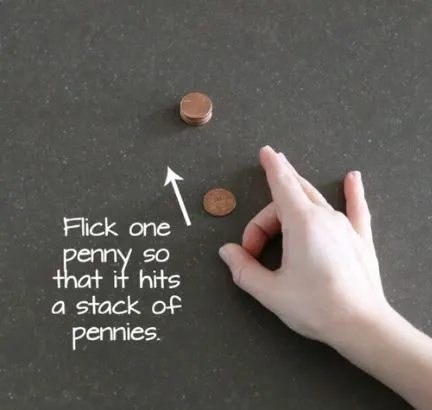
2.) Hold one extra penny in your fingers.
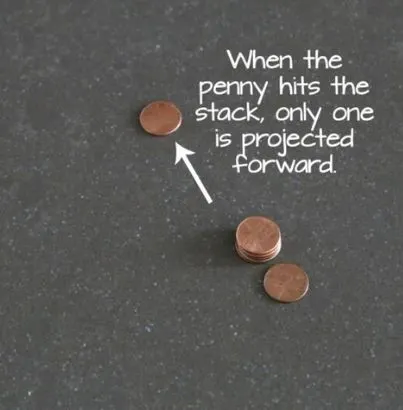
3.) Give the extra penny a quick, solid flick toward the base of the stack.
4.) Observe what happens!
What Happens?
Instead of knocking over the whole stack, the bottom penny zooms forward, while the rest stay in place!
Why Does This Happen?
The moving penny transfers its energy to the bottom penny, which then moves forward. However, the rest of the stack stays put because they were at rest and resisted the change in motion—this is inertia in action!
Experiment #2: Penny Dunk
This experiment is like the classic tablecloth trick—but a lot easier (and way less messy)!
Supplies Needed
- A clear glass of water
- An index card
- A stack of pennies (3-5)
How to Do It

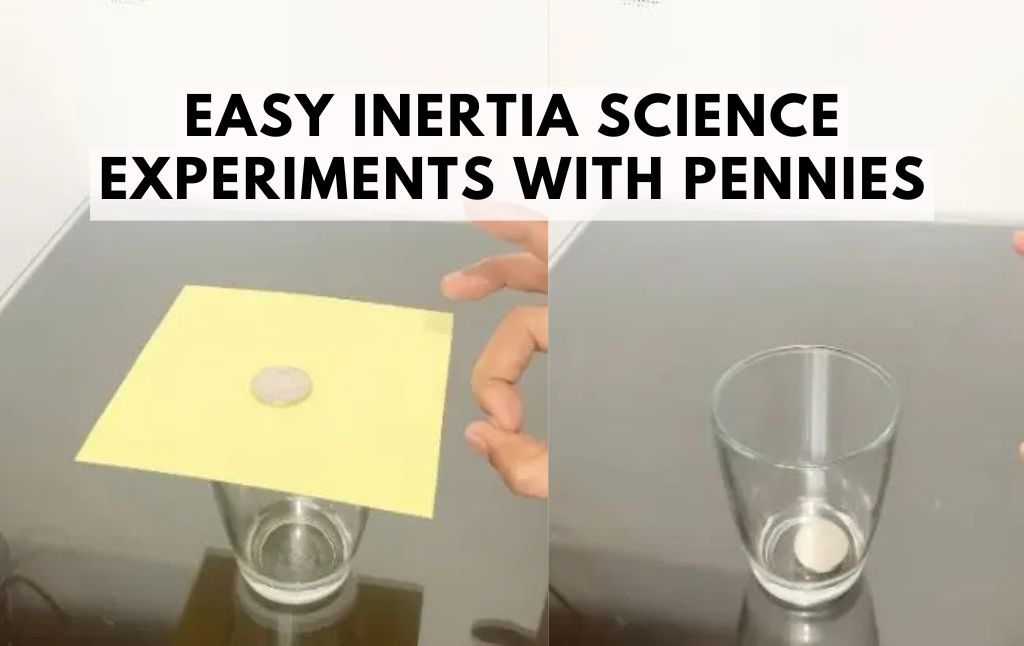
1.) You can fill an empty glass with water for better stability
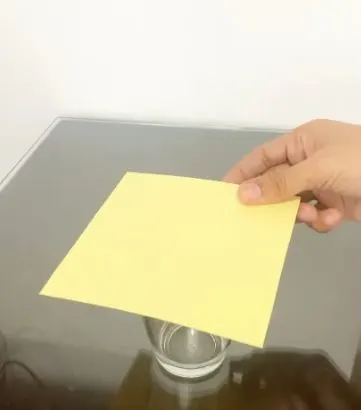
2.) Place an index card over the top of the glass.
3.) Stack one penny in the center of the index card.
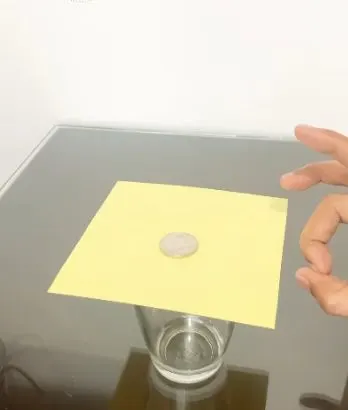
4.) Give the index card a firm flick. It will fly away while the pennies just drop straight into the glass.
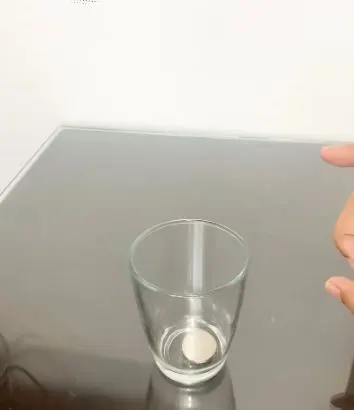
What Happens?
Instead of flying off with the index card, the pennies drop straight down into the water!
Why Does This Happen?
The index card moves quickly because of the flick, but the pennies stay in place due to inertia. Once the index card is gone, gravity pulls the pennies straight down into the water instead of moving them forward.
Science Behind the Experiments
Newton’s First Law of Motion (Law of Inertia) explains that objects resist changes in their motion.
In the Penny Stack Experiment, the stack stays at rest because there’s no force acting on it—only the bottom penny moves because it absorbs the force.
In the Penny Dunk Experiment, the pennies don’t move with the index card because they resist the force applied to the card. Once the card is gone, gravity takes over, making them fall straight down.
These experiments help kids understand how inertia affects movement in the real world.
Fun Challenges & Variations!
Try using more pennies in the stack! How many can you add before it falls?
Use different flicking speeds! Does a faster flick change the outcome?
Try using different materials! What happens if you replace the index card with cardboard?
Final Thoughts: Science Can Be Fun & Simple!
These easy inertia experiments are perfect for teaching kids about Newton’s First Law of Motion in a hands-on, exciting way! They require minimal materials and can be repeated over and over again to reinforce learning.
So, grab some pennies and start experimenting!
What other cool science tricks have you tried? Let us know in the comments!
Kids Activities
Looking for more fun kids activities and other ideas to keep kids engaged, learning, and having fun? Check out these:
How to Make a Kids Bottle Rocket: A Fun & Explosive DIY Experiment!
Egg Drop Inertia Science Project: A Fun Physics Experiment for Kids!
Making Flying Tea Bag Ghosts: A Spooky & Fun Science Experiment
How to Make a Rain Cloud in a Jar: A Fun and Educational Science Experiment
Rainbow in a Jar Density Experiment – A Fun and Colorful Science Activity
Hot and Cold Balloon Science Experiment for Kids