Most people don’t have a decluttering problem because they lack motivation.
They have a decluttering problem because the task feels enormous. “Clean out the house” isn’t really one task it’s dozens of small, tedious decisions hiding inside a single overwhelming sentence.
That’s usually why the junk drawer stays full for another year, and why the closet reorganization keeps getting pushed to “next weekend.”
The Declutter Challenge Printable exists to solve exactly that problem.
It’s a free, print at home set of trackers and checklists that break down the huge, vague goal of “get organized” into small daily actions you can actually finish.
Instead of staring at an entire house and feeling defeated, you’re staring at one line item: organize a drawer, sort a shelf, donate ten items.
That’s a task you can complete in fifteen minutes, and fifteen minutes repeated daily is how most real decluttering actually happens.
What’s Inside the Pack
Rather than walking through every single page, here’s the general shape of what you’re getting:
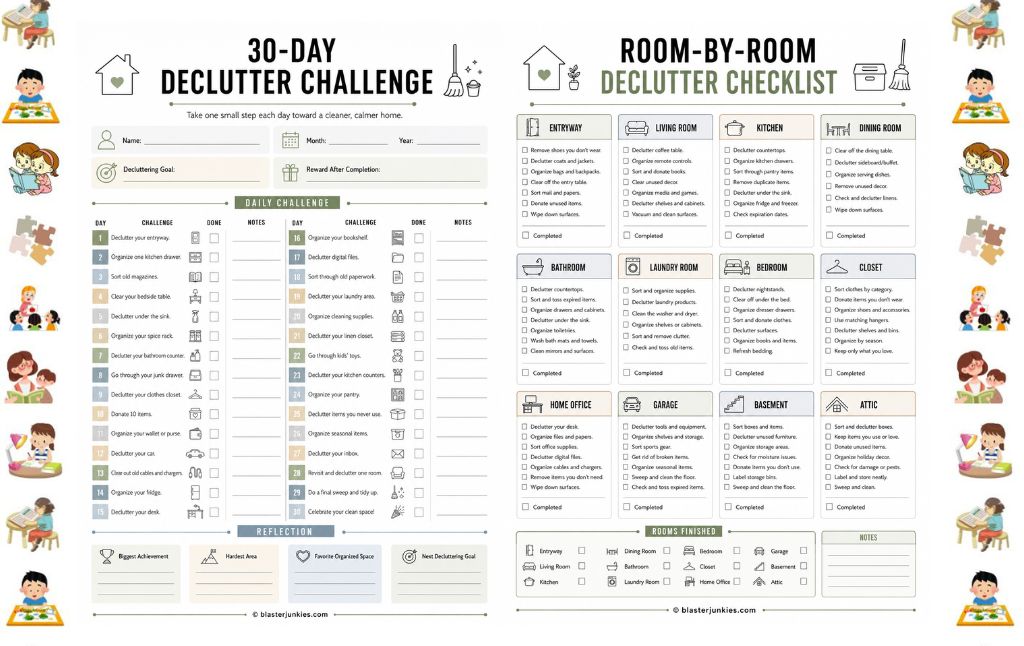
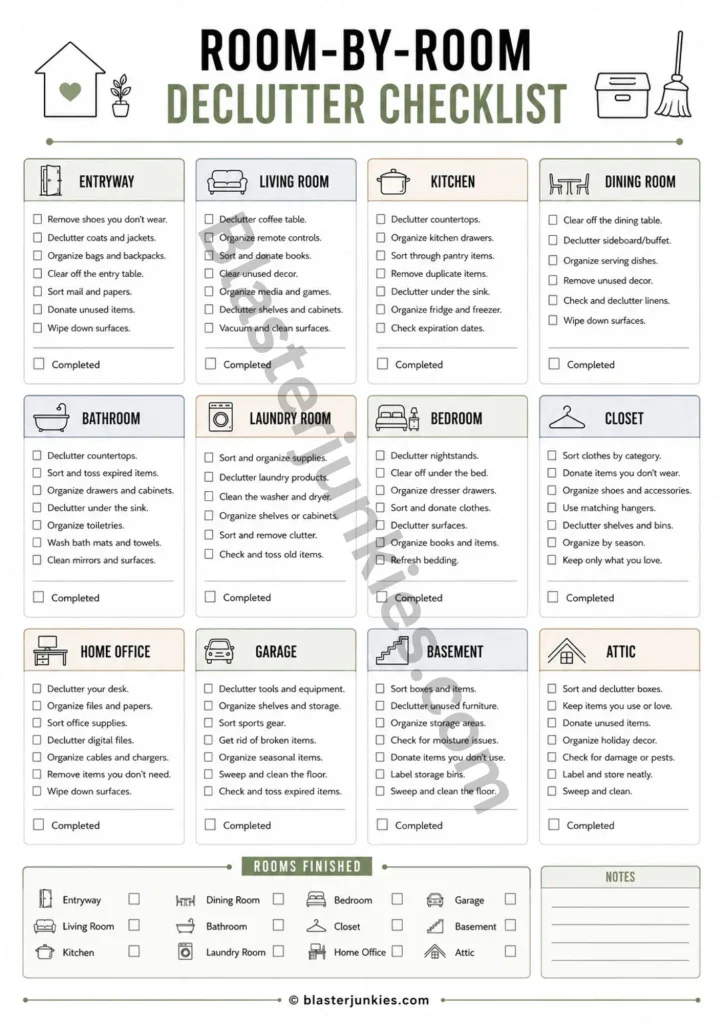
There’s a 30 day daily challenge that assigns one small task per day, a room by room checklist that breaks decluttering down by physical space (entryway, kitchen, bedroom, closet, garage, and so on),
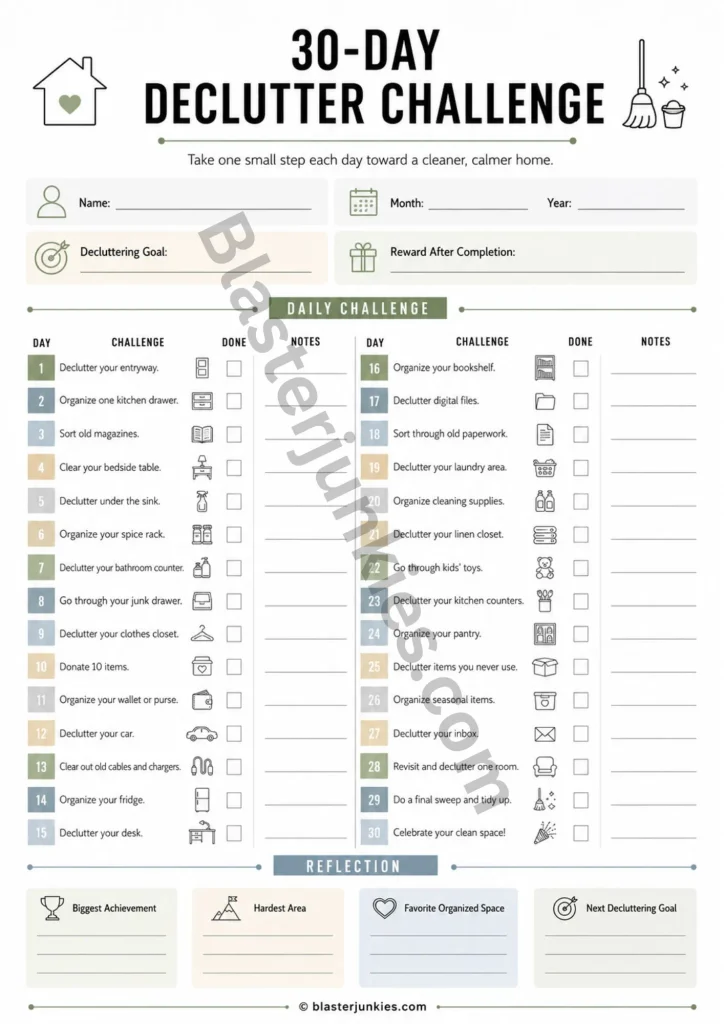
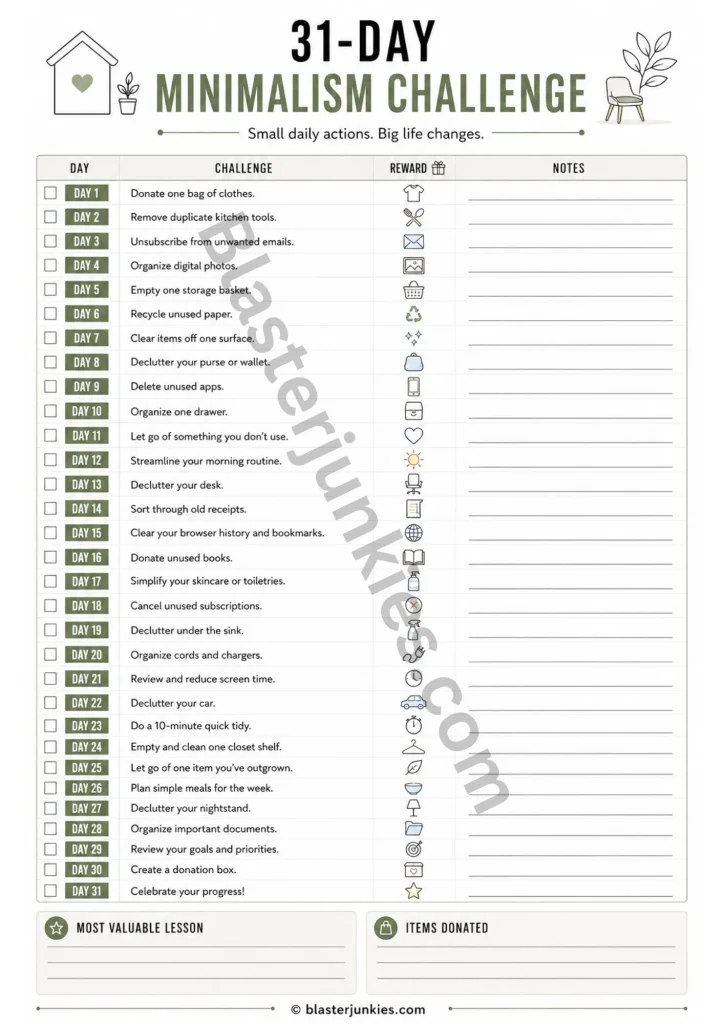
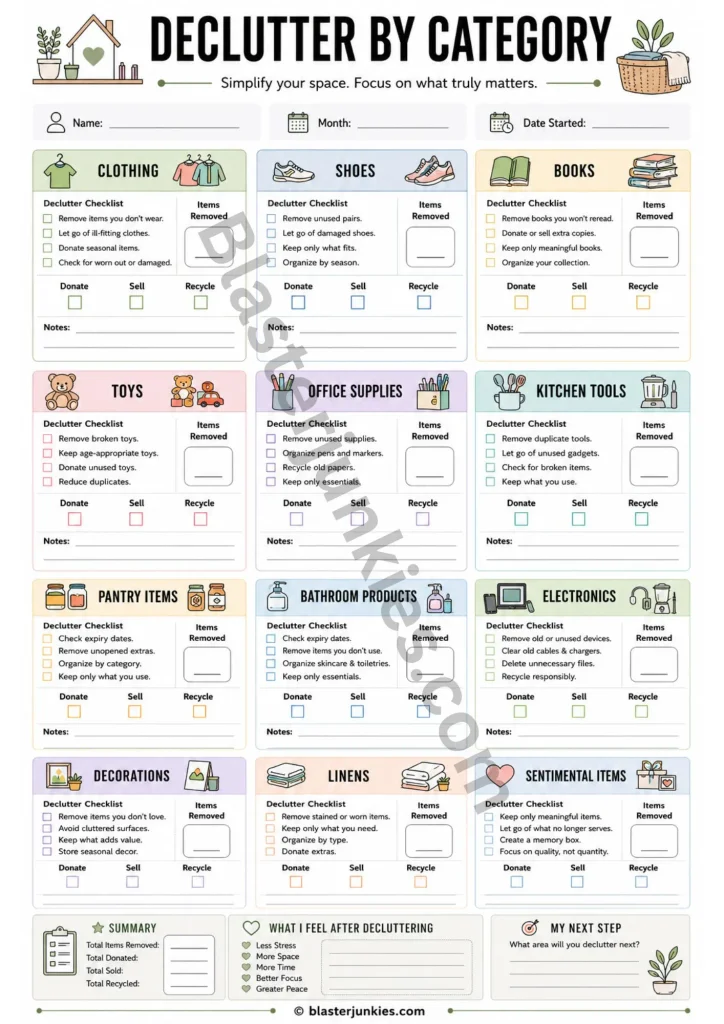
A 31 day minimalism challenge focused more on habits and mindset than physical spaces, and a declutter by category tracker for people who’d rather work through belongings by type clothing, books, toys, electronics instead of room by room.
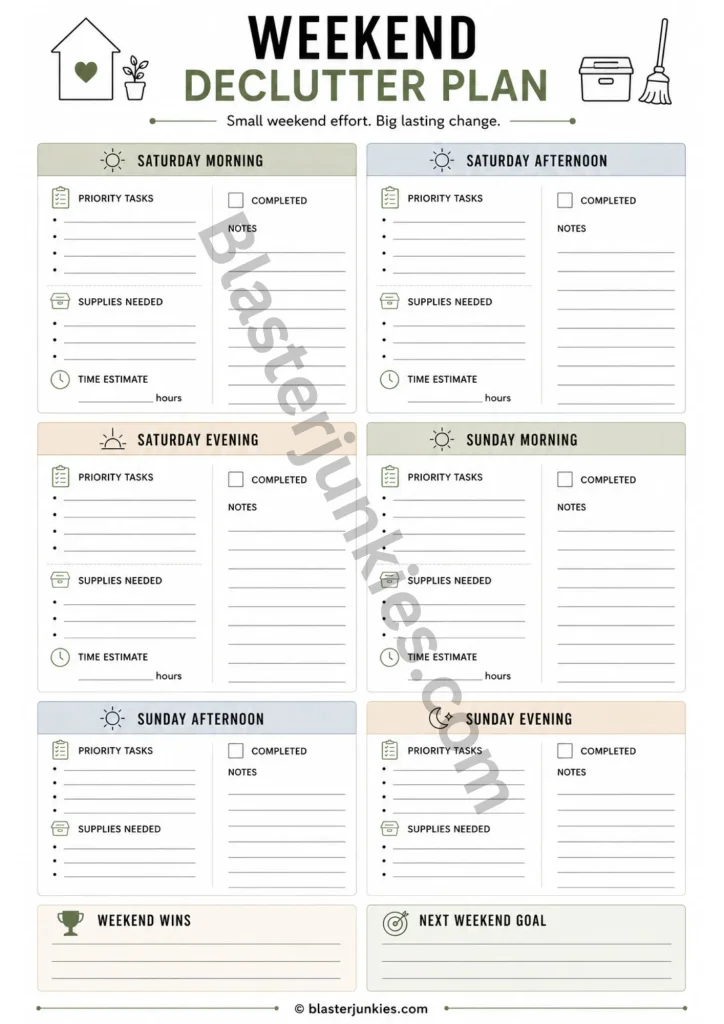
There’s also a weekend focused plan for people who only have a couple of concentrated days to work with,
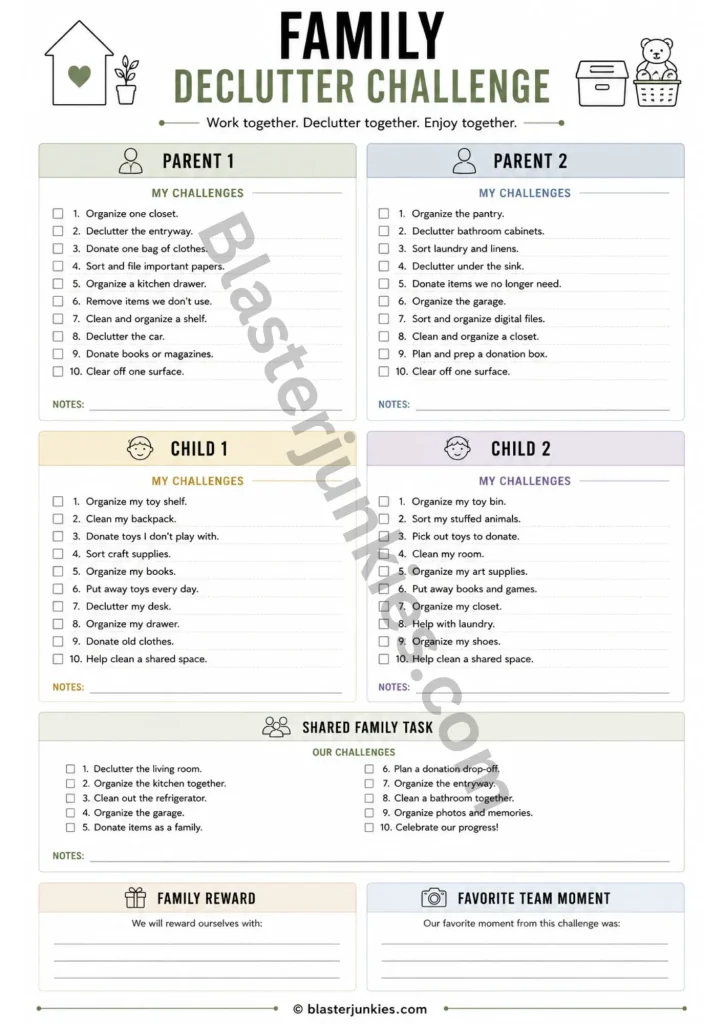
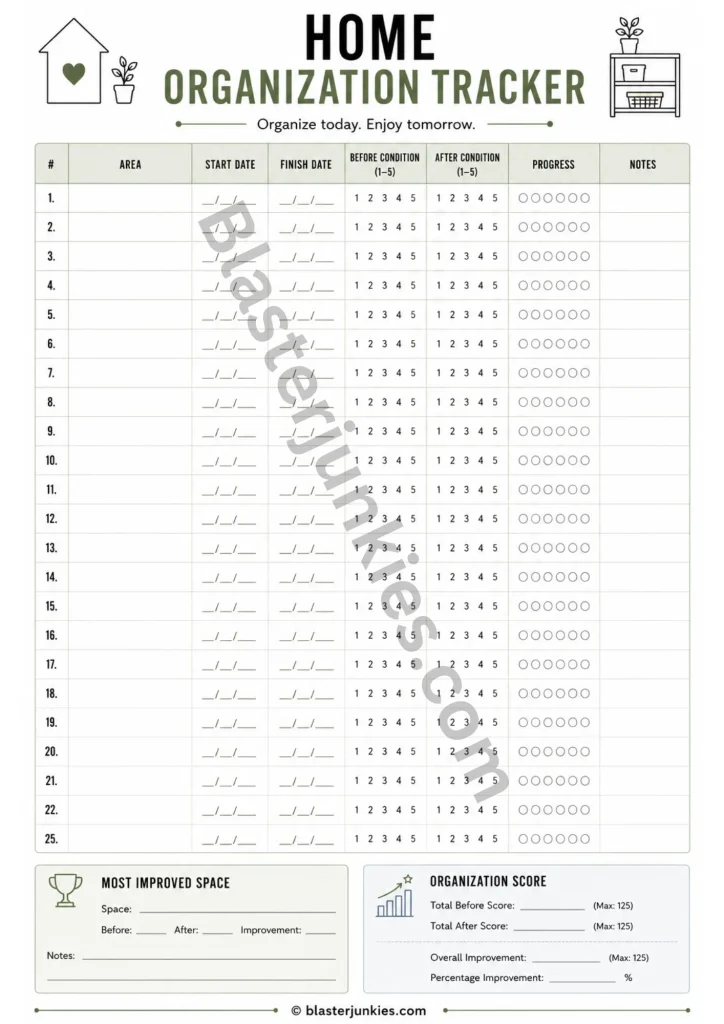
A family version that splits challenges between parents and kids so everyone contributes, a home organization tracker for logging before and after progress,
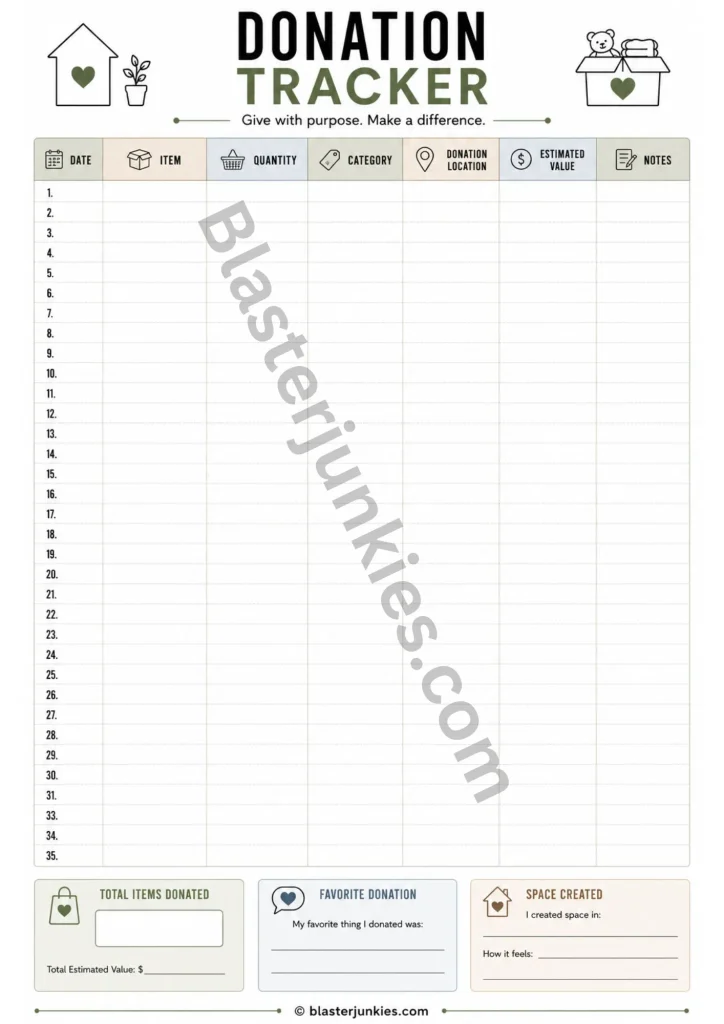
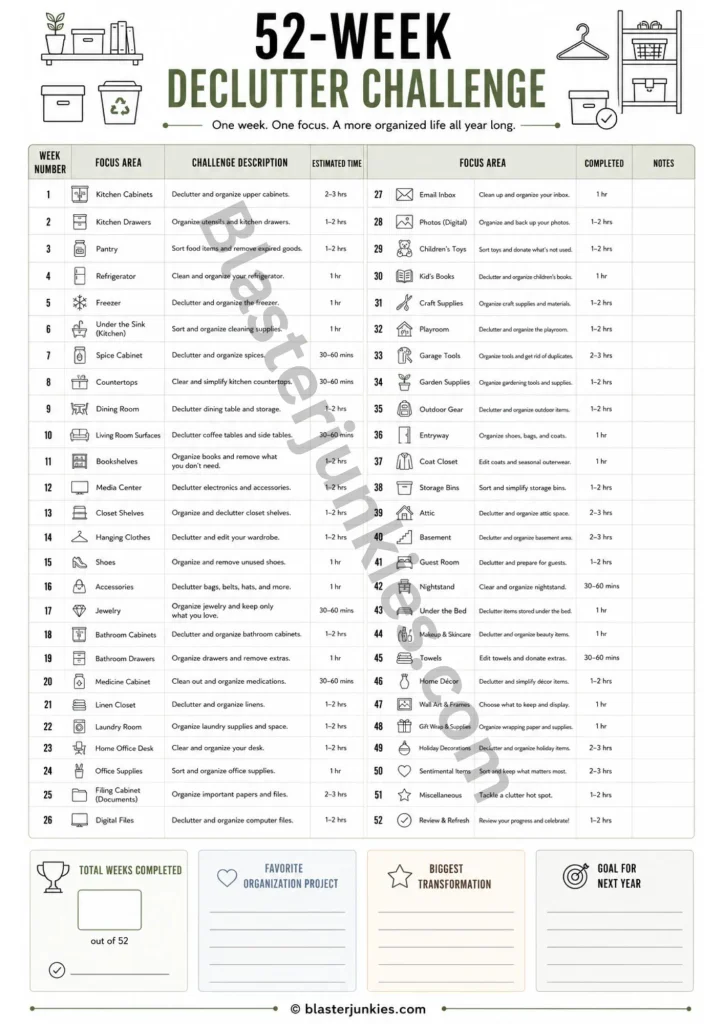
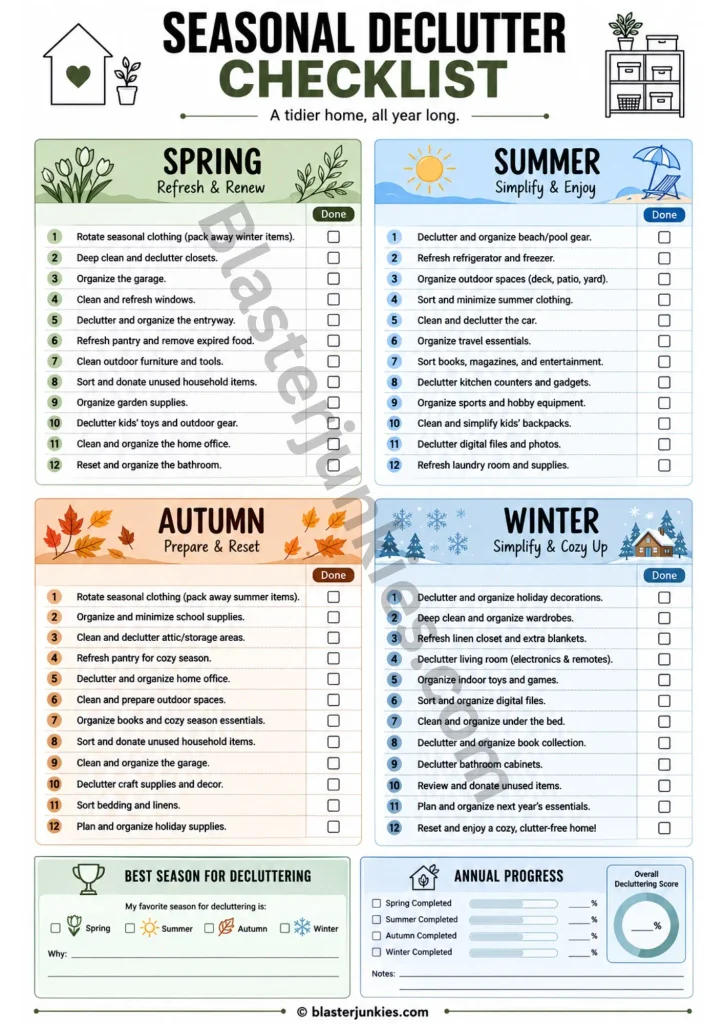
A donation tracker for keeping a record of what’s left the house, a 52 week version for anyone who wants to spread the whole project across a full year, and a seasonal checklist for people who prefer to reset their space four times a year rather than all at once.
All of it prints on standard paper, so the only real requirements are a printer and a pen.
Many people also laminate the trackers so they can check items off with a dry erase marker and reuse the same sheet month after month, or year after year in the case of the seasonal version.
Why a Printed Checklist Works Better Than a Mental To Do List
There’s a real psychological reason checklists like this work when vague intentions don’t.
Writing “declutter the house” on a sticky note doesn’t give your brain anywhere to start, so it usually doesn’t start at all.
Breaking that same goal into “declutter your entryway,” “sort old magazines,” and “clear your bedside table” gives you something concrete enough to act on immediately, with no planning required.
Checking a box also creates a small, satisfying sense of progress that a mental list can’t replicate.
Over a 30 day challenge, watching a page fill up with checkmarks becomes its own motivation you’re not just decluttering a house, you’re completing a challenge, which taps into the same part of the brain that likes finishing a streak or a habit tracker.
The reflection sections at the end of several of the trackers (biggest achievement, hardest area, favorite organized space) also give you a moment to actually notice the progress you made, instead of just moving straight on to the next mess.
How to Use It as an Adult
Pick the version that matches how you actually think, not the version that sounds the most impressive.
If your house is genuinely cluttered everywhere, the room by room checklist gives you a clear starting and ending point for each space, so you’re not left wondering if you’re “done” with the living room.
If you tend to accumulate specific categories of stuff clothes you don’t wear, books you’ll never reread the declutter by category tracker will feel more natural, since it lets you tackle all your shoes at once instead of a little bit in every room.
If you only have scattered pockets of time, the 30 day or 52 week versions are the better fit, since they’re designed to be done in small daily or weekly doses rather than one exhausting weekend.
If you do have a free weekend and want to make real visible progress fast, the weekend declutter plan breaks Saturday and Sunday into morning, afternoon, and evening blocks so the time doesn’t just evaporate.
Whatever version you choose, keep the donation tracker running alongside it.
Logging what left the house and its estimated value does two things: it gives you a tax deduction record if you itemize donations, and it reinforces that the clutter is actually leaving, not just getting shuffled into a different closet.
How to Use It With Kids
The family declutter challenge is built specifically for this. It splits tasks across each family member, including age appropriate jobs for kids organizing a toy shelf, sorting stuffed animals,
Choosing toys to donate, cleaning their own backpack alongside tasks the whole family tackles together, like organizing the living room or planning a donation drop off as a group.
The trick with kids is keeping their list short and specific rather than handing them an abstract instruction like “clean your room.”
A child who’s asked to “organize my toy bin” or “pick out toys to donate” has a task with an obvious finish line, which makes it far more likely to actually get done and done without a fight.
Letting kids check their own boxes as they go gives them the same small sense of accomplishment adults get from the tracker, and framing donation as a positive choice (“pick toys to give to kids who don’t have as many”) tends to go over much better than framing it as losing something.
Pairing the family declutter challenge with a small reward at the end written right on the tracker under “Family Reward” gives kids something to work toward together, and turns what could be a chore into a shared weekend project instead.
Building It Into a Regular Habit
Decluttering isn’t really a one time event, even though it often gets treated like one.
Homes accumulate clutter continuously, so the trackers that work best long term are the ones you return to on a schedule seasonally, or once a year with the 52 week version rather than the ones you finish once and never touch again.
If you’re building out a broader home routine around this, a few other printables pair naturally with it.
A Home Maintenance Checklist works well alongside the seasonal declutter tracker, since both are built around the same “reset the house a few times a year” rhythm.
If decluttering tends to bring up bigger feelings than expected which happens more often than people admit, especially with sentimental items the Self Care Checklist for Mental Health is a gentle companion for pacing yourself through it.
And once the house feels calmer, families often like to celebrate with something low key and screen based, like using the Family Movie Night Cards to pick a movie for everyone who pitched in.
The Bottom Line
The Declutter Challenge Printable isn’t magic it’s just structure.
It takes an overwhelming, easy to postpone goal and turns it into a series of small, doable tasks with a visible finish line.
Print the version that matches your household, check off one box at a time, and the “someday” project has a real chance of actually getting done.