Learning about the human body is one of the most fascinating journeys a child can take in science education.
When kids understand how their own bodies work how they breathe, move, digest food, and fight germs science suddenly becomes deeply personal and endlessly interesting.
These free, printable A4 worksheets cover ten major body systems in a visual, engaging, and age appropriate way.
Here’s a full breakdown of what’s inside and how to get the most out of every page.
What’s Inside the Worksheet Pack?
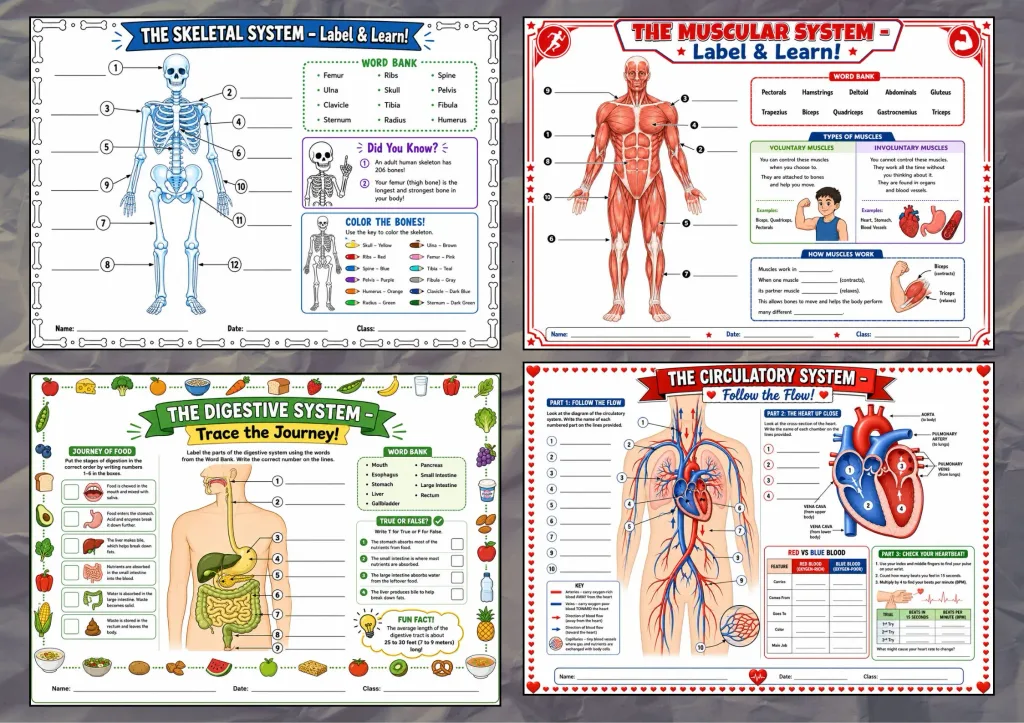
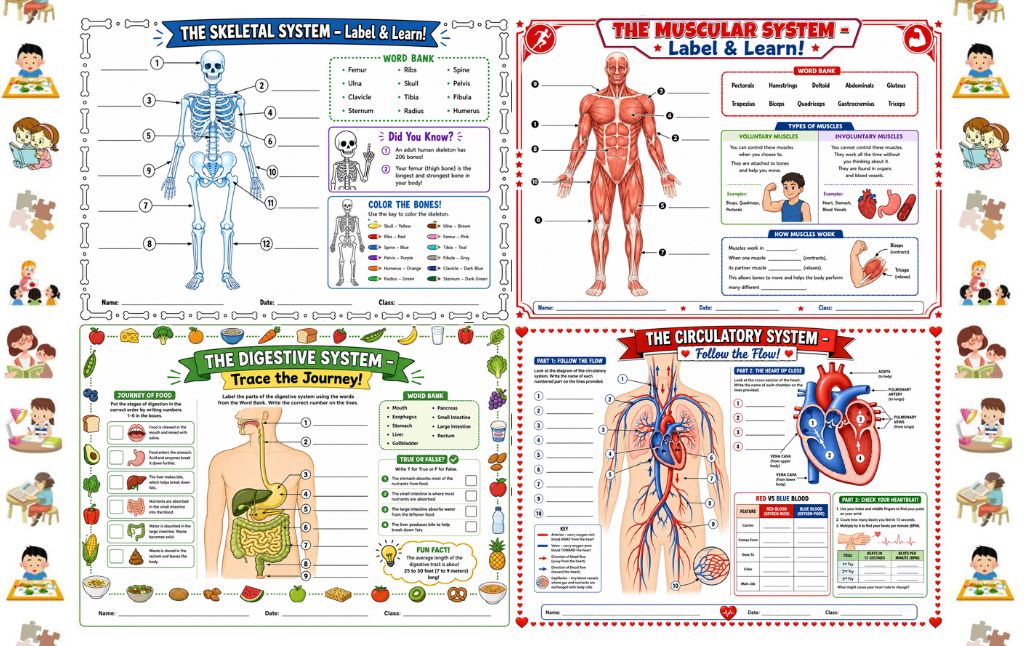
1. The Skeletal System Label & Learn
This colorful worksheet features a full body skeleton diagram with 12 numbered arrows pointing to major bones.
Kids use a word bank (Femur, Skull, Ribs, Spine, Clavicle, Tibia, Humerus, Pelvis, Fibula, Sternum, Ulna, Radius) to correctly label each part.
There’s also a Color the Bones activity using a color coded key, turning anatomy into a creative art project.
Two fun “Did You Know?” facts like the adult human body having 206 bones make learning stick.
10 Fun Camping Themed Do a Dot Printables to Download
10 Adorable Dinosaur Dot Activities to Print Today
2. The Muscular System Label & Learn
This worksheet introduces both voluntary and involuntary muscles, explaining the difference in simple, clear language.
Ten muscles are numbered on a detailed body diagram, with a word bank including Pectorals, Biceps, Hamstrings, Deltoid, Abdominals, Quadriceps, Gastrocnemius, Trapezius, Gluteus, and Triceps.
A “How Muscles Work” section explains how muscles contract and relax in pairs using the biceps and triceps as the perfect example making abstract physiology concrete.
3. The Digestive System Trace the Journey
Perhaps the most visually dynamic worksheet in the pack, this one takes food on a journey from mouth to rectum.
Kids label nine parts of the digestive system (Mouth, Esophagus, Stomach, Liver, Gallbladder, Pancreas, Small Intestine, Large Intestine, Rectum), then sequence the stages of digestion in the correct order from 1 to 6.
A True or False activity at the bottom reinforces comprehension, and a fun fact reveals that the digestive tract is 25, 30 feet long!
4. The Circulatory System Follow the Flow
This three part worksheet is ideal for older kids.
Part 1 asks students to label 10 parts of the circulatory system from a full body diagram.
Part 2 zooms into the heart’s four chambers for close up labeling.
Part 3 is an interactive activity kids actually check their own heartbeat by finding their pulse, counting beats in 15 seconds, and calculating beats per minute across three trials.
There’s also a compare and contrast table for oxygen rich (red) vs. oxygen poor (blue) blood.
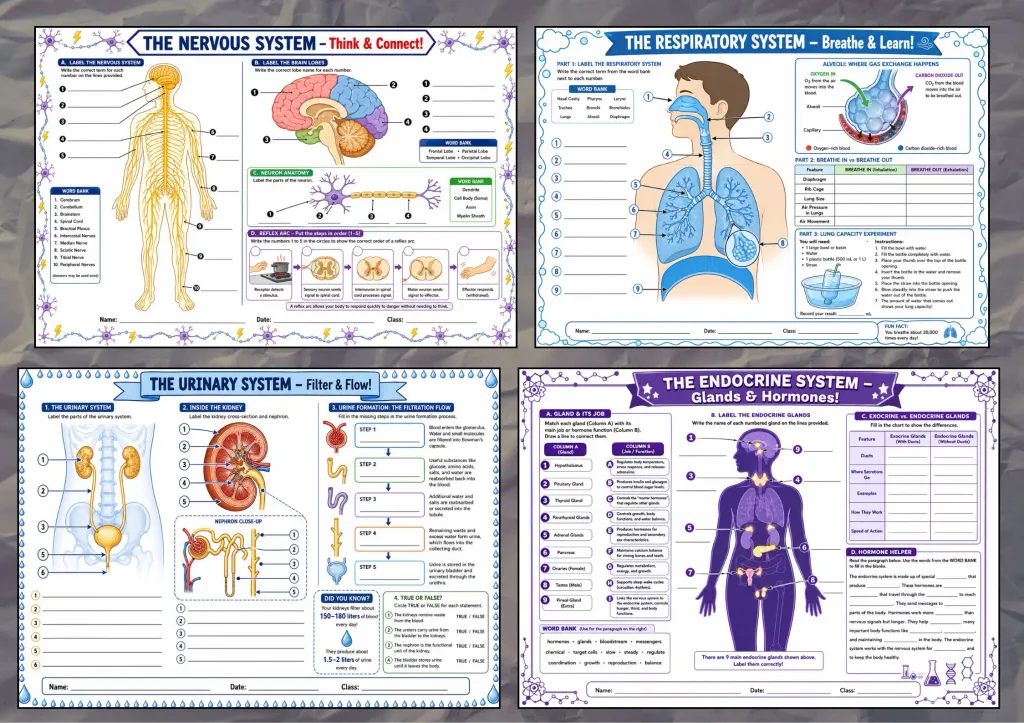
5. The Nervous System Think & Connect
The most complex worksheet in the pack, this one tackles the nervous system at three levels.
Section A labels the major nerves throughout the body (Cerebrum, Brainstem, Cerebellum, Spinal Cord, Brachial Plexus, Intercostal Nerves, Median Nerve, Sciatic Nerve, Tibial Nerve, Peripheral Nerve).
Section B labels the brain’s four lobes (Frontal, Parietal, Temporal, Occipital).
Section C labels neuron anatomy (Cell Body, Dendrite, Axon, Myelin Sheath).
Section D illustrates the reflex arc with step by step sequencing a brilliant way to explain how the body reacts before the brain even processes a thought.
6. The Respiratory System Breathe & Learn
Kids label nine parts of the respiratory system (Nasal Cavity, Pharynx, Larynx, Trachea, Bronchi, Bronchioles, Alveoli, Lungs, Diaphragm) and compare what happens to the body during inhalation vs. exhalation in a comparison table.
A gorgeous diagram of the alveoli explains gas exchange in a visually intuitive way.
Best of all, there’s a Lung Capacity Experiment at the bottom using just a plastic bottle, water, and a straw turning the worksheet into a hands on science activity.
7. The Urinary System Filter & Flow
This worksheet covers the full filtration process in three parts: labeling the urinary system organs, labeling a kidney cross section and nephron close up, and filling in the five steps of urine formation (from blood entering the glomerulus all the way to waste leaving the body).
A True or False activity and “Did You Know?” facts (kidneys filter 150, 180 litres of blood daily!) round off this thorough and well structured sheet.
8. The Endocrine System Glands & Hormones
This purple themed worksheet introduces the 9 main endocrine glands and their functions.
Students match each gland (Hypothalamus, Pituitary, Thyroid, Parathyroid, Adrenal, Pancreas, Ovaries, Testes, Pineal)
To its job in Column A/B format, label the glands on a body diagram, compare exocrine vs. endocrine glands, and complete a fill in the blank paragraph using a word bank. It’s a surprisingly accessible introduction to a typically complex topic.
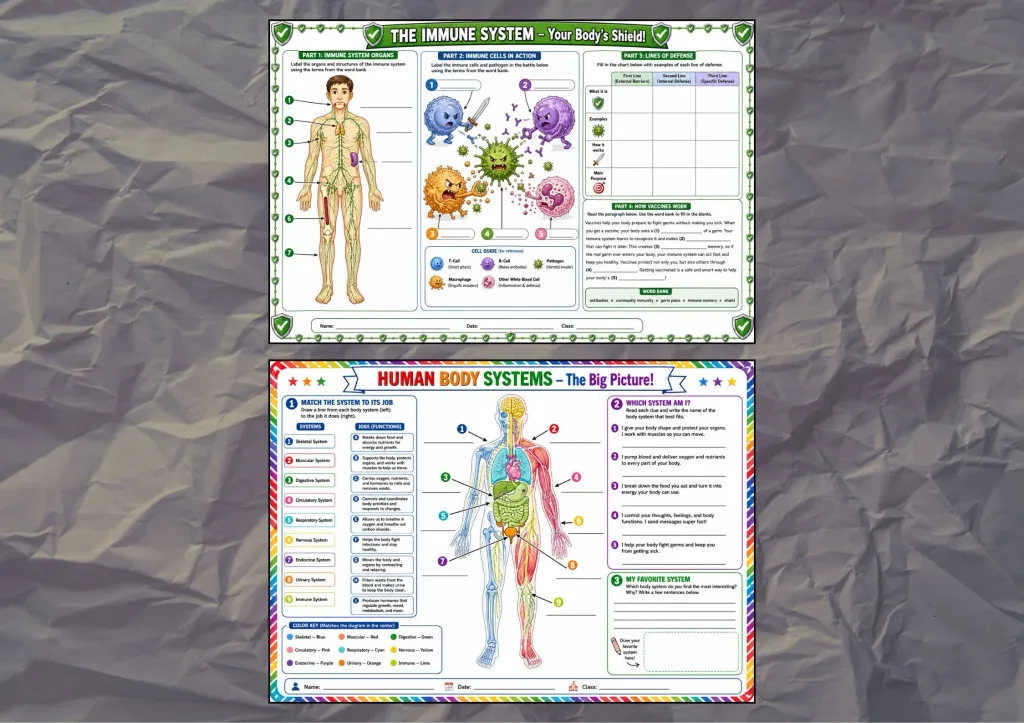
9. The Immune System Your Body’s Shield
One of the most timely and relevant worksheets in the pack, this one covers immune system organs
(Tonsils, Thymus, Lymph Nodes, Spleen, Bone Marrow, Lymph Vessels, Appendix), immune cells in action (T-Cell, B-Cell, Macrophage, Other White Blood Cells, Pathogens),
The three lines of defense, and how vaccines work. The visual “battle scene” of immune cells fighting a pathogen makes this page instantly memorable.
10. Human Body Systems The Big Picture
The final worksheet is a brilliant integrative review.
Kids match all 9 body systems to their functions, label each system on a composite body diagram, and play a “Which System Am I?” riddle game.
There’s also a “My Favourite System” creative writing prompt where students draw and explain the system they find most interesting a perfect end of unit reflection activity.
How to Use These Worksheets with Kids
For individual learners at home, print each sheet as you study a new body system one per week works well. Let children colour the diagrams first to build familiarity before filling in labels.
For classroom use, these worksheets work as lesson starters, independent practice tasks, or assessment tools.
The digestive system sequencing activity and the nervous system reflex arc sequencing are excellent for group discussion before individual completion.
For mixed age groups, younger children (ages 6–9) can focus on colouring and basic labelling, while older students (ages 10–13) can tackle the True/False, comparison tables, and fill in the blank paragraphs.
Pair each worksheet with a related activity: build a model skeleton from paper straws, act out a reflex arc in the classroom, or conduct the lung capacity experiment from the respiratory sheet. Science is always best when it moves off the page.
[ >> DOWNLOAD THE FULL 10 PAGE CAMPING BUNDLE HERE << ]
Free Reading Reward Charts for Kids Who Love Books
10 Colour Free Printable Reward Charts
10 Page Color Printable Brain Teaser Bundle
Grocery List Templates Printable Free
How to Use “Open When” Letters to Support Your Chil
Free Teacher Appreciation Printables Coloring page