Managing a classroom full of energetic, curious children is one of the most rewarding and challenging parts of teaching.
Behavior charts have long been a trusted tool for teachers and parents alike, offering a simple, visual way to track, encourage, and reward good behavior.
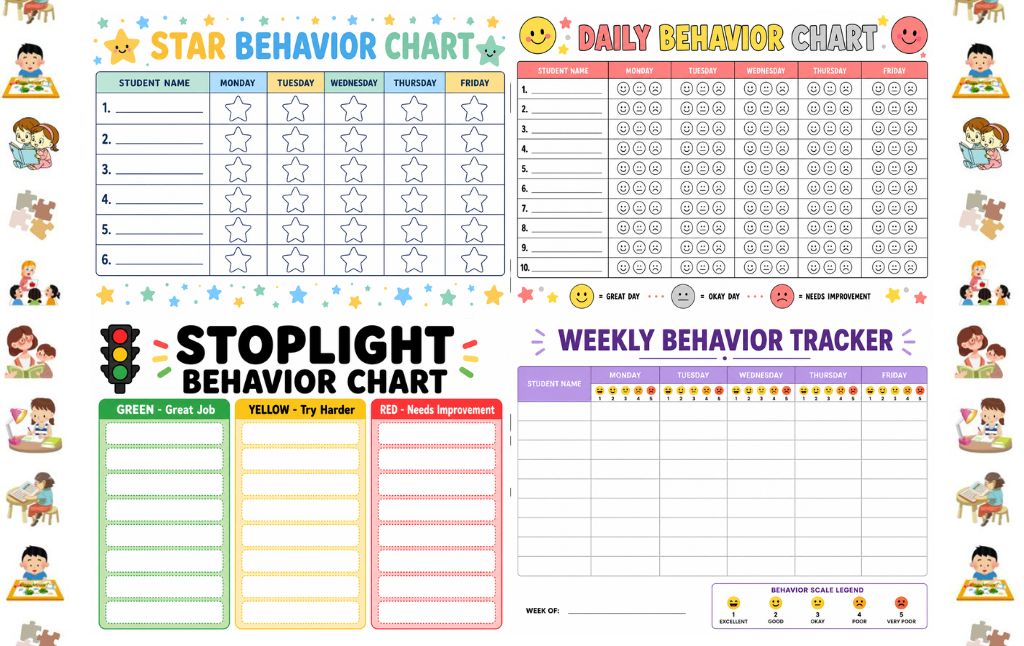
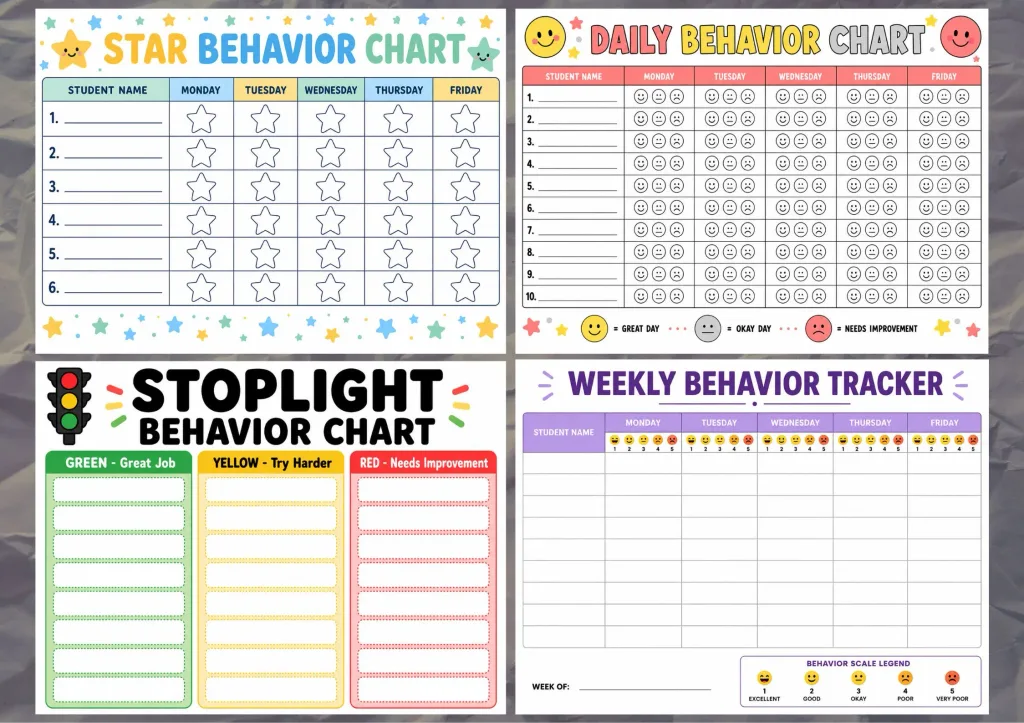
This printable pack includes ten different A4 sized behavior chart designs, each with its own theme, structure, and approach.
Whether you’re a classroom teacher managing 20+ students or a parent working one on one with your child at home, there’s a chart in this collection that fits your needs.
In this guide, we’ll explore why behavior charts work, the different styles included in this pack, and practical tips for using them effectively with kids of all ages.
Why Behavior Charts Work
Behavior charts tap into something fundamental about how children learn: they make abstract expectations concrete and visible.
A child might struggle to remember “be respectful” or “stay focused,” but a star sticker, a colored clip, or a filled in petal gives them an immediate, tangible signal of how they’re doing.
Psychologically, behavior charts work through several mechanisms. First, they provide immediate feedback children don’t have to wait until report card day to know whether their behavior is on track.
Second, they create a visual record of progress, which helps kids (especially younger ones who struggle with abstract time concepts) see how their week or month is unfolding.
Third, they introduce positive reinforcement in a way that feels like a game rather than a punishment, which keeps motivation high without shaming children for off days.
Importantly, the best behavior charts focus on growth and effort rather than perfection.
A child who moves from “needs improvement” to “okay” deserves just as much recognition as one who’s been “outstanding” all week.
This collection includes charts designed for exactly that kind of nuanced, encouraging tracking.
Back to School Printable Signs
Colour, Learn, and Celebrate: How to Use Black History Month Bookmarks with Kids
What’s Included in This Pack
This set of ten printables covers a wide range of formats, so educators and parents can choose the style that resonates best with their students or children. Broadly, the charts fall into a few categories:
Whole class tracking charts let teachers monitor multiple students at once across a school week, with columns for each day and rows for each child’s name.
These are ideal for classroom management at a glance a teacher can quickly scan the chart during morning meeting or end of day reflection time.
Daily and weekly individual trackers focus on a single child’s behavior across a school week, often using a numeric or face based rating scale (excellent, good, okay, poor, very poor).
These work well for students on individualized behavior plans or for parents tracking behavior at home alongside teacher input.
Themed reward charts use fun, kid friendly imagery rockets blasting off, flowers blooming, rainbows arching across the page to turn behavior tracking into a visual journey toward a goal or reward.
These are particularly effective for younger children who respond well to colorful, playful designs.
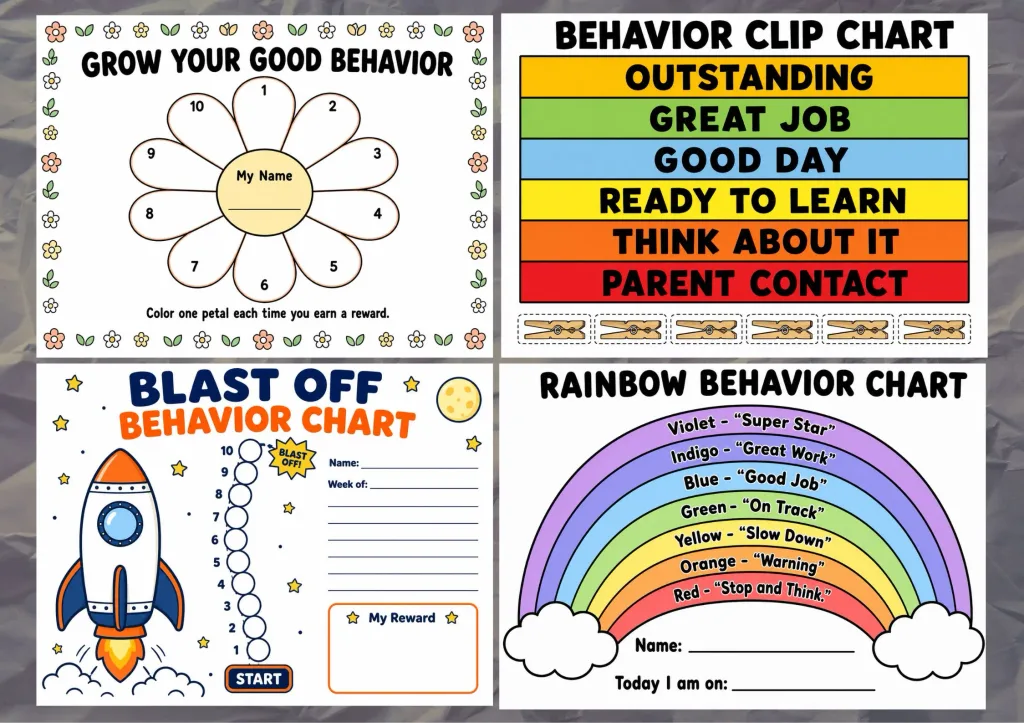
Color coded systems (like stoplight and rainbow charts) borrow familiar visual metaphors red means stop, green means go to help kids quickly understand where they stand without needing to read complex text.
Clip charts use a vertical scale of behavior categories, where a clothespin or marker is physically moved up or down throughout the day to reflect a student’s current status, giving real time feedback rather than just an end of day summary.
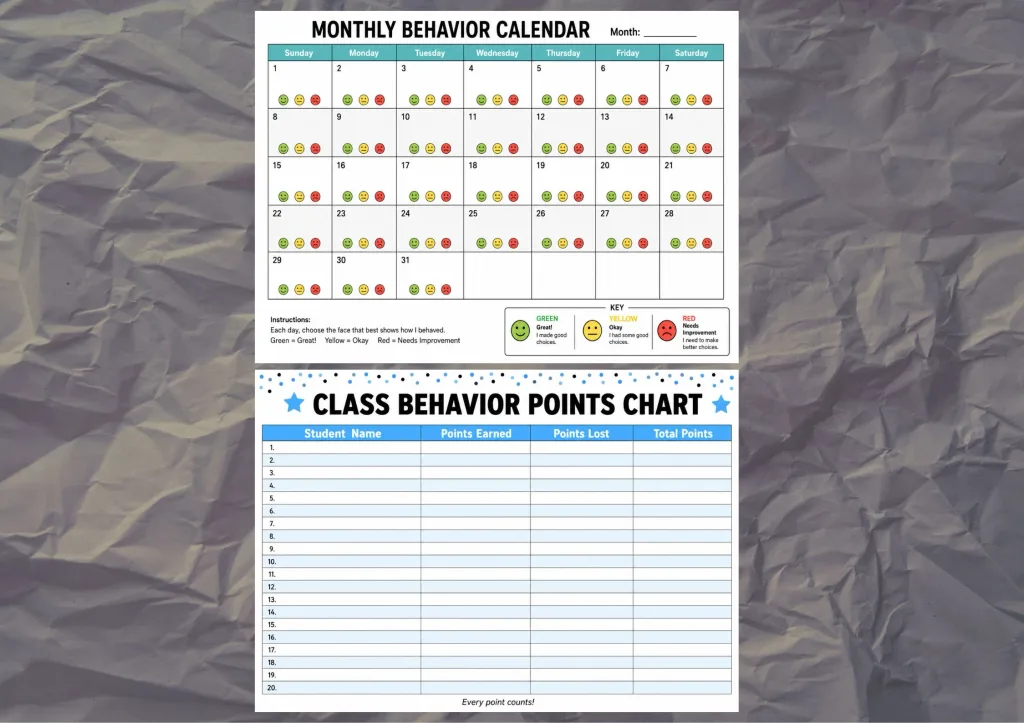
Points based systems introduce a more structured, almost game like element, where students earn and lose points for various behaviors, with totals calculated at the end of a tracking period useful for older students who can handle more complex systems and may respond well to friendly competition.
Monthly calendars extend tracking beyond a single week, giving a bird’s eye view of behavior patterns over an entire month useful for identifying trends, such as whether a child consistently struggles on certain days of the week.
How to Use These Charts Effectively
1. Choose the Right Chart for the Right Child (or Class)
Not every chart suits every situation. Younger children (preschool to early elementary) generally respond best to charts with simple visuals stars, smiley faces, or themed illustrations like rockets and flowers rather than numeric scales or dense tables.
Older elementary students can usually handle more detailed systems, like points charts or numeric rating scales, especially if they’re motivated by tracking their own “scores.”
For whole class management, a single chart that lists all students side by side works best, since it lets the teacher do a quick daily check in for everyone at once.
For individual behavior plans say, for a student working on a specific goal with a counselor or special education teacher an individual daily or weekly tracker offers more detailed, personalized feedback.
2. Set Clear, Age Appropriate Expectations First
A behavior chart is only as good as the expectations behind it. Before introducing any chart, sit down with your students (or child) and clearly explain what each rating, color, or symbol means in concrete terms.
“Green means you followed directions, kept your hands to yourself, and stayed on task” is far more useful than a vague “green means good.”
For color coded and clip style charts, post the key somewhere visible in the classroom so students can reference it throughout the day.
This transparency helps children understand exactly what they need to do to move toward the positive end of the scale and what behaviors might move them in the other direction.
3. Make It a Daily Routine
Consistency is everything with behavior charts. Pick a specific time each day morning meeting, right before dismissal, or during a transition to update the chart together with students.
This routine reinforces the connection between behavior and consequence (positive or corrective) while keeping the process quick and low stress.
For clip charts, some teachers allow movement throughout the day in real time, giving students immediate feedback the moment a behavior occurs.
For star or smiley face charts, a single end of day rating tends to work better, since it gives a more holistic view of the whole day rather than reacting to a single moment.
4. Pair the Chart With Meaningful Rewards
The themed reward charts in this pack like the rocket “blast off” tracker and the flower “grow your good behavior” chart are designed to build toward a reward once a goal is reached (filling all ten circles, coloring all ten petals, etc.).
When using these, decide on the reward in advance and make sure it’s something genuinely motivating but realistic extra recess time, choosing a class game, a small certificate, or a phone call home with good news.
For points based systems, consider setting up a simple “exchange rate,” where points can be traded for privileges or small prizes at the end of the week or month.
This teaches delayed gratification and basic goal setting skills.
5. Focus on Progress, Not Perfection
One of the biggest pitfalls of behavior charts is using them punitively, where a single bad moment colors a child’s entire day or week.
Instead, use these tools to highlight patterns and progress over time.
The monthly calendar chart, for example, is excellent for this a child can look back at a month and see that they had mostly green and yellow days, with only a couple of red ones, which feels far more encouraging than focusing on the red days in isolation.
When a child has a tough day, frame it as information rather than failure: “I noticed Tuesday was tricky what do you think made that day harder?”
This turns the chart into a tool for reflection and self-awareness rather than just a scorecard.
6. Involve Families
Many of these charts include space for a “week of” date or student name, making them easy to send home or share with parents.
Regular communication about behavior especially positive behavior helps build a partnership between home and school.
A quick note or a copy of a great week’s chart can go a long way in reinforcing good habits outside the classroom too.
7. Rotate and Refresh
Kids especially younger ones can lose interest in a chart after a few weeks, even if it’s working well.
Having multiple chart styles on hand (as this pack provides) means you can rotate designs periodically to keep things fresh and engaging, without losing the underlying structure of consistent behavior tracking.
[ >> DOWNLOAD THE FREE PRINTABLE CLASSROOM BEHAVIOR CHARTS PRINTABLE << ]
15 Free Printable Winter Bookmarks to Color
Free Printable Bible Verse Bookmarks to Color
15 Dog Bookmarks to Color Printables
50 States Coloring Pages Free Printables
10 Phases of the Moon Worksheets