The first year of formal math education sets the stage for everything that follows.
Children moving through Grade 1 need consistent, low pressure practice with numbers, operations, shapes, time, and money the foundational building blocks of all future math learning.
This collection of ten free printable A4 worksheets has been designed specifically to make that practice playful, visual, and effective.
Rather than relying on dry drills, these sheets use bright illustrations, friendly characters, and interactive formats (tracing, matching, comparing, and coloring) to keep young learners engaged while reinforcing core first grade math standards.
Below is an overview of what the set covers, why each skill matters developmentally, and practical tips for using the pack at home or in the classroom.
What’s Inside the Pack
The ten page set covers a broad sweep of early numeracy skills that align closely with typical Grade 1 curriculum goals:
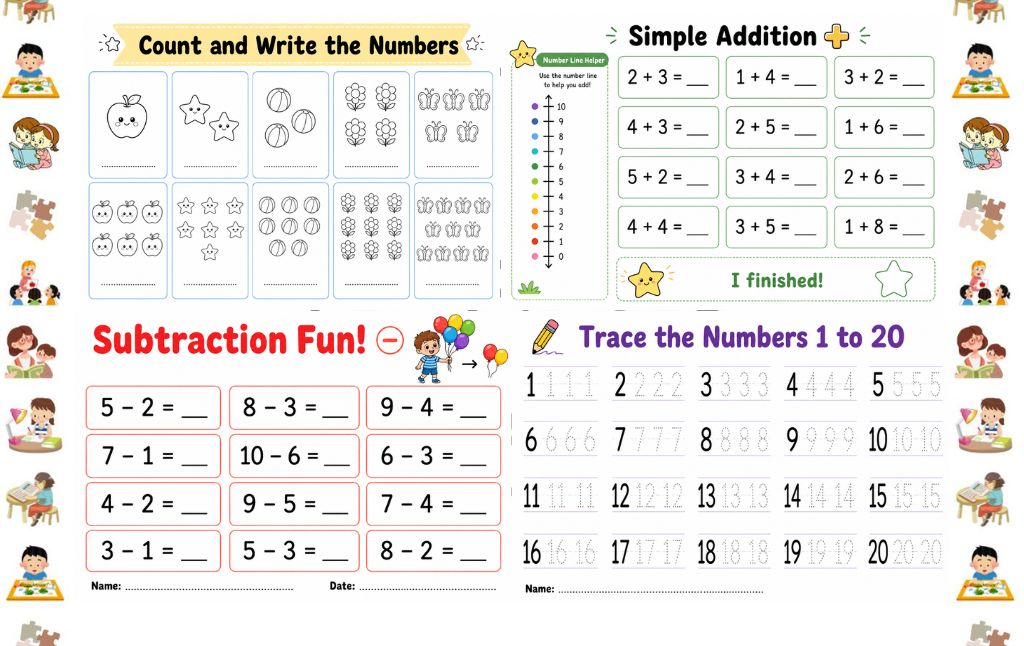
- Counting objects and writing numerals
- Simple single digit and low double digit addition
- Basic subtraction within 10
- Number formation and handwriting practice (1, 20)
- Number sequencing and pattern recognition
- Comparing numbers using greater than, less than, and equal to
- Identifying and naming basic 2D shapes
- Classifying numbers as odd or even
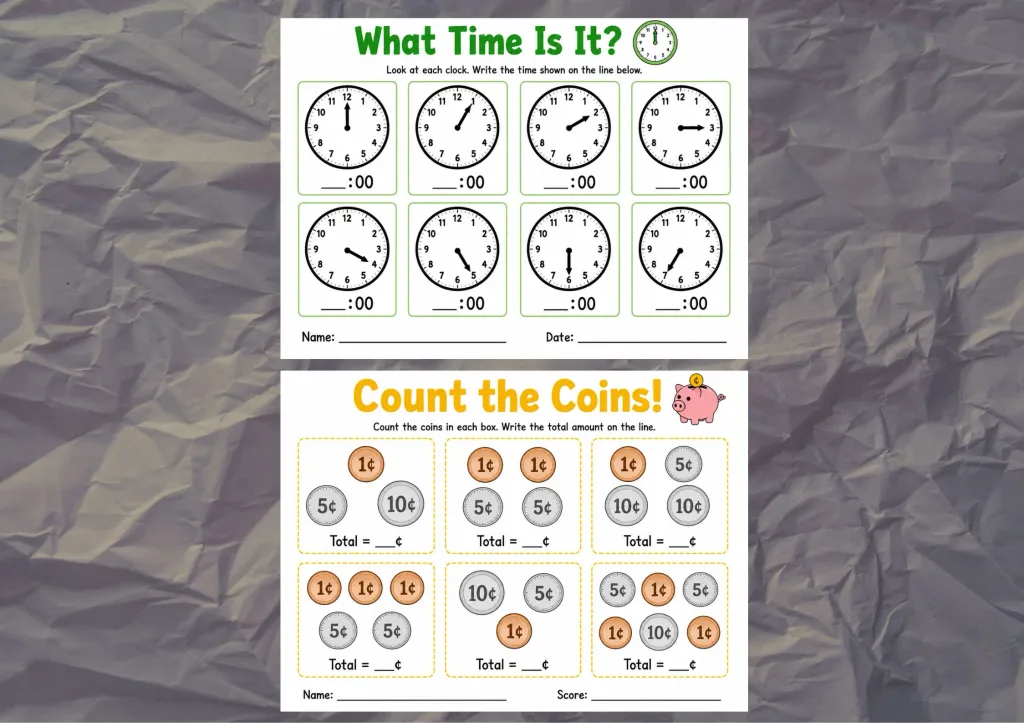
- Reading time on an analog clock to the hour
- Counting coins and adding monetary values
Together, these pages form a well rounded “first math toolkit” that touches on number sense, operations, geometry, measurement, and money five of the core domains young learners need to build fluency in.
10 Free Printable Tools to Encourage Positive Behavior in Kids
Back to School Printable Signs
Why This Combination of Skills Matters
Early math isn’t just about memorizing facts; it’s about building a flexible mental model of how numbers work and relate to the real world.
A worksheet pack that mixes counting, operations, shapes, time, and money gives children multiple entry points into number sense.
A child who struggles with abstract addition might find it easier to grasp the same concept through counting objects first, then transition to symbolic equations once the underlying logic feels natural.
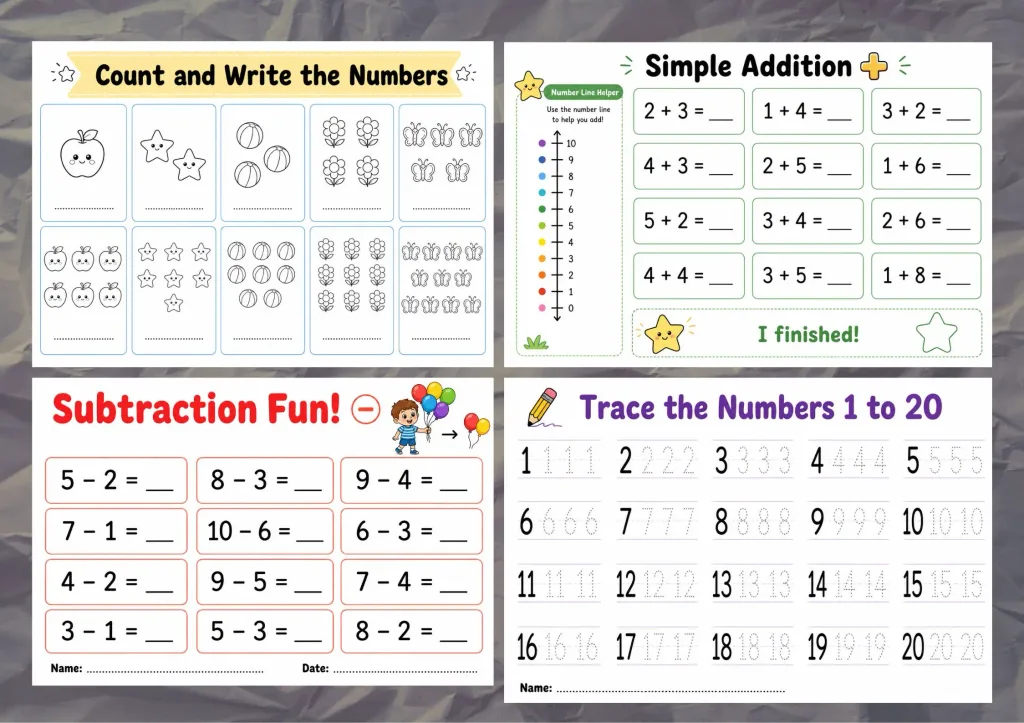
Similarly, including both addition and subtraction side by side helps children see these operations as two sides of the same coin a relationship that becomes critical once they begin learning about fact families and inverse operations in later grades.
Number formation practice supports fine motor development and handwriting fluency, which often lags behind cognitive understanding at this age.
And practical skills like telling time and counting coins connect abstract math to daily life, answering the perennial question, “why does this matter?”
How to Use These Worksheets With Kids
Start with a warm up, not a test. These sheets work best when framed as games rather than assessments.
Before handing over a worksheet, spend a minute or two talking through the topic point at a clock on the wall, count snacks at the table, or sort coins from a piggy bank.
This primes the child’s brain and reduces anxiety around the printed page.
Use manipulatives alongside the page. For the counting and addition/subtraction sheets, having physical objects nearby buttons, blocks, dried beans, or even fingers gives children a tactile bridge between the picture on the page and the abstract number they’re writing.
Encourage them to touch and move objects as they count rather than just looking and guessing.
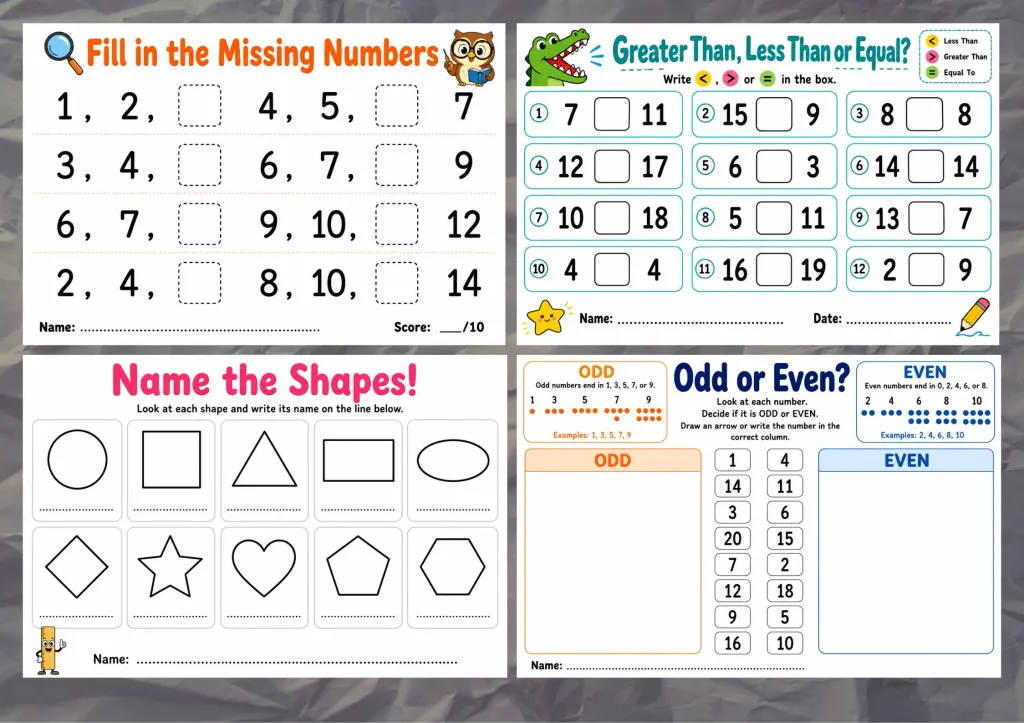
Lean on the built in supports. Several pages include scaffolding tools, like a number line for the addition sheet or labeled examples for the odd/even sorting activity.
Don’t rush past these. Walk through one or two examples together before letting the child work independently, modeling how to use the support tool as a thinking aid rather than just decoration.
Keep sessions short and frequent. A single worksheet, completed calmly over five to ten minutes, is far more valuable than three worksheets rushed through in frustration.
First graders typically have short attention spans, so it’s better to revisit this pack across several days than to attempt it all in one sitting.
Consider using one page as a daily “math minute” routine, perhaps right after breakfast or as a transition activity between other tasks.
Talk through the answers, don’t just check them. When reviewing completed work, ask the child to explain how they got their answer rather than simply marking it right or wrong.
“How did you count those butterflies?” or “How did you know 8 was bigger than 3?”
Reveals their thinking process and often uncovers small misconceptions like skipping numbers when counting, or confusing the greater than and less than symbols that are easy to correct early but harder to unlearn later.
Make mistakes low stakes. If a child gets something wrong, resist the urge to immediately correct it.
Instead, encourage them to recount, re trace, or try the problem a different way.
Praise effort and strategy (“I love how carefully you counted those stars!”) more than just correct answers.
This builds a growth mindset around math from the very beginning, which research consistently links to better long term outcomes and reduced math anxiety.
Rotate through different skill areas. Because this pack spans counting, operations, shapes, time, money, and number relationships, you can mix and match pages to match a child’s mood or energy level.
On a high energy day, a hands on counting or coin page might work well.
On a calmer day, number tracing or shape naming can feel more meditative. Variety keeps the practice feeling fresh rather than repetitive.
Connect it to real life whenever possible. After completing the clock worksheet, point out the actual time on a real clock throughout the day.
After the coin counting page, let the child help count real change from a wallet or piggy bank.
After the shapes page, go on a “shape hunt” around the house or yard, spotting circles, squares, and triangles in everyday objects.
These connections help children see math as something that exists in the world, not just on paper.
Celebrate completion. Many of these pages include a small “I finished!” marker or a score line use these as natural moments to celebrate.
A sticker, a high five, or simply displaying the finished page on the refrigerator can go a long way in building a positive association with math practice.
Printing and Setup Tips
Since these worksheets are formatted for A4 paper, they’ll print cleanly on standard printers worldwide.
For best results, print in black and white to keep ink costs low the line art illustrations are designed to be colored in by the child afterward, turning a math worksheet into an art activity too.
If you plan to reuse the pages, consider slipping each sheet into a clear plastic sleeve and using a dry erase marker, so children can practice the same skills repeatedly without using new paper each time.
[ >> DOWNLOAD THE FREE PRINTABLE 1ST GRADE MATH WORKSHEETS << ]
Colour, Learn, and Celebrate: How to Use Black History Month Bookmarks with Kids
15 Free Printable Winter Bookmarks to Color
Free Printable Bible Verse Bookmarks to Color
15 Dog Bookmarks to Color Printables
50 States Coloring Pages Free Printables
10 Phases of the Moon Worksheets
10 Free Human Body Systems Worksheets for Kids