This collection of 10 Easter themed Math Worksheets is designed specifically for kindergarten aged children. These activities focus on pattern recognition, a foundational skill for early math, logical reasoning, and literacy.
Below is a detailed explanation of each worksheet and a guide on how to use them effectively with your child or students.
What these worksheets are about and the variations you’ll find inside!
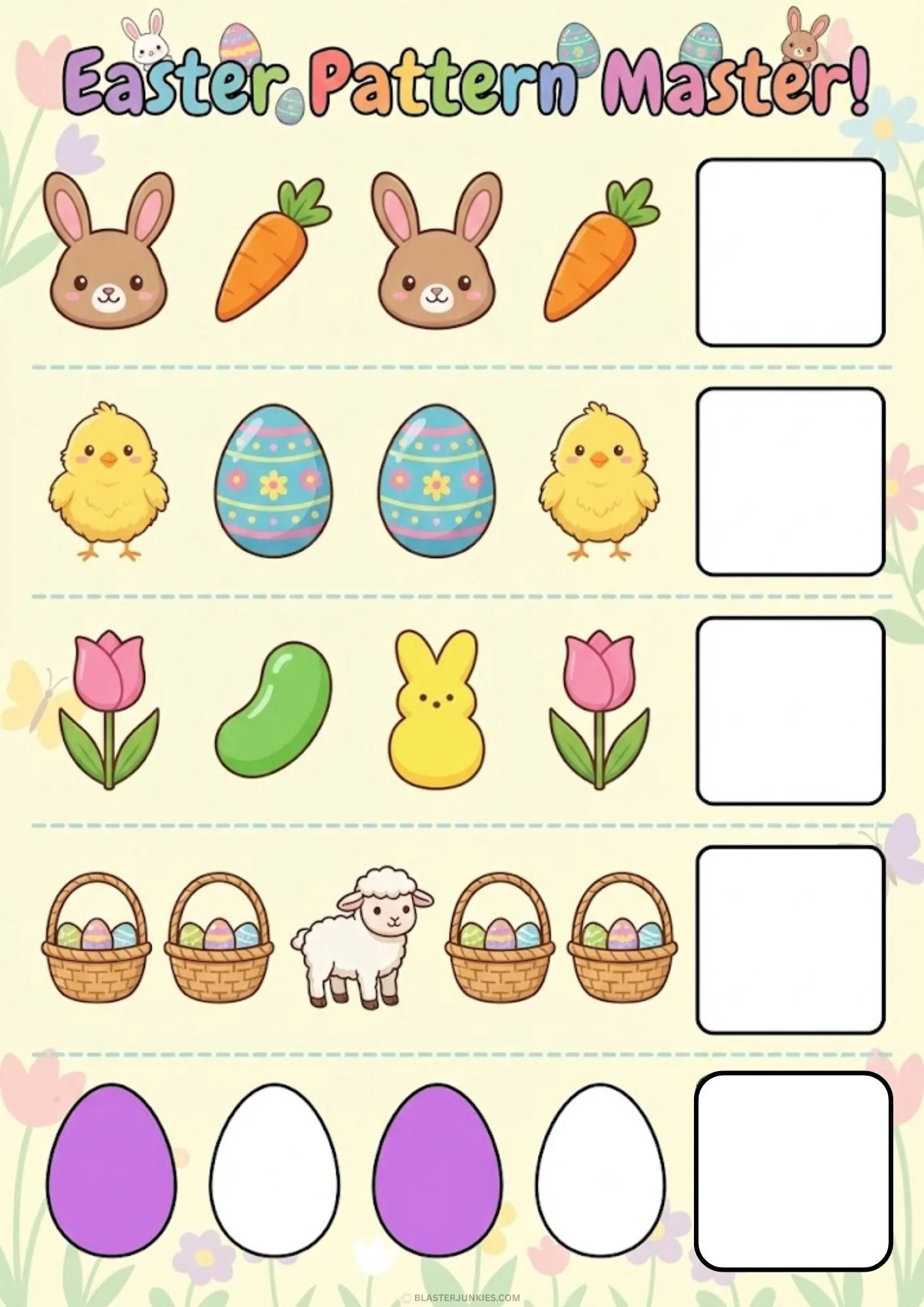
1. Easter Pattern Master (Color)
- Goal: To identify various pattern types (AB, ABB, ABC, and AAB).
- Content: Features bunnies, carrots, chicks, eggs, tulips, and jellybeans.
- The Task: The child looks at the sequence and determines which item belongs in the blank box at the end.
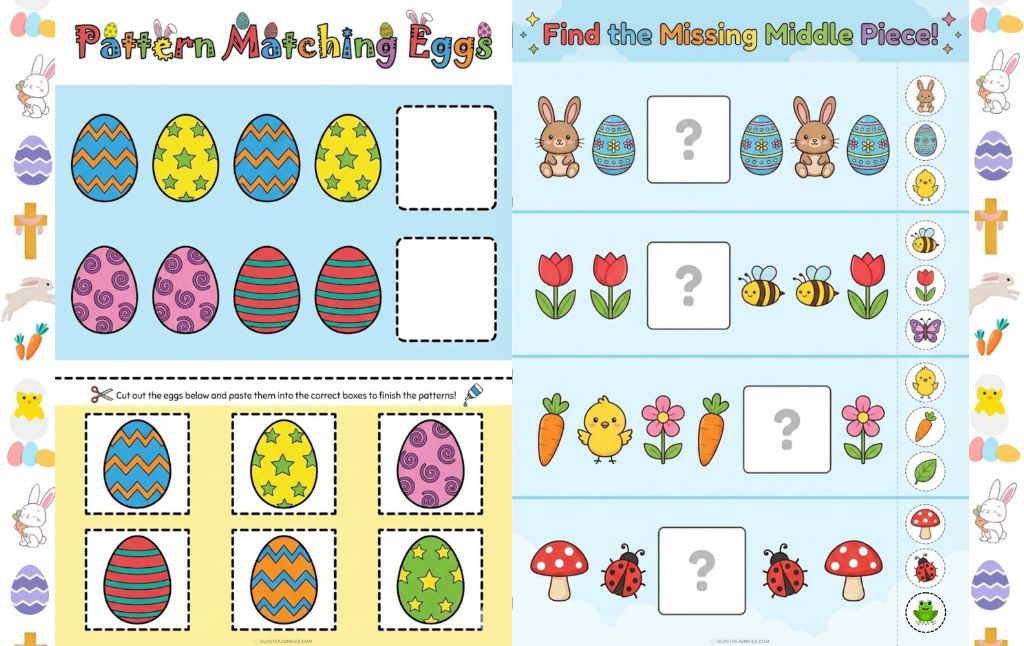
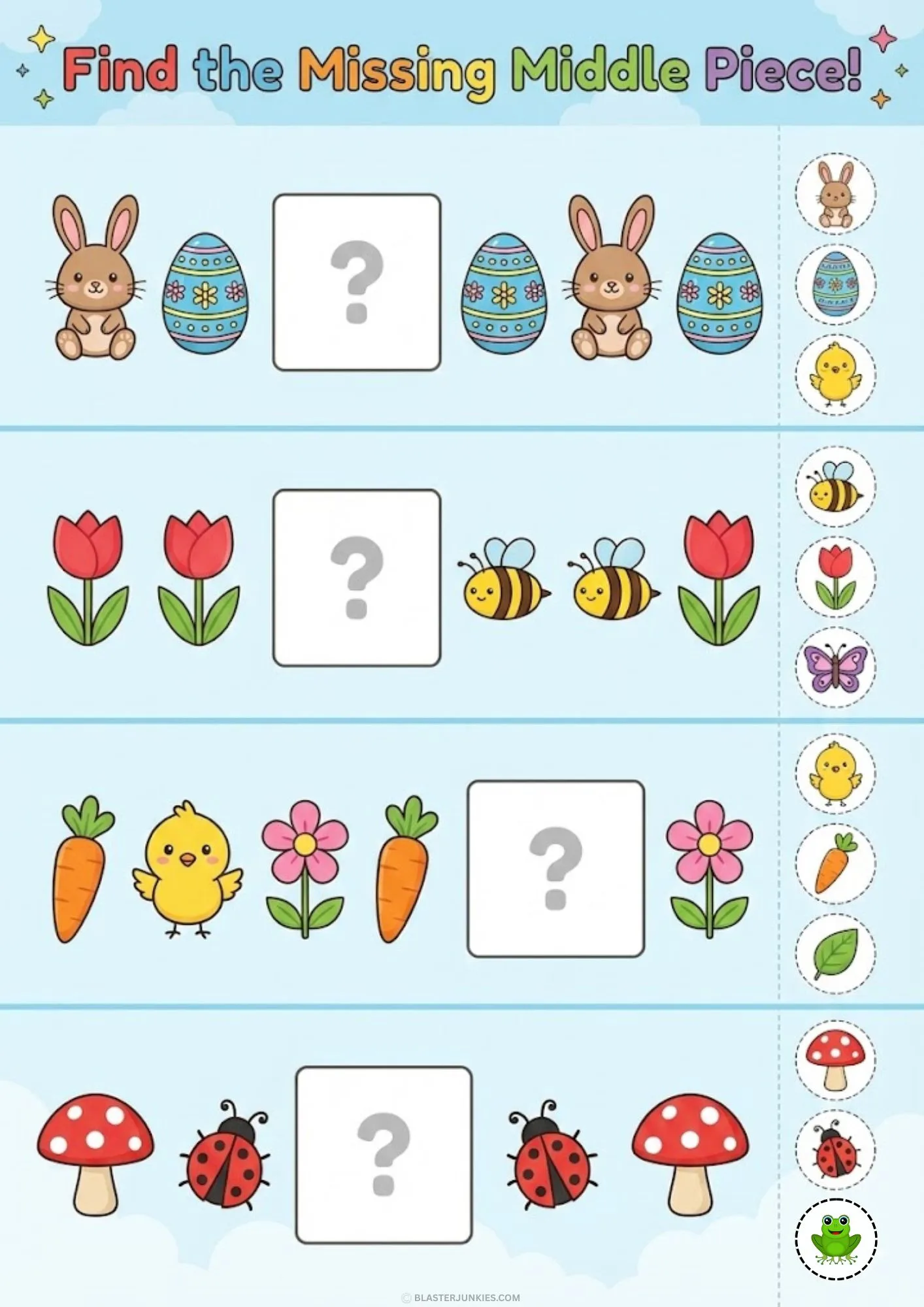
2. Find the Missing Middle Piece (Color)
- Goal: Challenging the child to see patterns “internally” rather than just at the end.
- Content: Includes bunnies, eggs, tulips, bees, chicks, and mushrooms.
- The Task: The child must identify the item that fits in the middle of the sequence (marked with a question mark) by choosing from the options on the right.
3. Pattern Matching Eggs (Color)
- Goal: Visual discrimination of complex designs.
- Content: Two rows of colorful Easter eggs with zig zags, stars, swirls, and stripes.
- The Task: A “Cut and Paste” activity where kids match the specific design pattern to finish the sequence.
4. Cut and Paste Easter Fun (Color)
- Goal: Fine motor development combined with pattern logic.
- Content: Baskets, decorated eggs, bunnies, tulips, and lollipops.
- The Task: Kids cut out the squares at the bottom and glue them into the empty boxes to complete the alternating patterns.
5. AAB Tricky Patterns (Color)
- Goal: Focused practice on the “AAB” pattern (two of the same, one different).
- Content: Peeps (marshmallow bunnies), chocolate bars, flowers, bees, stars, and carrots.
- The Task: The child identifies the pattern and selects the correct ending piece from the circular choices on the right.
6. ABC Easter Patterns (Color)
- Goal: Recognition of three-element patterns (ABC).
- Content: Easter hats, lambs, baskets, eggs, chicks, crosses, and bunnies.
- The Task: The child follows a sequence of three different objects and circles the one that starts the cycle over again.
7. Color the Next Egg (Color/Art)
- Goal: Pattern reproduction and artistic skill.
- Content: Detailed eggs with stripes, dots, zig zags, and flowers.
- The Task: Instead of picking a picture, the child must look at the design and draw/color the same pattern onto the blank egg at the end.
8. Draw What Comes Next (B&W)
- Goal: Simple AB pattern recognition and drawing practice.
- Content: Smiling flowers, jellybeans, and sunflowers.
- The Task: A coloring-friendly worksheet where kids draw the next simple shape in the box.
9. Chick and Egg Patterns (B&W)
- Goal: Binary (AB) pattern recognition with similar shapes.
- Content: Cracked eggs, chicks, bow-tie chicks, and striped eggs.
- The Task: Kids cut and paste the correct chick or egg to finish the simple alternating sequences.
10. Easter AB Patterns (B&W)
- Goal: Basic introductory patterns for beginners.
- Content: Simple bunny and carrot repetitions.
- The Task: This is the best “starting” sheet. The child simply circles the bunny or the carrot to complete the row.
Part 2: How to Use These Worksheets for Kids
To make the most of these printables, follow these steps:
1. Start with Concrete Objects (The “Real Life” Hook)
Before using the paper, use real Easter items like plastic eggs or jellybeans. Create a pattern (e.g., Pink egg, Blue egg, Pink egg) and ask the child, “What comes next?”
2. Identify the Pattern Type
Teach children to use letters to “code” the patterns.
- AB: Bunny, Carrot, Bunny, Carrot.
- AAB: Chick, Chick, Egg, Chick, Chick, Egg.
- ABC: Hat, Lamb, Basket, Hat, Lamb, Basket.
3. Use the “Point and Say” Method
Have the child point to each image and say the name out loud: “Egg, Egg, Chick… Egg, Egg, Chick.” Hearing the rhythm often helps children find the mistake or the missing piece faster than just looking at it.
4. Scissor Skills (Supervised)
For the “Cut and Paste” sheets, encourage the child to cut along the dotted lines themselves. This builds hand strength and coordination needed for writing.
5. Multi Sensory Extension
- Coloring: For the Black & White sheets (8, 9, 10), let the kids color the images after they finish the math portion as a reward.
- Correction: If a child gets a pattern wrong, don’t just tell them the answer. Ask, “Does it sound right if we say Bunny, Bunny, Carrot, Bunny, Bunny… Bunny?” Usually, they will hear the break in rhythm and correct themselves.
Printing Instructions:
- These are designed for A4 size paper.
- Select “Fit to Page” in your printer settings to ensure no edges are cut off.
- For the color sheets, use white cardstock if you want them to be more durable for classroom centers.
Easter Skip Counting Puzzles (Math Activities for Kids)
Easter Mazes for Kids (Fun & Challenging Activities)
26 Free Printable A-Z Alphabet Playdough Mats (Sensory Learning Fun!)
10 Scissor Skills Worksheets: The Ultimate Cutting Practice Pack (A4 PDF)