As spring arrives and gardens begin to burst with color, there is no better time to engage young minds with the wonders of the natural world. Flowers aren’t just beautiful to look at; they are incredible tools for teaching preschoolers essential developmental skills.
Our Free 10 Page Flower Activity Pack is designed to capture the curiosity of children aged 3 to 5. By combining cheerful “kawaii style” illustrations with educational milestones, these worksheets turn learning into a vibrant, hands-on experience.
In this guide, we will walk through every page of the kit and explain how to use these printables to help your child bloom.
A Detailed Look Inside the Pack
1. The Garden Coloring Page (Page 3)
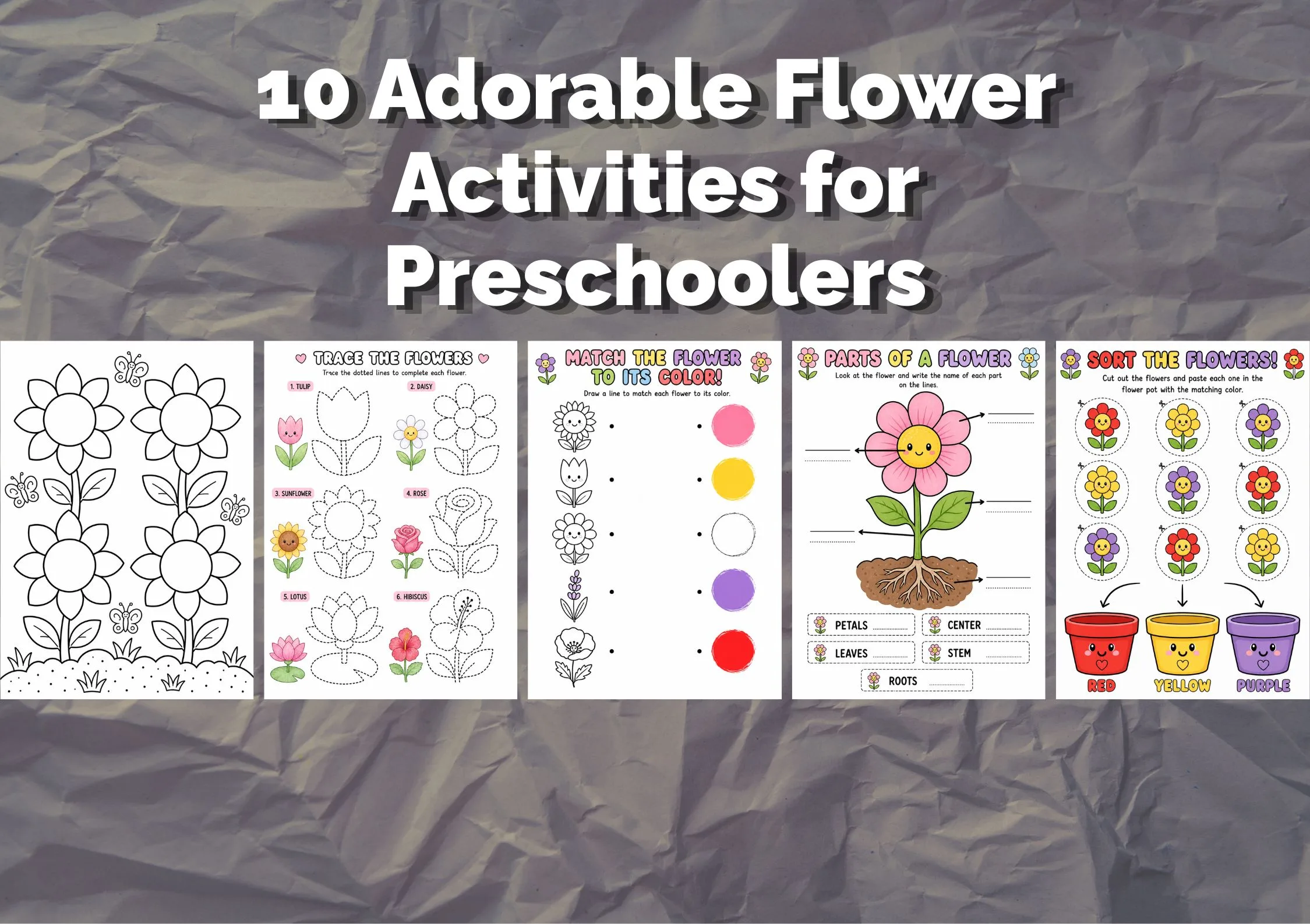
The journey begins with a classic coloring activity. This page features four large sunflowers and friendly butterflies.
The Goal: To encourage creative expression and build the hand muscles needed for writing.
Educational Twist: Ask your child to name the colors they are using or count the butterflies as they color.
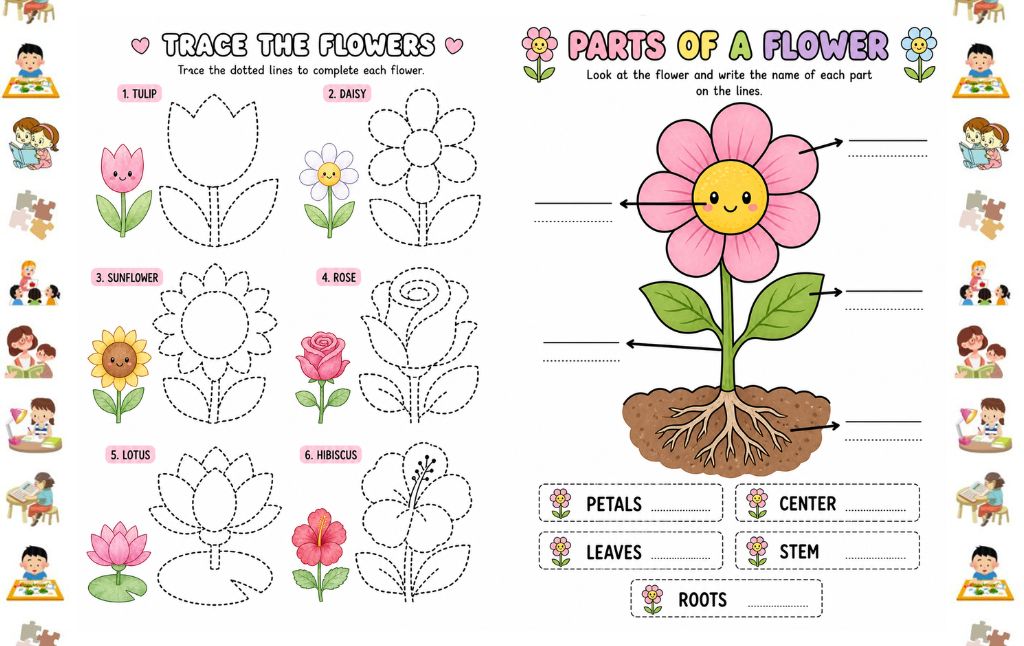
2. “Trace the Flowers” (Page 4)
This page introduces six distinct flower types: Tulip, Daisy, Sunflower, Rose, Lotus, and Hibiscus.
The Goal: To develop pencil control and visual-motor integration.
How to Use: Have the child follow the dotted lines to “complete” the flower. This helps them recognize that different flowers have different geometric structures (e.g., the pointed petals of a lotus vs. the round petals of a daisy).
3. Color Matching Challenge (Page 5)
Children are asked to draw lines connecting specific flowers to their corresponding colored circles.
The Goal: Visual discrimination and color identification.
How to Use: Encourage the child to say the color name out loud before drawing the line. This reinforces the link between the visual color and the spoken word.
4. Basic Botany: “Parts of a Flower” (Page 6)
This is an introductory science lesson. The worksheet identifies the petals, center, leaves, stem, and roots.
The Goal: Vocabulary building and understanding biological structures.
How to Use: Point to each part on the diagram and explain its job (e.g., “The roots drink the water from the soil”). Use the word bank at the bottom to help the child write or dictate the labels.
5. “Sort the Flowers!” Categorization (Page 7)
A dynamic cut-and-paste activity where kids sort nine flowers into three colored pots: Red, Yellow, and Purple.
The Goal: To develop scissor skills and logical categorization.
How to Use: Assist the child in cutting out the circular flower icons. Have them “plan” their garden by placing the flowers in the pots before gluing them down.
6. “Color the Flower” by Number (Page 8)
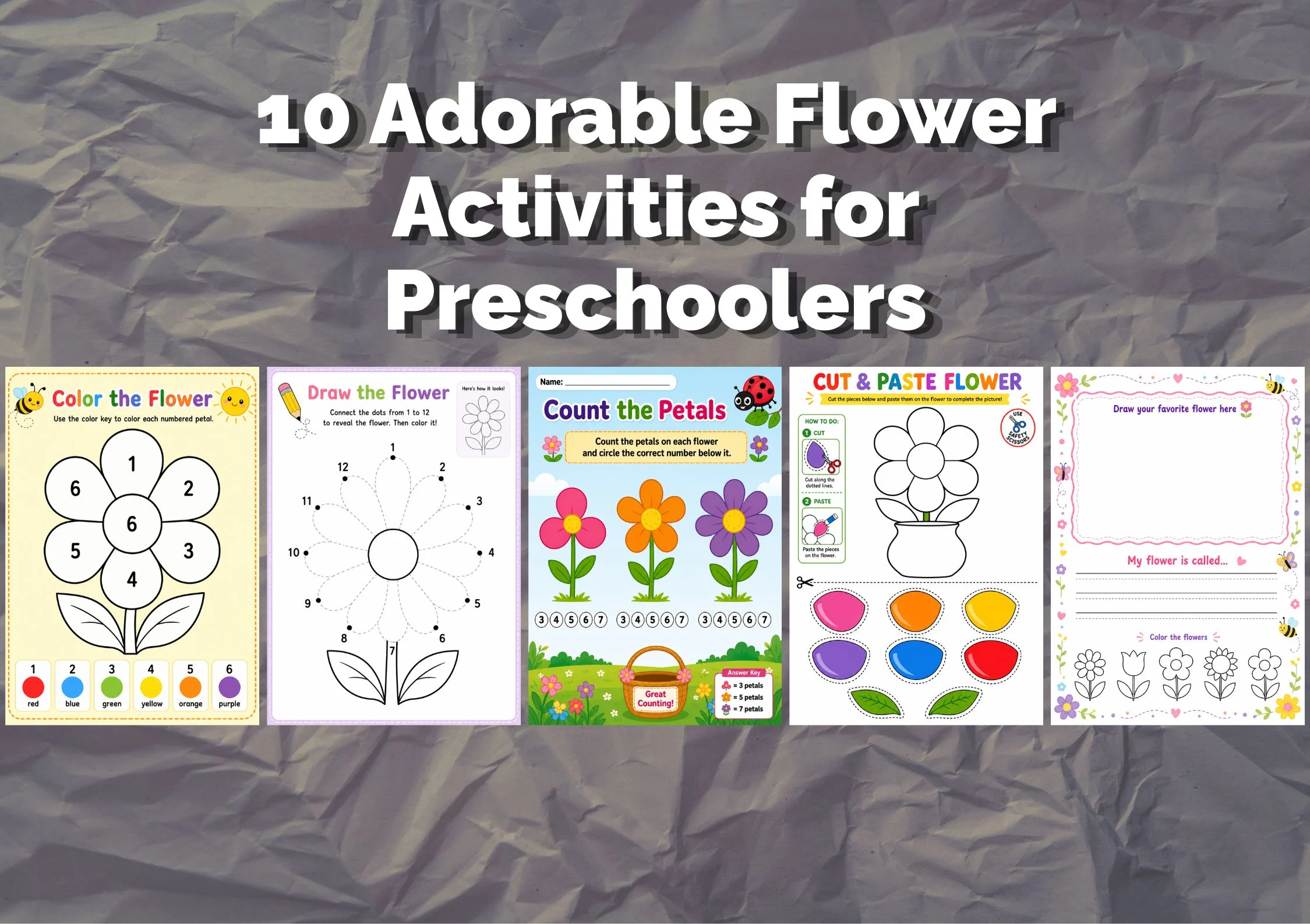
Using a numerical key (1=Red, 2=Blue, etc.), the child colors a large, happy flower.
The Goal: To practice following multi-step directions and number recognition.
How to Use: This is a great “quiet time” activity. It requires focus and helps children learn to associate symbols (numbers) with specific actions (colors).
7. Dot to Dot: “Draw the Flower” (Page 9)
A classic connect-the-dots from 1 to 12.
The Goal: Reinforcing numerical sequencing.
How to Use: Encourage the child to count aloud as they move the pencil from number to number. Once the flower is “revealed,” let them color it as a reward for their math work.
8. “Count the Petals” (Page 10)
This page features three flowers with different petal counts (3, 5, and 7).
The Goal: One-to-one correspondence and quantity identification.
How to Use: Have the child point to each petal individually while counting. Then, they circle the correct number from the options provided below.
9. Build a Flower: Cut & Paste (Page 11)
A spatial reasoning task where the child “assembles” a flower into a pot using individual petals and leaves.
The Goal: Bilateral coordination and spatial awareness.
How to Use: This is the most complex motor task in the pack. Cutting out the petal shapes and fitting them around the center circle requires patience and precision.
10. Creative Expression: “My Favorite Flower” (Page 12)
The final page offers a large blank space for the child to draw their own creation, with primary lines at the bottom for writing the flower’s name.
The Goal: Early literacy and imagination.
How to Use: Ask the child to invent a “new” flower. What does it smell like? What is it called? Help them write the name on the lines provided.
How to Use This Kit Effectively
To get the most out of these A4 PDFs, follow these “Teacher-Tested” tips:
Laminate for Reusability: Pages like the “Trace the Flowers” and “Count the Petals” can be laminated or placed in plastic sheet protectors. Give your child a dry erase marker, and they can practice their skills over and over again.
Use Real Life Props: Before doing the “Parts of a Flower” sheet, go outside and look at a real dandelion or daisy. Touch the stem, feel the petals, and see if you can see the roots. This “concrete to abstract” connection is vital for preschool development.
Safety First: For the “Sort the Flowers” and “Build-a-Flower” pages, ensure you are using blunt-nosed safety scissors. If the child is just starting out, you can do the “rough cut” and let them do the “detail cut.”
The “Gallery” Method: When your child finishes a page, hang it up on the fridge or a dedicated “Art Wall.” This builds confidence and gives them a sense of pride in their academic work.
The Benefits of This Pack
Fine Motor Mastery: Every page involves gripping, drawing, or cutting, which prepares the hands for the rigors of kindergarten writing.
Math Readiness: By counting petals and following number keys, kids develop a “number sense” that serves as the foundation for addition and subtraction.
Science Curiosity: Learning that flowers have parts and needs (roots and water) sparks a lifelong love for nature and biology.
No Prep for Adults: These are ready to print. No expensive materials are needed just paper, crayons, glue, and scissors.
45 Cottagecore Teatime Junk Journal Kit What’s Inside & Why You’ll Love Every Single Page
40 Fresh Floral Prints for Junk Journaling A Beautiful New Collection You’ll Love
37 Honey Dreams Bee Junk Journal Kit What’s Inside This Bee Junk Journal Kit?
30 Pressed Flowers Botanical Papers Junk Journal Filler Pages
40 Botanical Beauty Wildflower Junk Journal Pages The Printable PDF Collection
30 Summer Fairy Junk Journal Pages You Need to Print
24 Whimsical Wildflower Watercolor Junk Journal Spread: A Complete Creative Study
50 Adorable Dog Junk Journal Pages That Will Make Every Scrapbooker Obsessed
50 Shabby Chic pages for Your Sewing Junk Journal
100 Dreamy Backgrounds for Your Next Junk Journal Masterpiece