Homework can be one of the biggest sources of stress in a household, not because the work itself is too hard, but because it is disorganized.
Assignments pile up, deadlines slip by unnoticed, and both kids and parents end up scrambling at the last minute.
This printable pack of 10 student homework planner sheets tackles that problem head on. Designed in clean A4 format with bright, age friendly colors and icons, each sheet approaches organization from a slightly different angle, giving families and classrooms a full toolkit rather than a single one size fits all template.
What makes this pack especially useful is its variety.
Some sheets focus on the big picture, like an entire month or term, while others zoom into a single day or even a single study session.
Together, they teach a child the foundational life skill of breaking large goals into manageable, trackable steps, a skill that pays dividends far beyond the classroom.
Fruit of the Spirit Craft Pack
What’s Inside the Pack
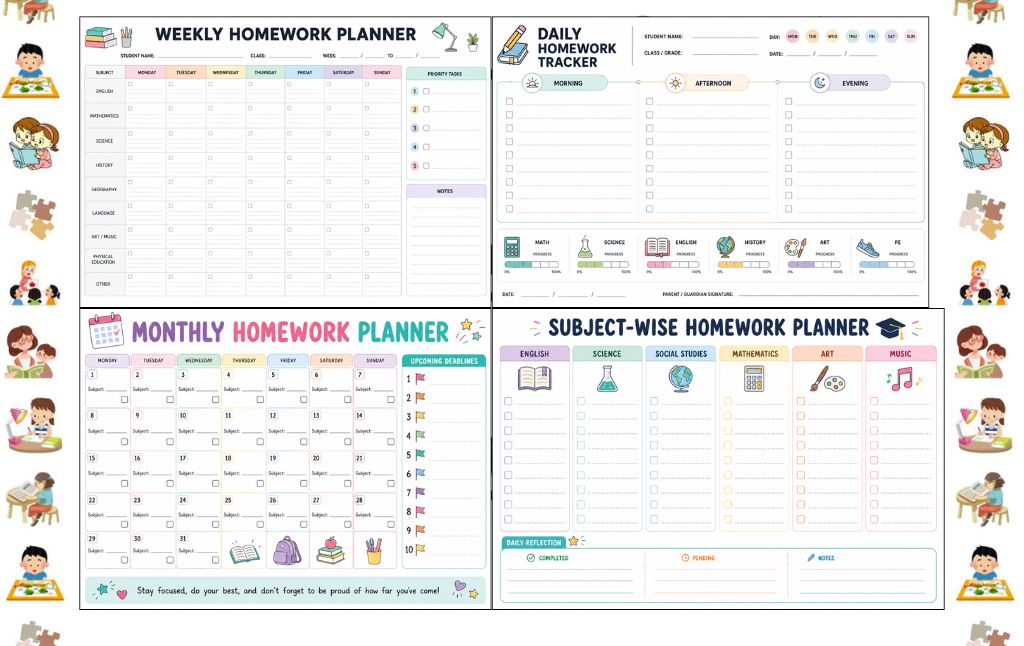
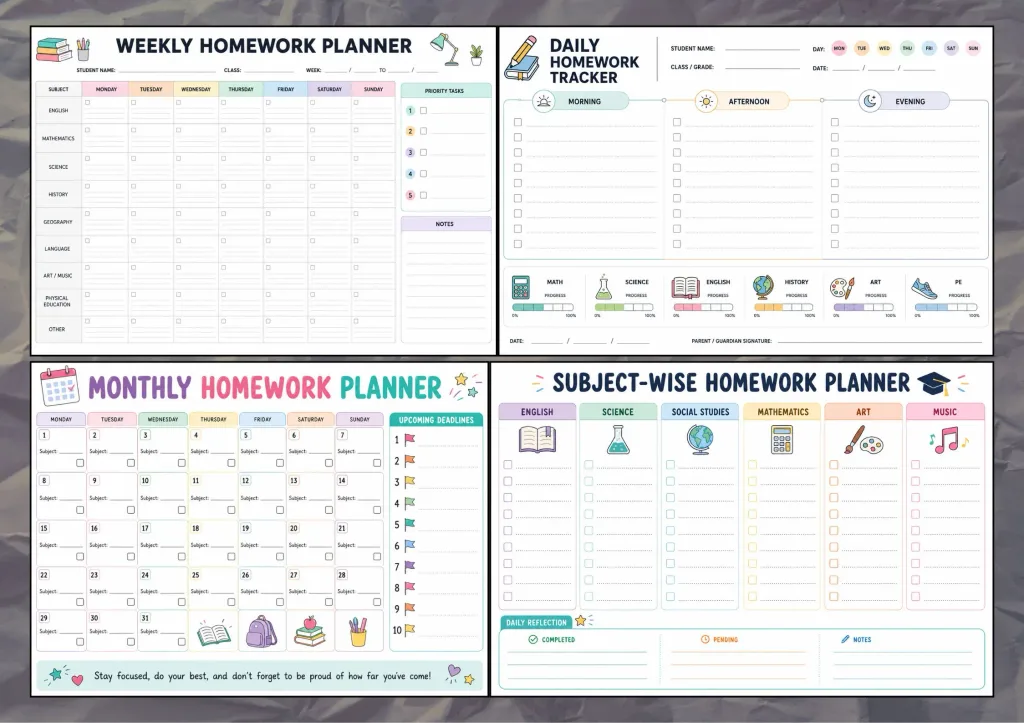
The collection includes a weekly homework planner with a subject by day grid covering English, Mathematics, History, Science, Geography, Language, Art/Music, Physical Education.
A daily homework tracker breaks each day into morning, afternoon, and evening blocks with checkboxes for tasks, alongside subject progress bars for Math, Science, English, History, Art, and PE that fill up toward one hundred percent as work gets done, plus a space for a parent or guardian signature.
There is a monthly homework planner laid out as a full calendar grid with numbered date boxes, a subject line and checkbox on every date, and an upcoming deadlines section that ranks the ten most important due dates.
The Skills Kids Build by Using These Planners
At first glance, a planner might seem like nothing more than a piece of paper with boxes on it, but the habits formed by filling those boxes in every day are genuinely transformative.
The most obvious skill is time management. When a child sees their entire week laid out subject by subject, or their entire day broken into morning, afternoon, and evening blocks, they begin to understand that time is a finite resource that needs to be allocated thoughtfully, rather than something that simply happens to them.
Closely related is the skill of prioritization. Several sheets in this pack, including the weekly planner’s ranked priority tasks and the term organizer’s star ranked weekly goals, ask children to actively decide what matters most.
This is a higher order thinking skill that many adults still struggle with, and the earlier kids practice it in a low stakes setting, the more naturally it becomes part of how they approach any project.
The checkbox and progress bar format throughout the pack also taps into a powerful psychological principle:
the satisfaction of visible progress. Watching a progress bar creep toward one hundred percent, or seeing a string of checkmarks accumulate across the week, provides a small dopamine reward that reinforces the behavior of starting and finishing tasks.
This is especially valuable for children who struggle with motivation or who feel overwhelmed when homework is presented as one large, undefined blob of work rather than a series of small, completable steps.
Finally, sheets like the daily homework tracker, which includes a parent or guardian signature line, and the term organizer, which tracks an entire month, help build accountability and a sense of ownership over one’s own learning.
When a child is responsible for filling in their own planner and showing it to a parent, homework stops being something that happens to them and becomes something they actively manage.
Getting Started: Printing and Setup
A few simple steps will get this pack ready for daily use:
Print the sheets on standard A4 paper.
For sheets that will be used every single day, such as today’s homework plan or the daily homework tracker, consider printing several weeks’ worth at once, or print one master copy and photocopy it as needed.
Slip frequently reused sheets, like the weekly planner or the homework planner with books and materials needed, into a clear plastic sleeve so they can be filled in with a dry erase or wet erase marker and wiped clean each week.
Punch holes and store the sheets in a dedicated three ring binder or folder, organized by type, so the child always knows where to find their planner.
Fill in the student name, class, and date fields together the first time, so the child understands what each section is for before using it independently.
Putting the Sheets to Work: A Simple Routine
Start of the Week
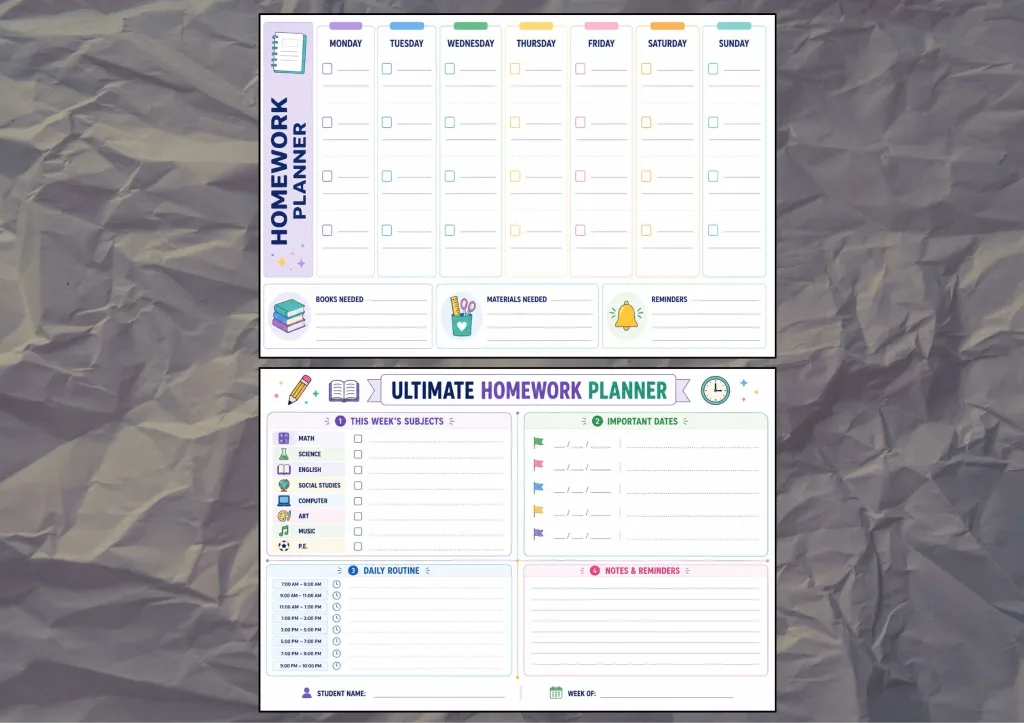
On Sunday evening or Monday morning, sit down with your child and the weekly homework planner or the ultimate homework planner.
Look ahead at the week’s subjects, write down any known assignments or tests, and fill in the upcoming deadlines or important dates sections.
This is also the moment to set the week’s top priorities or goals using the star ranked sections found in the term organizer or weekly planner.
Each Day
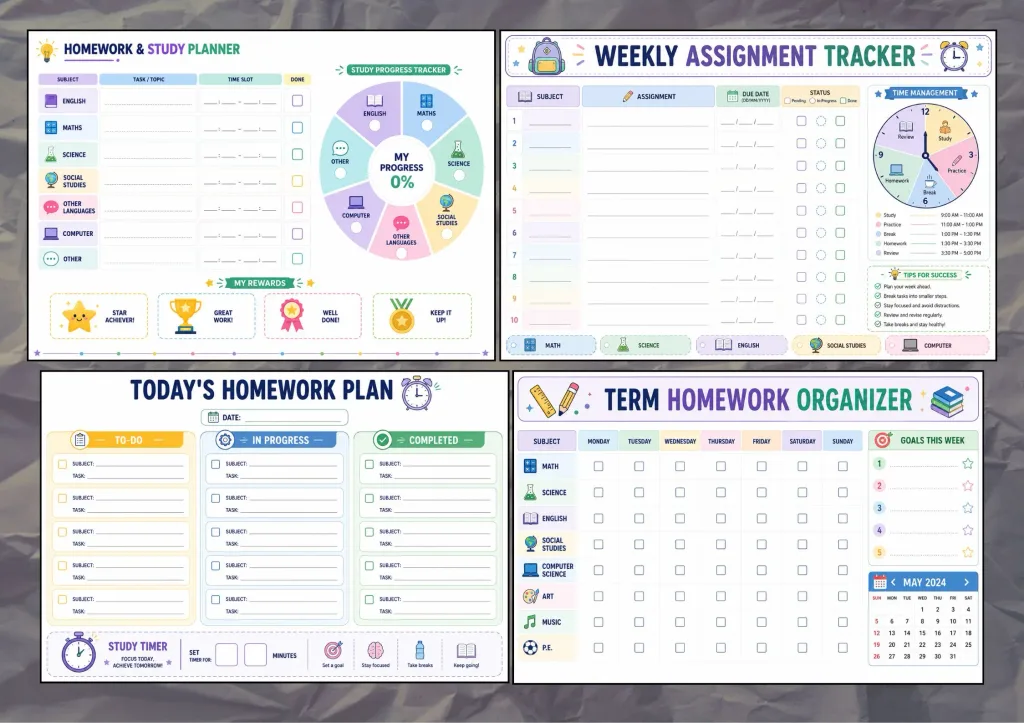
Every morning or right after school, have your child fill out today’s homework plan, sorting tasks into to do, in progress, and completed columns.
As the day goes on, tasks move from one column to the next, giving a satisfying visual sense of momentum.
For younger children, the daily homework tracker with its morning, afternoon, and evening sections works well as a gentler version of the same idea, paired with the subject progress bars to celebrate completed work.
Tracking Assignments and Studying
Whenever a longer term assignment is given, log it on the weekly assignment tracker with its subject, description, due date, and status.
As due dates approach, use the homework and study planner to break the assignment into smaller tasks with assigned time slots, and use the circular study progress tracker to mark each subject as it is addressed.
The study timer on today’s homework plan is perfect for focused work sessions, encouraging kids to set a realistic time goal and then work toward it without distraction.
End of the Week and Month
On Friday or over the weekend, revisit the subject wise homework planner’s daily reflection section to review what was completed and what remains pending, and use this to plan the following week.
Once a month, glance back at the monthly homework planner to see overall patterns:
which subjects tended to pile up, which days were busiest, and whether the upcoming deadlines were met on time.
Tips for Different Ages and Needs
Not every sheet will suit every child equally. Here is how to match the pack to different learners:
Younger primary students: Start with the homework planner that includes books needed, materials needed, and reminders sections.
The simple checkbox per day format is easy to follow, and the materials list helps build the habit of packing the right things for school.
Upper primary and middle school students: The weekly homework planner and daily homework tracker work well, since they cover a fuller range of subjects and introduce the priority ranking concept.
Students juggling multiple long term projects: The weekly assignment tracker and homework and study planner, with their due dates, status columns, and time slots, provide the structure needed to avoid last minute cramming.
Students who need extra motivation: The homework and study planner’s rewards badges and circular progress wheel, along with the progress bars on the daily tracker, turn routine work into a small game with visible milestones.
Students who struggle with focus: Today’s homework plan, with its study timer and short list of focus tips, encourages short, timed bursts of concentrated effort followed by breaks
[ >> DOWNLOAD THE STUDENT HOMEWORK PLANNER PRINTABLES << ]
10 Free Printable 1st Grade Math Worksheets (A4 Size)
The Ultimate Guide to Classroom Behavior Charts
Back to School Printable Signs: A Fun, Stress Free Way to Celebrate Every Milestone
Colour, Learn, and Celebrate: How to Use Black History Month Bookmarks with Kids
15 Free Printable Winter Bookmarks to Color