This comprehensive 10 Connect the Dots Printable Pack is a high energy educational resource designed for children in preschool and elementary school.
Sized for standard A4 printing, this collection features 10 high quality illustrations that challenge a child’s counting ability while providing a rewarding coloring activity at the end.
Unlike standard dot to dot puzzles, this pack includes a unique “Sub Step” or Decimal system (e.g., 22.2, 22.4, 22.6) on several pages, which introduces kids to more precise spatial reasoning and the concept of numbers between numbers.
Detailed Breakdown of the Activity Pages
The pack is organized into various popular themes to keep children engaged:
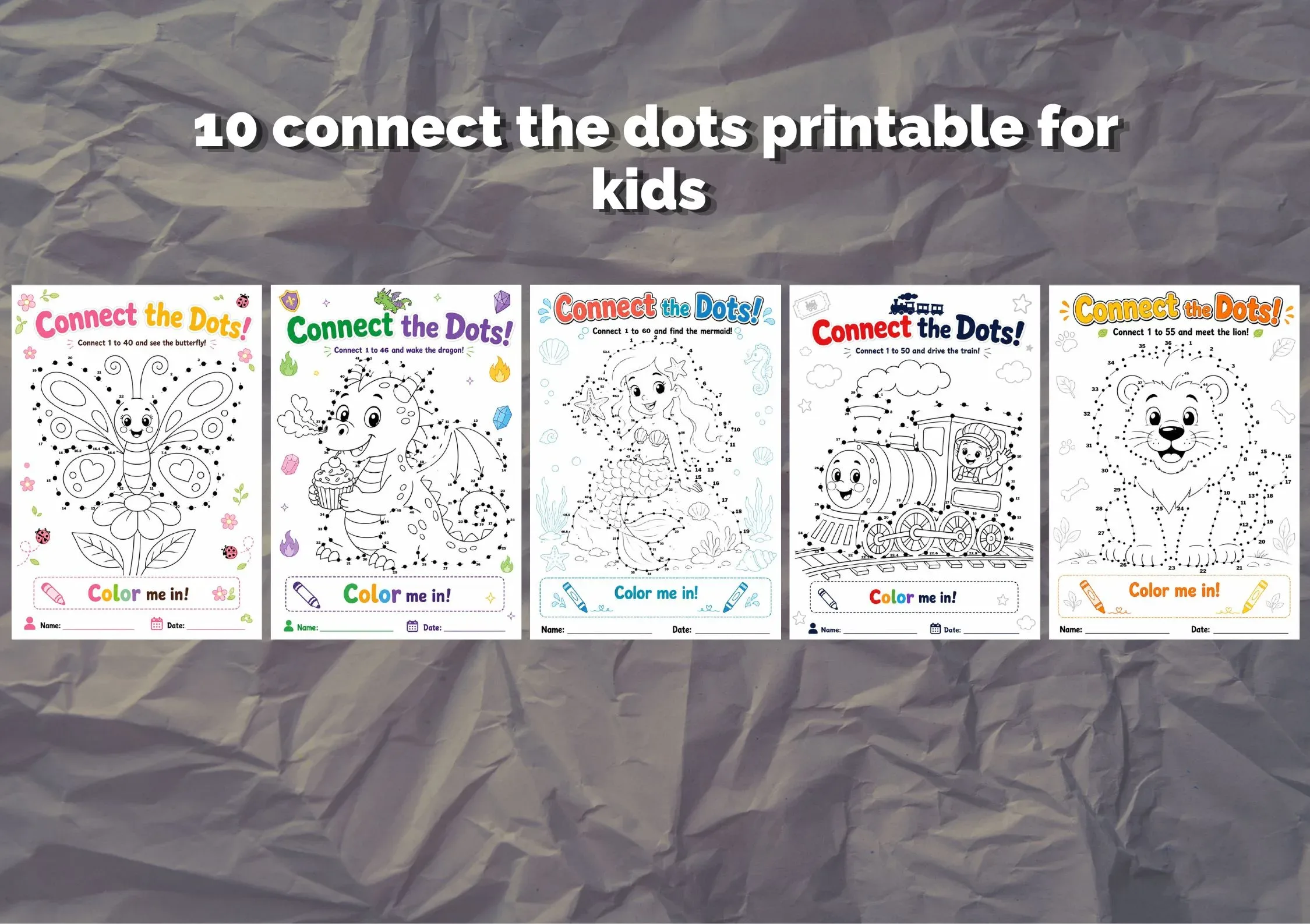
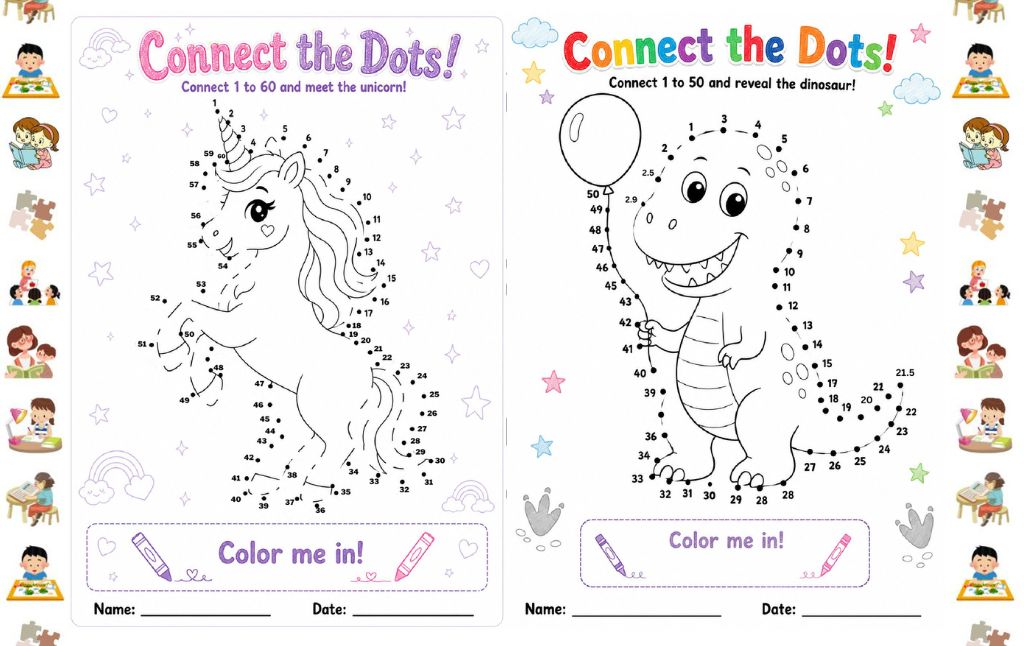
The Happy Dinosaur (Page 3): Connects 1 to 50. This page introduces “half steps” like 2.5 and 2.9, helping children understand that lines sometimes need extra precision to form a curve.
The Sparkly Unicorn (Page 4): Connects 1 to 60. A higher level counting challenge that focuses on forming the complex silhouette of a unicorn’s body and flowing mane.
The Space Rocket (Page 5): Connects 1 to 55. This layout uses long, straight lines, making it excellent for practicing ruler use or steady hand drawing.
The Splashing Dolphin (Page 6): Connects 1 to 42. Features a sequence of decimals (24.5 to 26.5) to create the fluid motion of splashing water.
The Royal Castle (Page 7): Connects 1 to 83. The most complex architectural puzzle in the pack. It requires focus to navigate the many towers and flags.
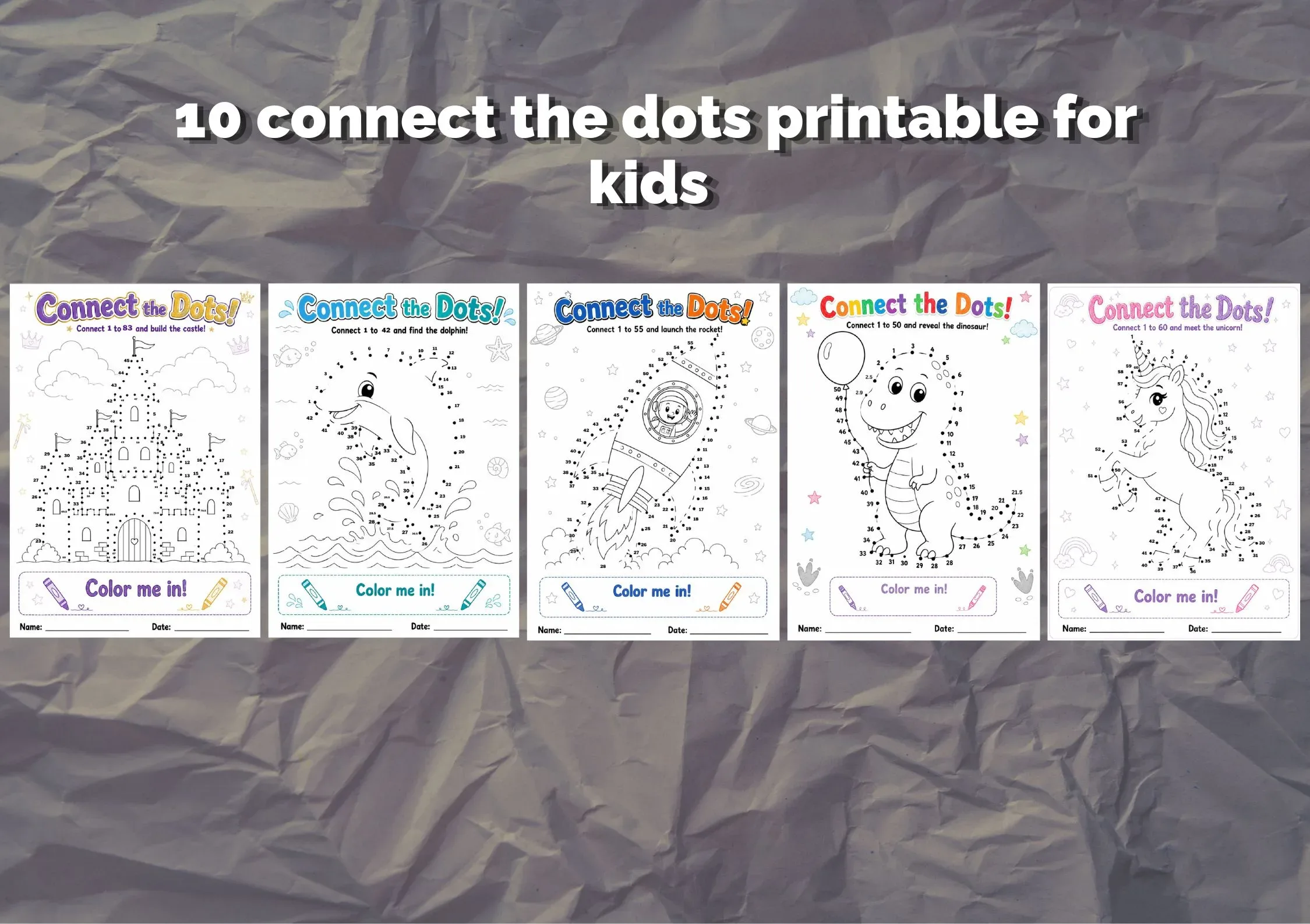
The Brave Lion (Page 8): Connects 1 to 55. Focuses on circular patterns to create the lion’s mane, great for developing wrist flexibility.
The Deep Sea Mermaid (Page 9): Connects 1 to 60. Uses decimals (53.2, 53.4) to define the intricate scales and hair of the mermaid.
The Choo Choo Train (Page 10): Connects 1 to 50. Features sub steps (22.2, 22.4, 22.6, 22.8) to define the wheels, teaching children about mechanical symmetry.
The Garden Butterfly (Page 11): Connects 1 to 40. A perfect introductory page that uses sub steps to create the delicate, symmetrical curves of butterfly wings.
The Cupcake Dragon (Page 12): Connects 1 to 46. A whimsical finale that mixes counting with a fun, character-driven story.
Connecting the Dots to Success: The Ultimate Guide to Our 10 Page Activity Pack
As parents and educators, we are always looking for “stealth learning” activities that feel like play but are actually building the foundational blocks of academic success.
Connect the dots (or dot to dot) puzzles are a classic example of this.
Our 10 Page Connect the Dots Printable Bundle takes this traditional concept and upgrades it for the modern learner.
By moving beyond simple 1-10 counting and introducing intricate designs with decimal sub steps, we’ve created a toolkit that bridges the gap between basic counting and advanced fine motor control.
Why Connect the Dots is a “Superfood” for the Brain
It might look like your child is just drawing lines, but under the surface, their brain is working overtime. Here are the core developmental areas these worksheets target:
1. Number Sense and Sequencing
Mastering the order of numbers is the first step toward math fluency.
By following the dots from 1 to 83 (as seen on the Castle page), children reinforce their internal number line.
The inclusion of decimals (like 22.2 and 22.4) introduces them to the idea that numbers are infinite and exist in a specific sequence even between integers.
2. Fine Motor Precision
Writing is a physical skill that requires muscle memory.
Navigating a pencil through 50 points to reveal a Dinosaur helps strengthen the “tripod grip” and improves hand eye coordination.
This precision directly translates to neater handwriting in the future.
3. Visual Discrimination and Concentration
To solve the Mermaid or Unicorn puzzles, a child must scan a busy page to find the “next” number.
This trains the eyes to focus and filter out distractions a vital skill for reading and staying on task in a classroom.
4. The Reward of Completion
There is a psychological “win” when a child draws the final line and the mystery image is revealed. This builds self esteem and encourages them to tackle more difficult challenges.
How to Use This Pack for Maximum Learning
To get the most out of these A4 PDFs, try these different approaches based on your child’s age:
For Preschoolers (Beginner)
Focus on the Butterfly (Page 11) or Dolphin (Page 6).
The “Finger Trace” First: Before using a pencil, have the child find “Number 1” and trace the path with their index finger while you count out loud together.
Rainbow Lines: Instead of a pencil, let them use a different colored crayon for every ten numbers (1-10 is red, 11-20 is blue). It creates a vibrant, educational piece of art!
For Kindergarteners (Intermediate)
Move to the Rocket (Page 5) or Train (Page 10).
Introduce the Ruler: These pages have many straight sections. Teach them how to line up a ruler between the dots to make the edges of the train or rocket look “extra sharp.”
Identify the Decimals: Explain that numbers like “22.2” are like “small steps” between the big numbers. It’s a great introduction to the ruler markings they will see in school.
For Primary Students (Advanced)
Challenge them with the Castle (Page 7) or Unicorn (Page 4).
Timed Challenge: See if they can reveal the castle in under 5 minutes without making a mistake.
Creative Storytelling: Once the image is revealed, have them write three sentences about the character. “Where is the Dragon going with that cupcake?” “Who lives in the Castle?”
Beyond the Dots: The Coloring Bonus
Every page in this bundle features the “Color me in!” banner. The learning doesn’t end when the lines are connected.
Symmetry Practice: On the Butterfly page, encourage them to color the left wing exactly like the right wing.
Color Theory: Ask them what colors would make the Dolphin’s water look “cold” versus “warm.”
Texture Work: On the Lion, show them how to use short, quick strokes with their crayon to mimic the texture of fur.
Printing and Setup Instructions
Download: Save the high resolution PDF to your computer.
Print Settings: Select “Actual Size” on your printer settings for A4 paper. This ensures the numbers remain easy to read.
Laminate for Reusability: If you want your child to practice these multiple times, laminate the pages! They can use dry erase markers to connect the dots, wipe them clean, and do it again.
Travel Friendly: These are perfect for long car rides or flights. Clip them to a small clipboard, and you have hours of screen-free entertainment.
Conclusion
The 10 Connect the Dots Printable Pack is more than just a set of worksheets; it’s a journey of discovery. It turns a math lesson into a dragon, a counting drill into a unicorn, and a fine motor exercise into a castle.
By engaging both the logical (math) and creative (coloring) sides of the brain, you are providing your child with a balanced, enjoyable educational experience.
Download your bundle today and start connecting the dots to a brighter future!
Butterfly Template Free Printables For Coloring
15 the very hungry caterpillar printables for Coloring
How to Use These 10 Free Flower Tracing Templates for Kids
Blooming Brilliance: A Guide to the 10 Adorable Flower Activities for Preschoolers
45 Cottagecore Teatime Junk Journal Kit What’s Inside & Why You’ll Love Every Single Page
40 Fresh Floral Prints for Junk Journaling A Beautiful New Collection You’ll Love
37 Honey Dreams Bee Junk Journal Kit What’s Inside This Bee Junk Journal Kit?
30 Pressed Flowers Botanical Papers Junk Journal Filler Pages
40 Botanical Beauty Wildflower Junk Journal Pages The Printable PDF Collection