This comprehensive 15 page “The Very Hungry Caterpillar” Activity Pack is a multi disciplinary educational resource designed for preschoolers and kindergarteners.
Sized perfectly for A4 printing, these worksheets use the beloved characters and story beats from Eric Carle’s classic book to teach counting, days of the week, the life cycle of a butterfly, and fine motor precision.
Below is a detailed explanation of the kit’s contents, followed by a comprehensive blog guide on how to maximize its educational impact.
Detailed Breakdown of the Printables
The pack is carefully sequenced to mirror the narrative of the book:
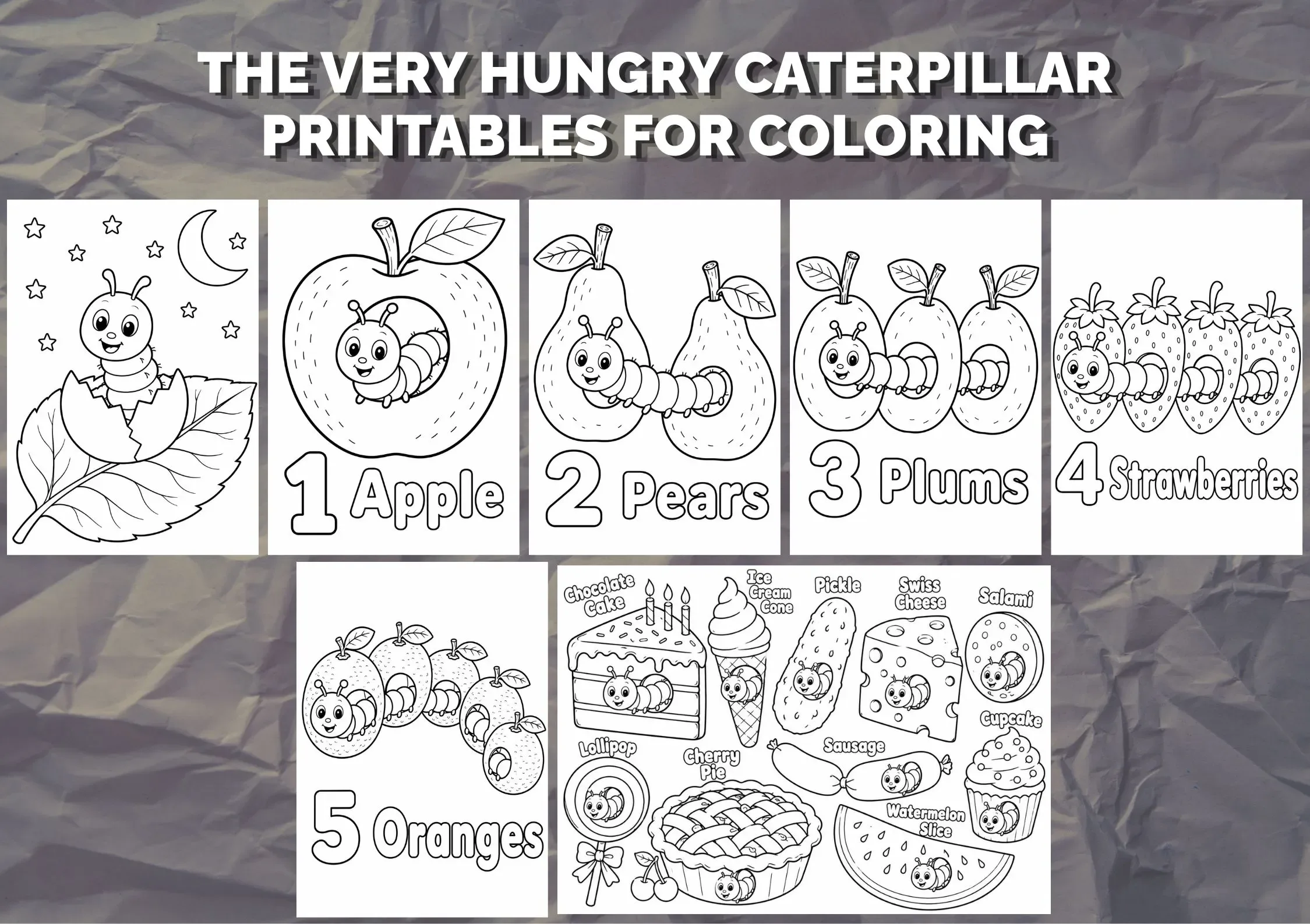
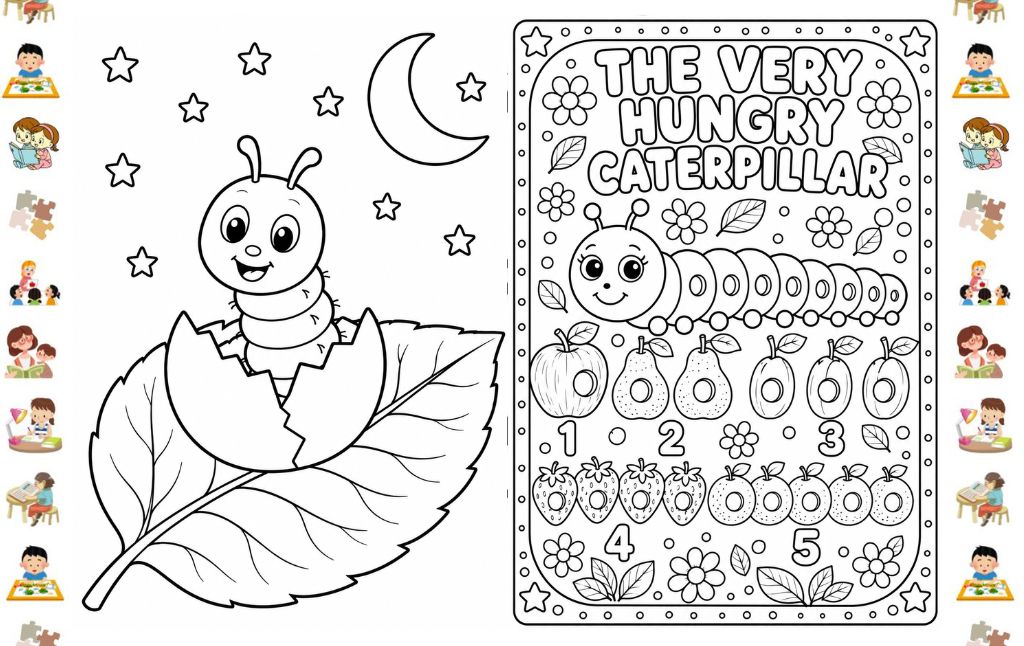
The Beginning (Page 3): Features the tiny egg on a leaf under a starry night. Skill: Early storytelling and landscape coloring.
Number Series (Pages 4–8): Individual pages for Monday through Friday. Kids color the caterpillar crawling through 1 apple, 2 pears, 3 plums, 4 strawberries, and 5 oranges. Skill: Number recognition (1-5) and color matching.
The Saturday Feast (Page 9): A busy page featuring all the “junk food” items (cake, pickle, salami, etc.). Skill: Vocabulary building and item identification.
The “Fat” Caterpillar (Page 10): The caterpillar has eaten the green leaf and grown large. Skill: Understanding cause and effect (eating leads to growth).
The Cocoon/Chrysalis (Page 11): A peaceful image of the caterpillar sleeping. Skill: Scientific terminology.
The Transformation (Page 12): The moment the butterfly emerges from the cocoon. Skill: Understanding metamorphosis.
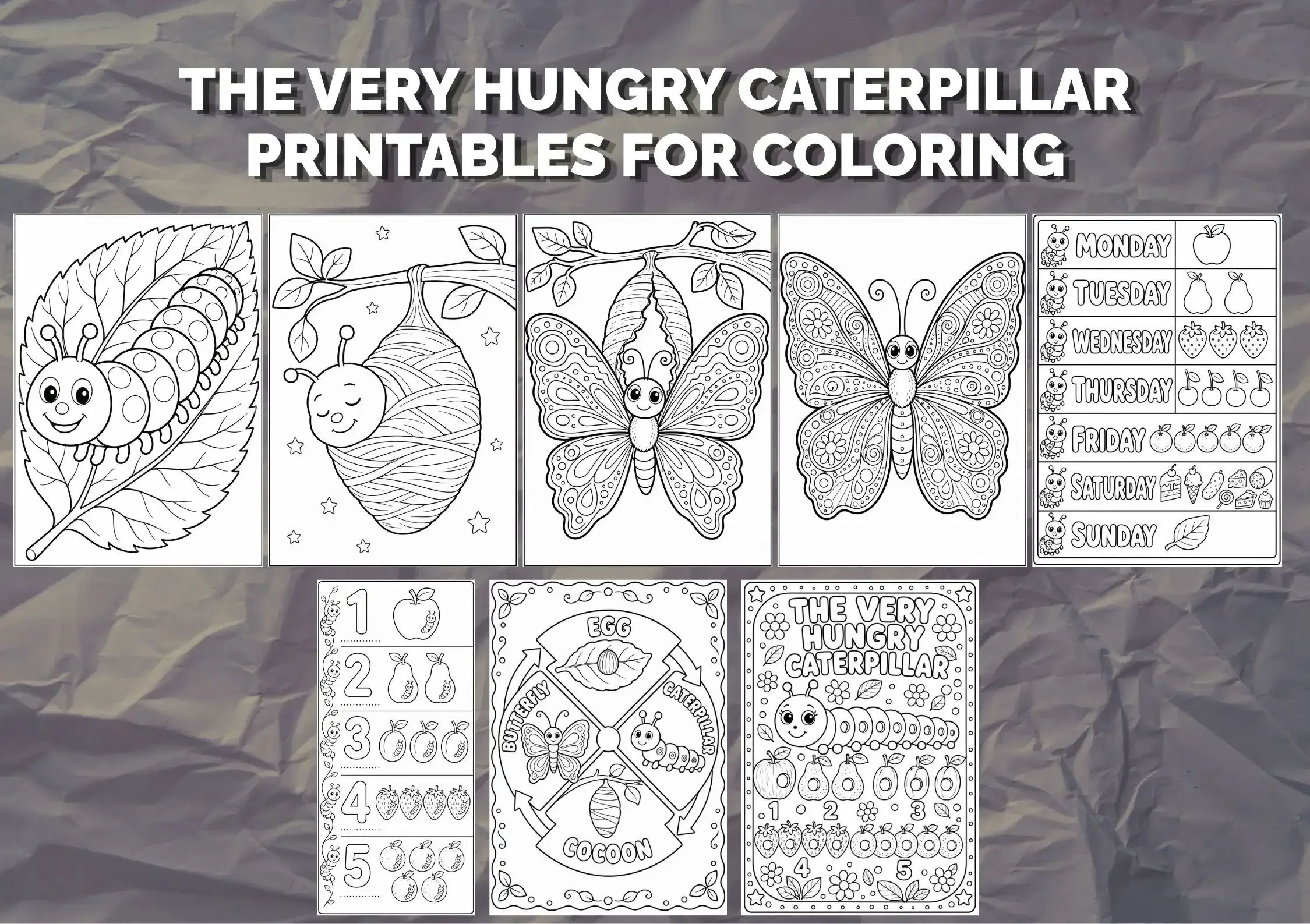
The Beautiful Butterfly (Page 13): A high detail illustration with intricate wing patterns. Skill: Symmetry and creative color expression.
Days of the Week Chart (Page 14): A summary grid linking Monday Sunday with the specific foods eaten. Skill: Temporal sequencing and memory recall.
Counting & Tracing (Page 15): A structured worksheet for tracing numbers 1–5 alongside small fruit icons. Skill: Pre writing and one-to-one correspondence.
The Life Cycle Diagram (Page 16): A circular flow chart labeled “Egg, Caterpillar, Cocoon, Butterfly.” Skill: Biological systems and logical flow.
Master Summary (Page 17): A decorative poster featuring the title and all key fruits. Skill: Review and consolidation.
Munching Through Milestones: A Guide to the Hungry Caterpillar Coloring Pack
For over 50 years, The Very Hungry Caterpillar has been a cornerstone of childhood literacy.
But beyond the beautiful tissue paper collages and the charming “pop” of the caterpillar through the pages, Eric Carle created a perfect educational framework.
Our 15 Page Printable Very Hungry Caterpillar Pack takes that framework and turns it into a tactile, hands on learning adventure.
For teachers and parents, these A4 worksheets are more than just a way to keep kids busy they are a “no prep” curriculum covering math, science, and literacy.
1. Mathematical Foundations: Counting to Five
The heart of early math is one to one correspondence the ability to count objects by touching each one individually. Pages 4 through 8 are designed specifically for this.
How to use: Have your child color the fruit first. Then, as they color the caterpillar, have them “munch” through each fruit while counting out loud: “One, two, three plums!” This reinforces that the numeral “3” represents three physical items.
2. Scientific Literacy: The Magic of Metamorphosis
Preschoolers are naturally curious about the world. This pack uses the story to explain a complex biological process: the life cycle of a butterfly.
The Lesson: Use Page 16 (The Life Cycle Diagram) to explain that life moves in a circle. Use the terms “Egg,” “Larva” (Caterpillar), “Pupa” (Cocoon), and “Adult” (Butterfly).
Comparison: Use Page 3 and Page 10 to show the physical change from tiny to large, helping children understand the concept of growth and nourishment.
3. Temporal Sequencing: The Days of the Week
Understanding the concept of time yesterday, today, and tomorrow is a major milestone for five year olds.
The Chart: Page 14 serves as a visual calendar. By linking “Monday” to “Apple” and “Friday” to “Oranges,” children use “associative memory” to learn the names of the days in the correct order.
Activity: Ask your child, “If today is Wednesday and the caterpillar ate three plums, what day was it yesterday?”
4. Pre Writing and Fine Motor Skills
Before a child can write “Caterpillar,” they must master the curves and lines of individual letters and numbers.
Number Tracing: Page 15 provides guided tracing for numbers 1–5. The dashed lines provide the “scaffold” the child needs to build muscle memory.
Intricate Coloring: Page 13 (The Butterfly) features smaller, more complex shapes. This encourages older preschoolers to focus on staying “inside the lines,” a key skill for developing hand-eye coordination.
Expert Tips for Parents & Teachers
The “Munch” Punch: After the child colors a fruit page (like the Apple on Page 4), use a standard hole puncher to let the child “punch” a hole through the fruit where the caterpillar “ate” it. This is incredible for building grip strength!
Laminate for Longevity: For the Days of the Week (Page 14) and Life Cycle (Page 16) pages, consider laminating them. This allows the child to use a dry-erase marker to check off items as you read the book together.
Color Coding: Encourage the child to use “realistic” colors (red for apples, purple for plums) to build real world associations, or let them go “wild” on the Saturday feast page to encourage creative expression.
Read Along Synergy: Don’t just hand over the papers! Read the story aloud and have the child find the matching worksheet as you turn the pages. This turns a passive listening activity into an active learning session.
Creative Corner: How Kids Can Play
Fingerprint Fruit: Instead of crayons, let the kids use ink pads and their own fingerprints to fill in the circles on the caterpillar’s body (Page 10).
The “Saturday” Collage: On Page 9, have the child circle their favorite food and draw one thing they would eat if they were a very hungry caterpillar.
Symmetry Art: On Page 13, show the child that if they color one wing blue, the other wing should be blue too. This is a great introduction to the concept of mirror imaging.
Conclusion
The Very Hungry Caterpillar Activity Pack is a bridge between the magic of a story and the practical skills of a classroom. By the time your child has colored the final butterfly, they will have mastered the basics of counting, the order of the week, and the fascinating cycle of nature.
How to Use These 10 Free Flower Tracing Templates for Kids
Blooming Brilliance: A Guide to the 10 Adorable Flower Activities for Preschoolers
45 Cottagecore Teatime Junk Journal Kit What’s Inside & Why You’ll Love Every Single Page
40 Fresh Floral Prints for Junk Journaling A Beautiful New Collection You’ll Love
37 Honey Dreams Bee Junk Journal Kit What’s Inside This Bee Junk Journal Kit?
30 Pressed Flowers Botanical Papers Junk Journal Filler Pages
40 Botanical Beauty Wildflower Junk Journal Pages The Printable PDF Collection
30 Summer Fairy Junk Journal Pages You Need to Print
24 Whimsical Wildflower Watercolor Junk Journal Spread: A Complete Creative Study
50 Adorable Dog Junk Journal Pages That Will Make Every Scrapbooker Obsessed