Picture a typical Tuesday morning in a family home. One parent is searching for a permission slip that was due yesterday.
Another is trying to remember whether the dentist appointment is this week or next.
A child is panicking because they forgot to pack their homework. A sibling has no idea whose turn it is to take out the bins.
And somewhere in the middle of all that noise, nobody can remember what is for dinner tonight.
This is not a failure of any individual. It is simply the natural result of running a busy household without a centralized system.
A family command center fixes exactly that. It is a single, dedicated spot in the home, usually in the kitchen, hallway, or mudroom, where all the information a family needs to function smoothly is organized, visible, and accessible to everyone.
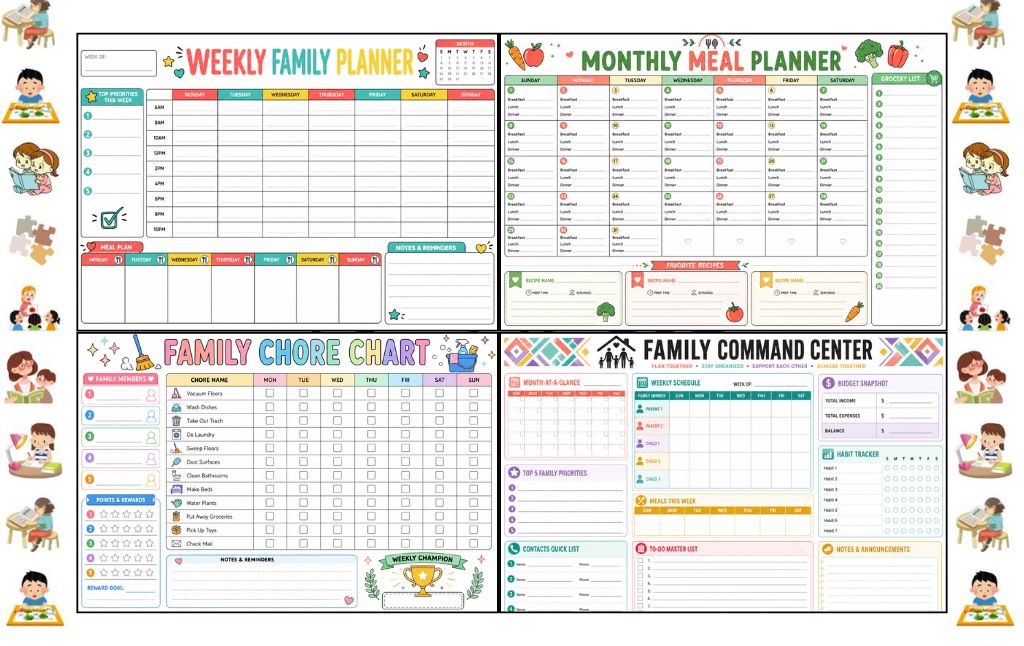
This free printable pack of ten A4 sheets provides every component a command center needs, covering daily schedules, meal planning,
Chore assignment, budgeting, grocery shopping, children’s study planning, family goal setting, emergency preparedness, kids’ daily routines, and a master command center overview.
Each sheet is beautifully designed, practical to fill in, and easy to print and update as the seasons of family life change.
What’s Inside the Pack: Ten Sheets, One Complete System
This pack covers every corner of family life in ten beautifully designed, print ready A4 sheets.
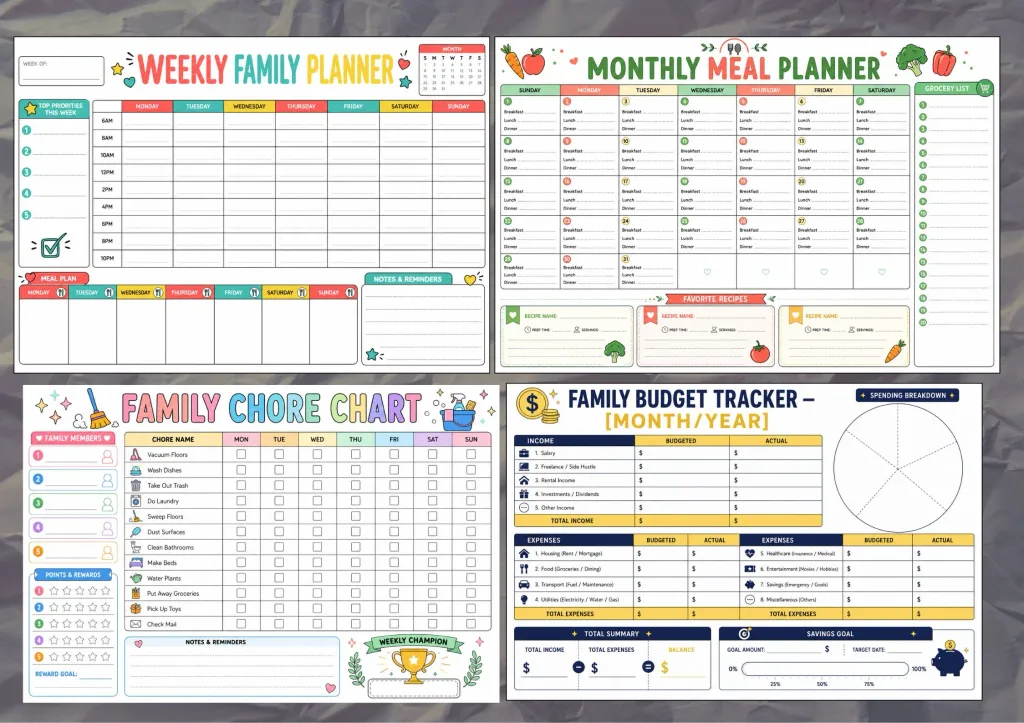
The weekly family planner maps the entire week with hourly time slots, a meal plan column, and a top five priorities panel.
The monthly meal planner extends food planning across a full calendar with recipe cards and a grocery list.
The family chore chart assigns and tracks twelve household tasks with a fun points and rewards system.
The family budget tracker compares budgeted versus actual income and expenses, complete with a savings goal thermometer.
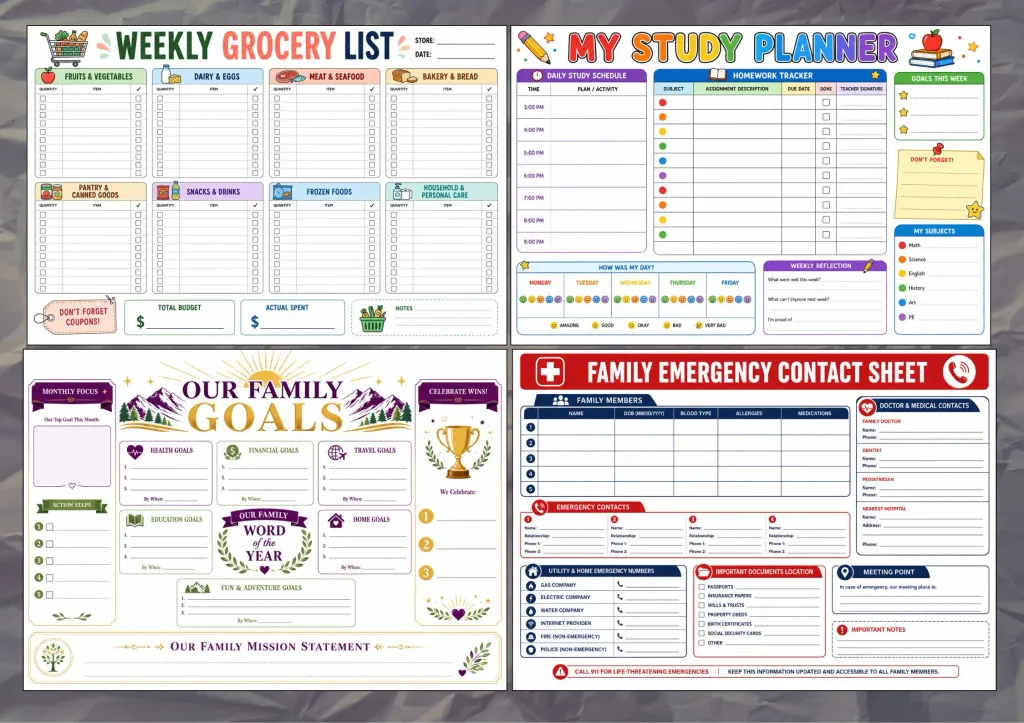
The weekly grocery list organizes shopping into eight categories for a stress free store run.
For children, the My Study Planner covers after school schedules, homework tracking, and a mood diary.
The family goals sheet captures health, financial, travel, education, home, and adventure goals alongside a family mission statement.
The emergency contact sheet stores medical details, doctors, utility numbers, and an evacuation meeting point.
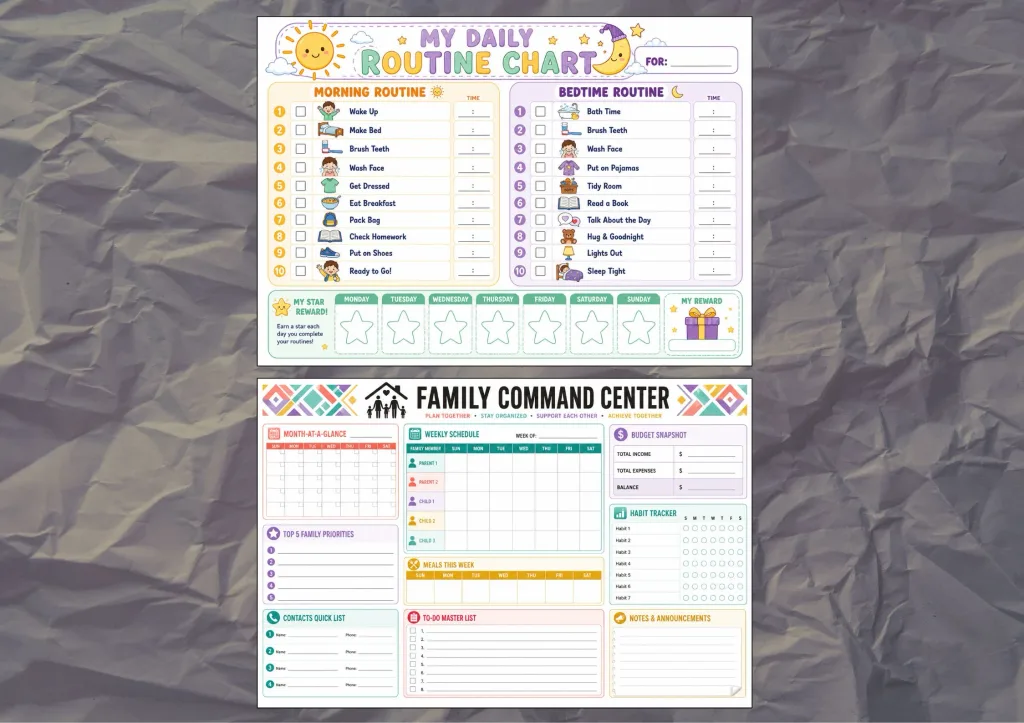
The daily routine chart walks kids through ten illustrated morning and bedtime steps with a star reward tracker.
Finally, the master command center brings everything together on one at a glance overview sheet.
Free Classroom Labels with Pictures for Easy Organization
Stay Organized with This Free Meal Planner Printable
How a Family Command Center Transforms Daily Life
The concept of a family command center is not new, but the research behind why it works is compelling.
Environmental psychology consistently shows that when important information is externalized onto visible surfaces rather than kept in individual minds, cognitive load drops, communication improves, and family stress decreases.
The simple act of moving the family schedule from each parent’s phone calendar onto a shared wall planner means that any family member can answer questions about the week without having to ask someone else,
Which reduces the mental labor that tends to fall disproportionately on one person in most households.
For children specifically, the visual and predictable nature of a command center is developmentally significant. Young children thrive on routine and predictability.
When a child can walk to the kitchen wall and see exactly what is happening today, what the plan is for dinner, and what their morning steps look like, they feel safe and oriented rather than anxious and dependent.
The routine chart in particular, with its illustrated steps and star reward system, replaces the parental nagging that creates morning conflict with a child owned system that motivates through visible progress rather than adult pressure.
The chore chart and goals sheet serve a different but equally important developmental function.
When children see their name on the chore chart alongside their parents’, they receive a clear message that they are a contributing member of the household, not just a passenger in it.
When the family sits together to fill in the goals sheet at the start of a new year or school term, children learn that the future is something you plan for together, that goals are made concrete by being written down, and that families celebrate progress as a team.
These are foundational life skills that no school subject teaches directly but that play out across a lifetime.
Setting Up Your Family Command Center: A Step by Step Guide
Getting the system up and running takes one focused afternoon and pays dividends every single week:
Choose a location that every family member passes through multiple times a day.
The kitchen wall near the exit, the inside of a pantry door, the hallway by the front door, or a dedicated corkboard or magnetic whiteboard panel all work well.
Print all ten sheets on A4 paper. For sheets that will be reused weekly, such as the weekly family planner, chore chart, grocery list, and study planner, either print multiple copies to last the term or laminate one copy of each and use dry erase markers so the sheet can be wiped clean and refilled each week.
Fill in the permanent information sheets first. The emergency contact sheet and the family goals sheet contain information that does not change weekly.
Fill these in carefully, laminate them if possible, and mount them in a permanent spot on the command center.
Hold a brief family meeting to introduce the system. Show each family member where their column appears on the weekly schedule, explain the chore chart points system and the reward goal, walk children through their routine chart, and let everyone write their name on their respective sections.
Buy in matters, and children who feel included in setting up the system are far more likely to use it.
Establish a weekly reset time. Sunday evenings work well for most families.
This is the moment to fill in the new weekly planner, update the meal plan, write the grocery list, assign this week’s chores, and review any upcoming deadlines on the monthly meal planner.
Update the budget tracker once a month, ideally on the first day of the new month.
Enter the new income and budgeted expense figures, then update actuals as the month progresses.
Tips for Different Family Structures and Ages
This pack is flexible enough to work for families at very different stages:
Families with toddlers and preschoolers: Focus on the daily routine chart as the primary child facing sheet.
Use picture based explanation and sticker stars as the reward. Keep everything else parent managed.
Families with primary school children: Introduce the chore chart with the points system, let children use the My Study Planner independently, and include them in weekly planning conversations.
Families with teenagers: The My Study Planner, chore chart, and goals sheet are all highly relevant for teenagers. Including them in budget conversations using the budget tracker is also a powerful financial literacy tool.
Single parent households: The emergency contact sheet and weekly family planner are especially valuable, as all coordination responsibility sits with one person.
The system reduces the mental overhead significantly.
Blended or co parenting families: The weekly schedule grid, which accommodates up to five family members, can be used to coordinate custody schedules, school week versus weekend plans, and extracurricular commitments across households.
Making It a Family Habit, Not Just a Wall Display
The difference between a command center that transforms family life and one that becomes wallpaper within two weeks is consistent engagement.
A few habits make all the difference. First, make the weekly reset non negotiable.
Put it in the family calendar as a recurring commitment, keep it short, no more than fifteen to twenty minutes, and involve everyone.
Second, refer to the sheets throughout the week rather than just filling them in on Sunday.
When a child asks what is for dinner, point to the meal plan.
When a family member wants to know whose turn it is to vacuum, point to the chore chart.
The more the sheets are used as reference tools rather than planning artifacts, the more valuable they become.
Third, celebrate the wins the system creates. When the week runs smoothly because everyone could see the schedule, note it.
When a child completes their morning routine without reminders all week, make a big deal of awarding their stars.
When the grocery run stays within budget because the list was prepared and categorized in advance, acknowledge the saving.
The positive reinforcement of noticing what the system is doing for the family is what keeps everyone engaged with it over months and years rather than weeks.
[ >> DOWNLOAD THE STAY ORGANIZED WITH THIS FAMILY COMMAND CENTER KIT<< ]
Student Homework Planner Printables
Fruit of the Spirit Craft Pack: A Fun, Faith Based Activity for Kids
10 Free Printable 1st Grade Math Worksheets (A4 Size)
Back to School Printable Signs: A Fun, Stress Free Way to Celebrate Every Milestone
Colour, Learn, and Celebrate: How to Use Black History Month Bookmarks with Kids