This high resolution 20 Page Number Playdough Mat Collection is an elite educational resource designed specifically for toddlers, preschoolers, and kindergarteners.
Sized for standard A4 printing, these mats represent a “triple threat” in early childhood development: they simultaneously target fine motor strengthening, number sense (quantification), and early literacy (tracing).
Detailed Breakdown of the Number Mats
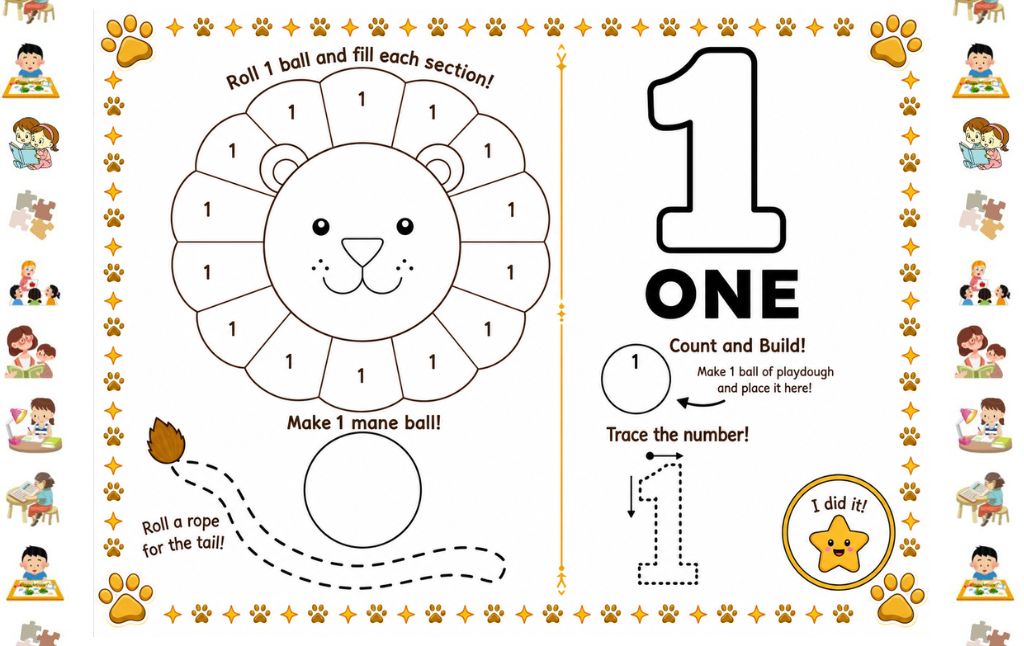
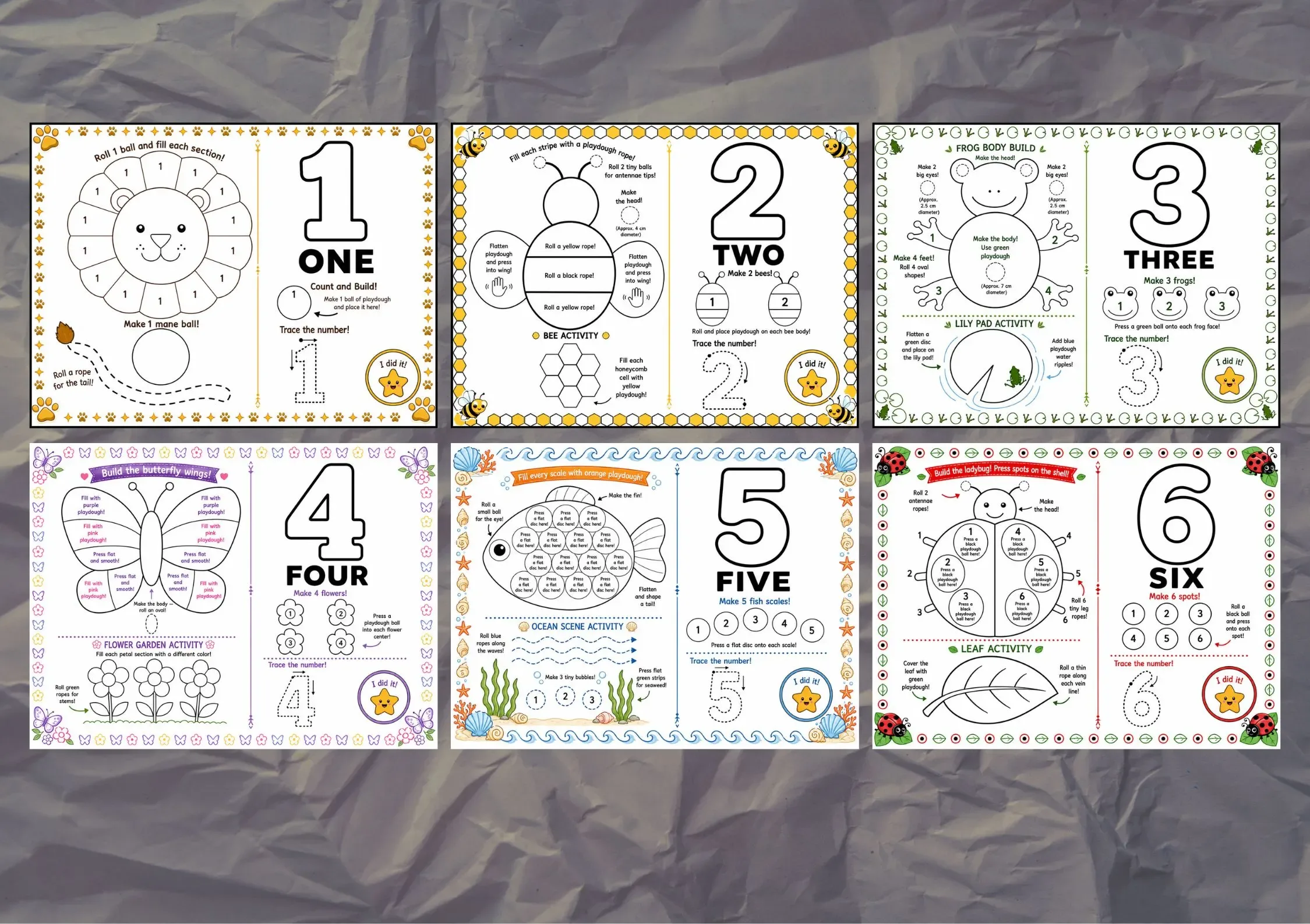
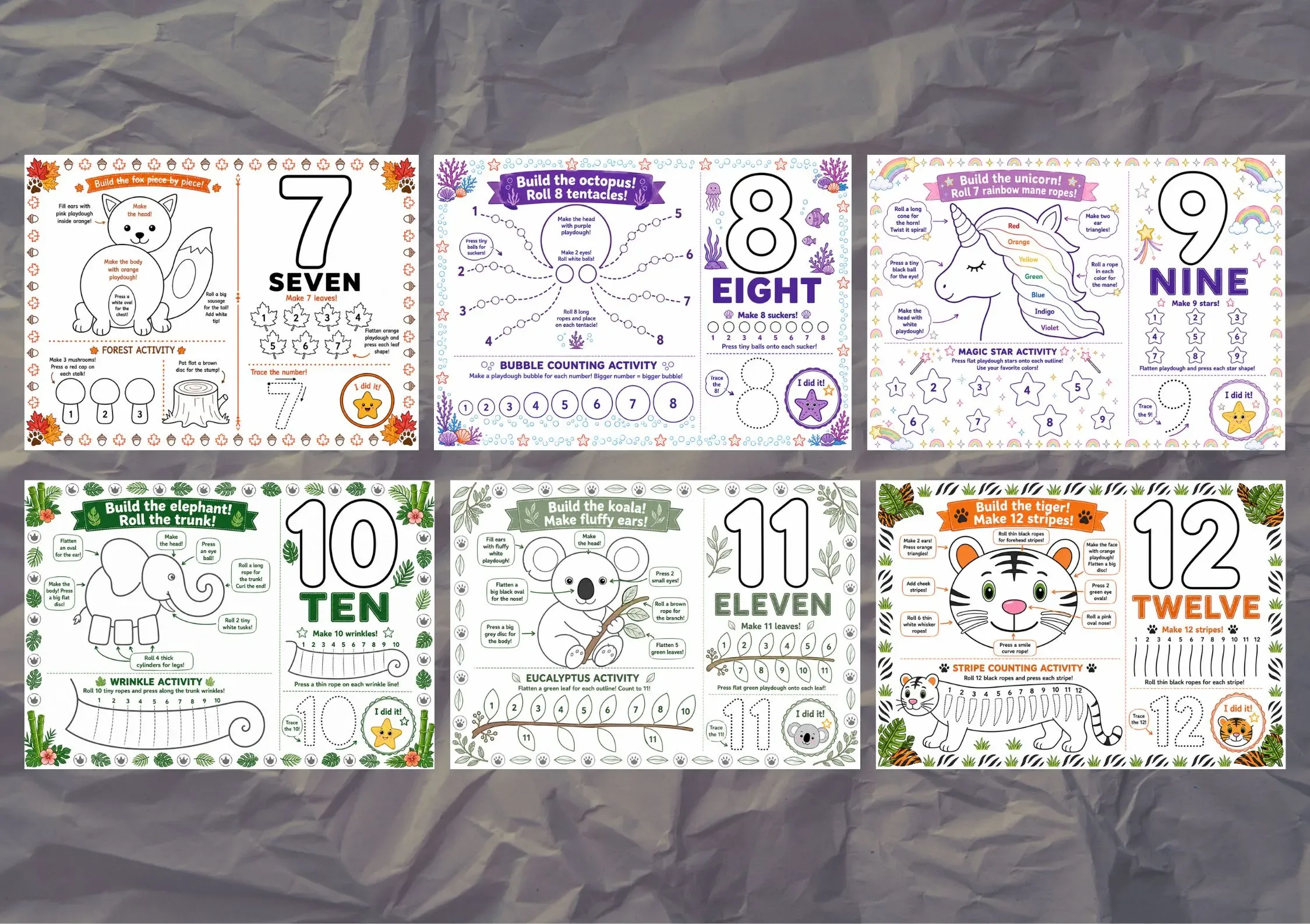
The collection consists of 20 individual mats (Numbers 1–20), each featuring a unique animal or nature theme. The layout of each A4 page is strategically split into two functional zones:
1. The Creative Sculpture Zone (The Left Side)
This area features a large, themed character that requires specific playdough techniques. Each mat provides “scaffolding” (step by step instructions) for the child:
The “Snake” Technique: “Roll a rope for the tail” (Lion-1) or “Roll 8 tentacles” (Octopus-8).
The “Pancake” Technique: “Flatten a green disc for the lily pad” (Frog-3) or “Press 12 orange discs for stripes” (Tiger-12).
The “Pinch” Technique: “Press tiny balls for suckers” (Octopus-8) or “Press 18 tiny spikes” (Hedgehog-18).
2. The Mathematical & Literacy Zone (The Right Side)
This area focuses on academic mastery:
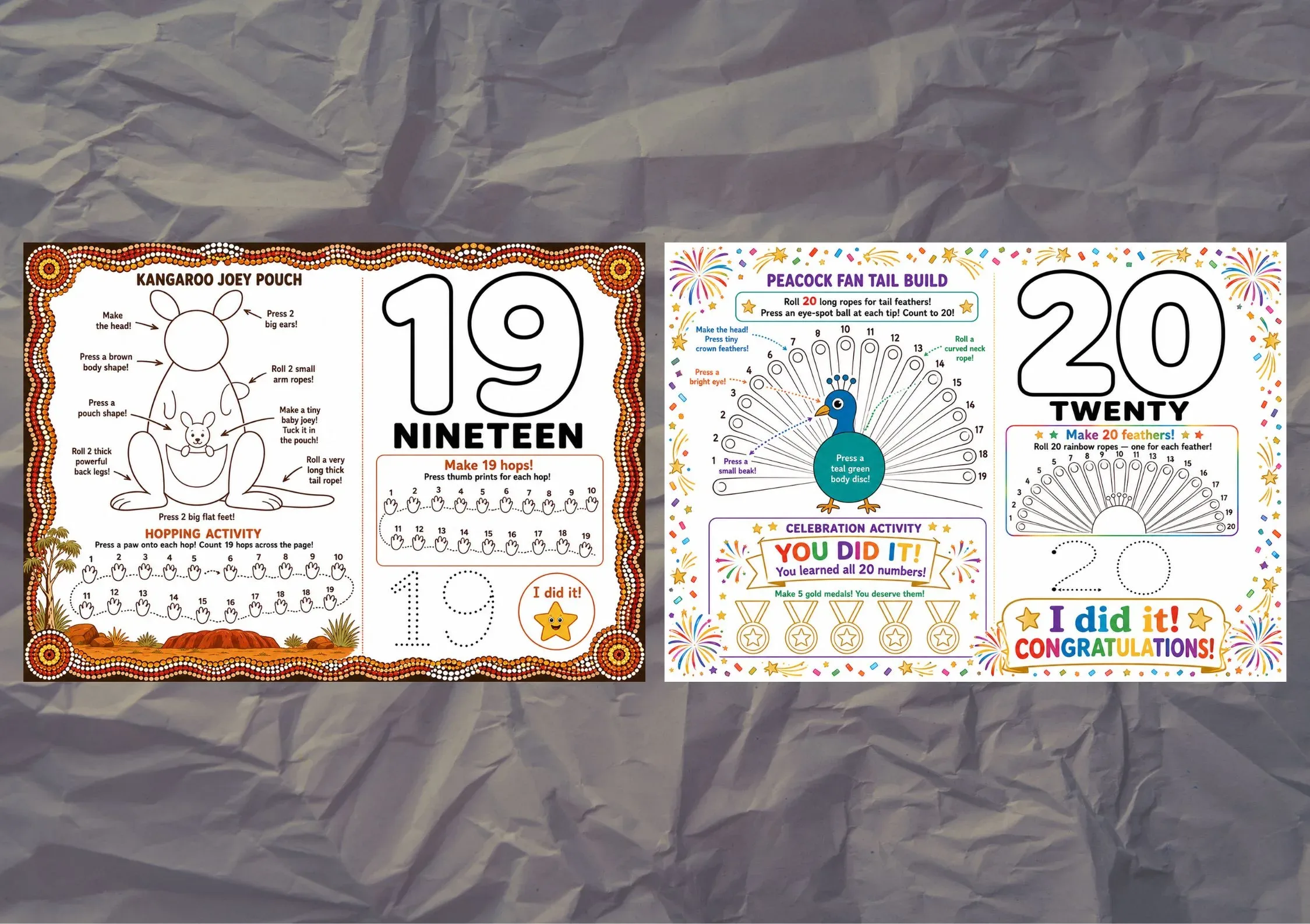
One to One Correspondence: Children place playdough blobs on numbered objects (e.g., 15 bamboo pieces for the Panda or 20 rainbow feathers for the Peacock).
Visual Number Recognition: Large block numbers dominate the corner.
Pencil Control/Handwriting: A dedicated tracing section at the bottom where children practice the numerical shape.
Positive Reinforcement: Each page concludes with an “I did it!” star to build confidence.
Rolling Toward Success: The Ultimate Guide to the 20 Animal Number Playdough Mats
In the busy world of early childhood education, we often search for the “perfect” activityone that keeps a child occupied, silent, and learning all at once.
While iPads are tempting, the true gold standard of brain development remains tactile, sensory play.
Our 20 Page Number Playdough Mat Bundle is more than just a printable; it is a meticulously engineered “gym” for your child’s brain and hands.
By combining the squishy, satisfying nature of playdough with the rigid logic of mathematics, we’ve created a learning tool that children actually ask to play with.
The Science of Squish: Why Playdough?
Before a child can write their name or solve an addition problem, they need fine motor precision.
This refers to the strength and coordination of the small muscles in the fingers and wrists.
Muscle Memory: When a child rolls a “rope” for the Zebra’s stripes (Number 12), they are using the same muscles required to hold a pencil correctly.
Bilateral Coordination: Using two hands to roll a ball for the Lion’s mane (Number 1) helps the left and right hemispheres of the brain communicate.
Proprioception: Squishing dough onto the Peacock’s tail (Number 20) helps children understand how much pressure to apply to objects a skill vital for controlling a pencil on paper.
Building Number Sense from 1 to 20
Counting is easy to memorize (like a song), but Quantification understanding that the number “8” actually represents eight physical things is much harder.
These mats solve that struggle through One to One Correspondence activities.
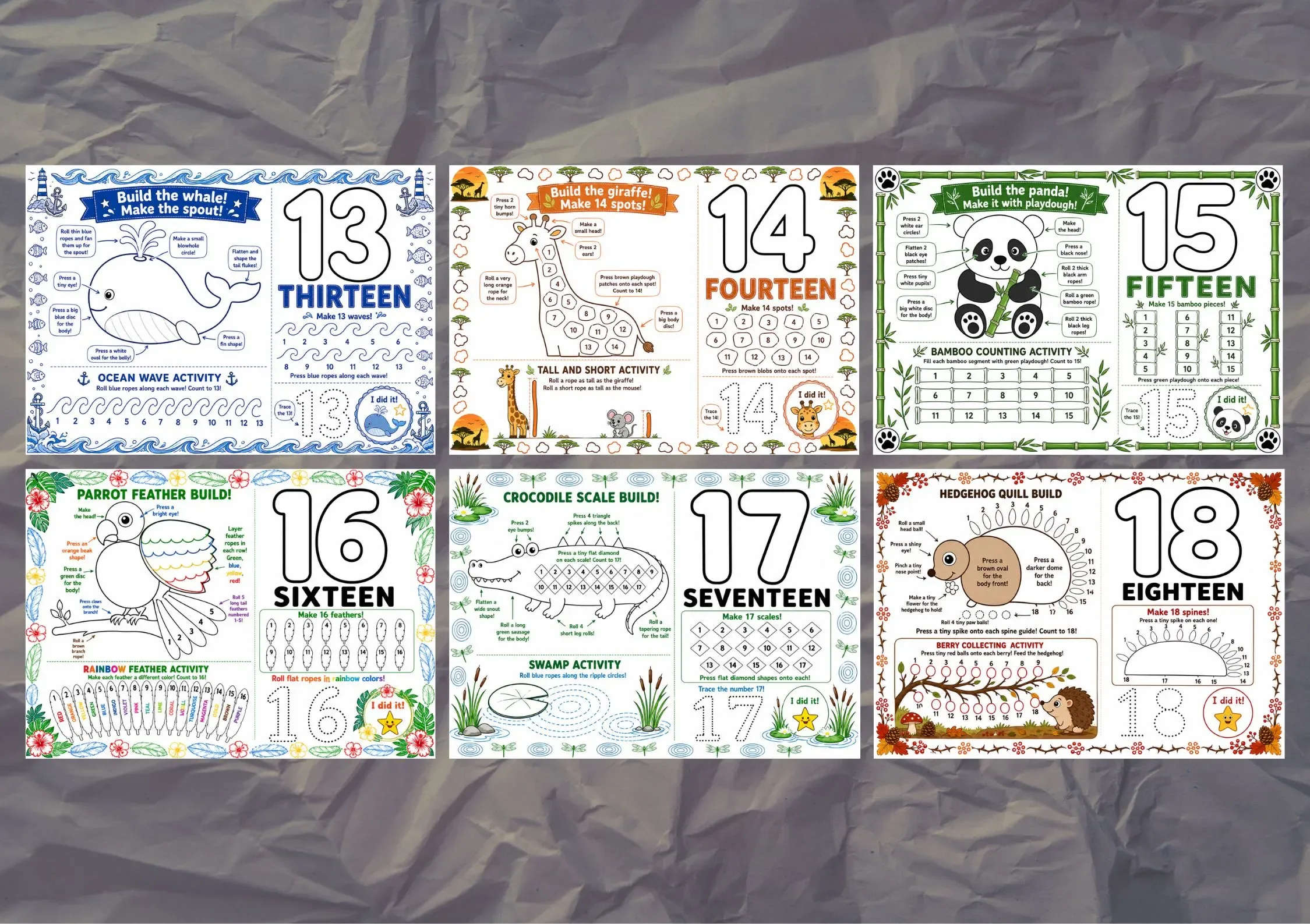
On the Octopus mat (Number 8), the child doesn’t just see the digit 8; they have to physically roll 8 tentacles and 8 suckers.
This tactile counting “anchors” the number in their long term memory.
As the kit progresses into the teen numbers (11–20), the complexity increases.
Building 17 scales for the Crocodile or 15 bamboo segments for the Panda teaches children patience and the concept of “sets,” which is the foundation for future multiplication and division.
How to Prepare and Use the Mats: A Parent’s Guide
To turn these A4 PDFs into a permanent classroom fixture, follow these simple steps:
Step 1: Printing and Preservation
Since playdough contains salt, oil, and water, it will eventually destroy plain paper.
Laminate: For the best experience, run each sheet through a laminator. The plastic creates a non stick surface that makes clean up a breeze.
Dry Erase Pockets: If you don’t have a laminator, slide the pages into heavy duty plastic dry-erase sleeves.
Step 2: Set the Stage
Provide your child with a variety of dough colors. Encourage them to match the “Color Guide” at the bottom of the mats.
For example, use orange for the Tiger, gray for the Elephant, and a rainbow of colors for the Unicorn.
Step 3: Scaffolding the Lesson
Don’t just give the child the mat and walk away! Use the “Watch Me, Try Me” method:
Read the prompt: “It says here to roll a rope for the lion’s tail. Watch how I roll the dough between my hands.”
Guide the counting: “Let’s count the suckers on the octopus together as you press them on. One… two… three…”
Trace together: Once the sculpture is done, have them use their finger or a dry-erase marker to trace the number at the bottom.
Creative Extension Ideas
Once your child has mastered the basics, you can “level up” the play:
The “Secret Recipe” Game: Ask the child to make a “soup” for the animal. “The Panda needs 15 pieces of bamboo soup! Can you count them into this bowl?”
Texture Mapping: Give the child a plastic fork or a toothpick.
After they make the Hedgehog (Number 18), have them use the tool to draw “fur texture” into the dough.
The Time Challenge: For older kids, use a kitchen timer. “Can you build the Giraffe’s 14 spots before the timer dings?”
Why Teachers Love This Set
In a classroom setting, these mats are perfect for Learning Centers.
They are “low prep” you print them once, laminate them, and they last for years.
Ink Friendly Design: While the borders are colorful, the central activities use clear lines to save on printer ink while still looking vibrant.
Differentiated Learning: A younger student might only manage to put a blob on the number, while an older student can focus on making the “ropes” and “discs” exactly as instructed.
Conclusion: A Legacy of Play
The 20 Animal Number Playdough Mat Collection represents the best of “stealth learning.”
To your child, they are playing with a “Rainbow Unicorn” or a “Grumpy Bulldog.”
To you, they are building the hand strength of an artist and the mathematical mind of a scientist.
Download your high resolution A4 bundle today.
Put on some music, open a jar of fresh dough, and watch as your child sculpts their way to a brighter academic future.
[ >> DOWNLOAD THE FULL 20 PAGE NUMBER BUNDLE HERE << ]
20 Free Printable Animal Playdough Mats
Free Printable Alphabet Q-Tip Painting Templates for Early Learners
15 Bridal Shower Games Free Printables
20 Free Stencil Printables Template Pack
Brain Dump Templates! 20 Cute Brain Dump Worksheets
15 Paper Piecing Patterns Free Printables Templates
15 free adult coloring printables quotes doodle art
10 connect the dots printable for kids
Butterfly Template Free Printables For Coloring
15 the very hungry caterpillar printables for Coloring
How to Use These 10 Free Flower Tracing Templates for Kids
Blooming Brilliance: A Guide to the 10 Adorable Flower Activities for Preschoolers