If you have ever watched a two year old insist on carrying their own bag, pour their own water, or help stir the bowl even when it makes twice the mess, you have already witnessed one of the most powerful and underused forces in early childhood:
The intrinsic toddler drive to contribute. Between the ages of two and three, children are at a developmental sweet spot where they are physically capable enough to complete simple household tasks,
Emotionally motivated by approval and belonging, and cognitively ready to understand a simple sequence of steps.
What they are not yet ready for is abstract explanation, long lists, or anything that looks boring.
This is exactly where this printable chore chart pack for toddlers aged two to three comes in.
The pack contains eleven A4 sized single task chore charts, each one dedicated to one specific household job and designed with bright,
Large illustrations, a cartoon toddler character modelling the task, colour coded day of the week rows, a visual reward system, and a cheerful heading that names the chore in simple, First person language.
Every element of the design has been tuned to the way toddlers actually process and respond to information: visually, immediately, and with the promise of recognition.
What the Pack Covers: Eleven Real Household Tasks
The eleven charts cover a carefully chosen set of tasks that are genuinely achievable for a two to three year old with minimal adult supervision once the habit is established.
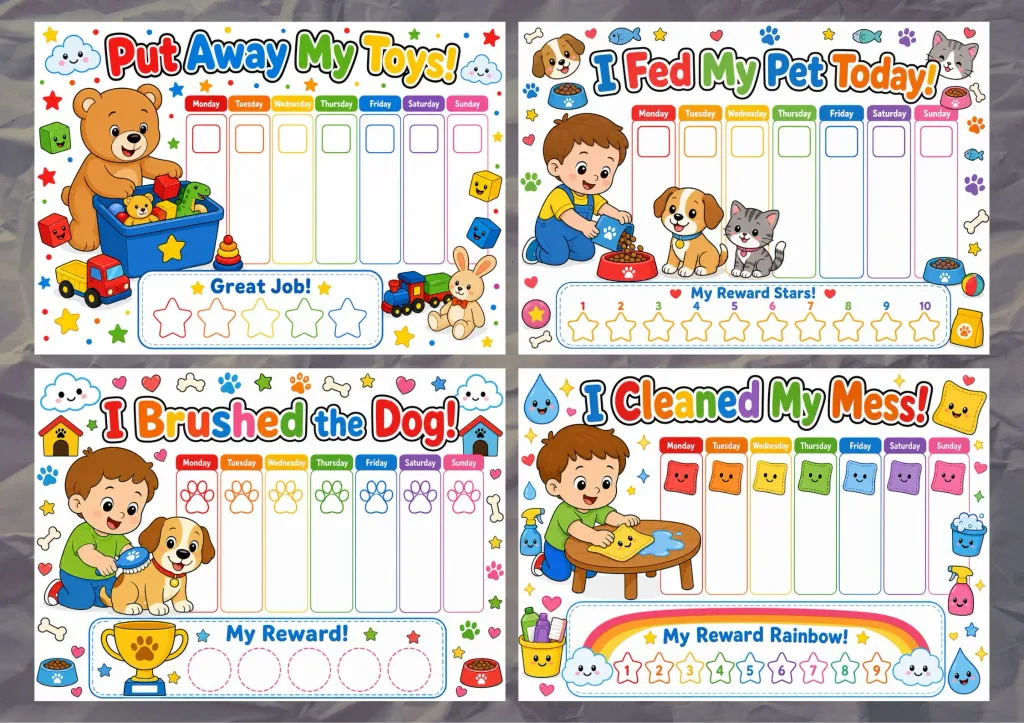
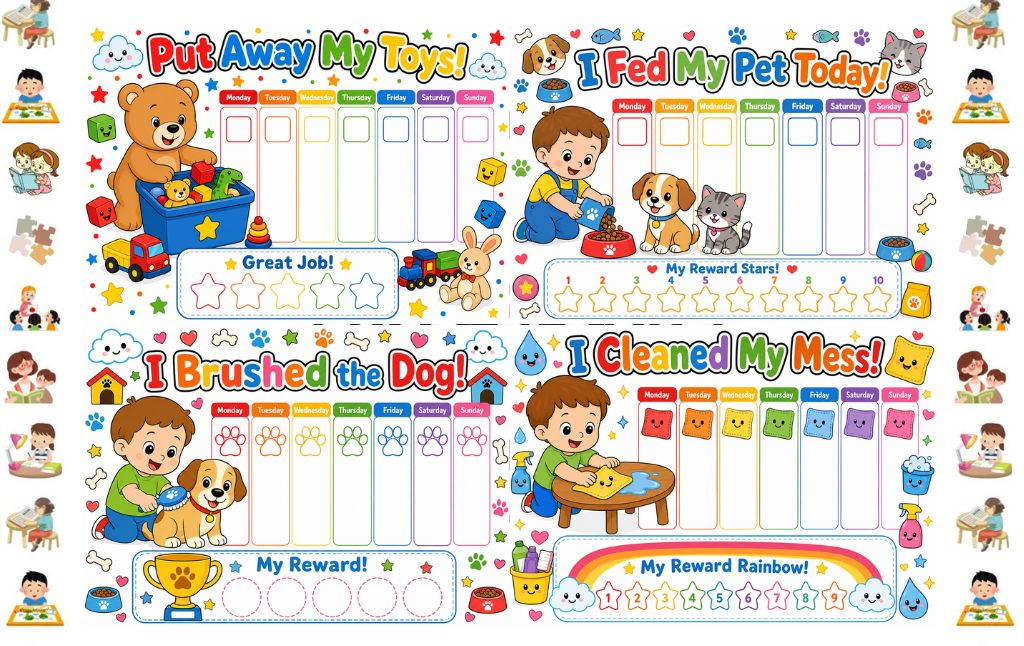
Put Away My Toys features a teddy bear placing blocks into a toy box, which mirrors exactly what a toddler is asked to do at tidy up time.
I Fed My Pet Today shows a cartoon boy pouring kibble into a pet bowl, surrounded by a dog and cat, with paw print accents and a ten star reward ladder.
I Brushed the Dog tracks the weekly pet grooming habit with rainbow coloured paw print icons for each day.
I Cleaned My Mess pairs a child wiping a table with a smiling sponge with a reward rainbow that fills in one colour per completed day.
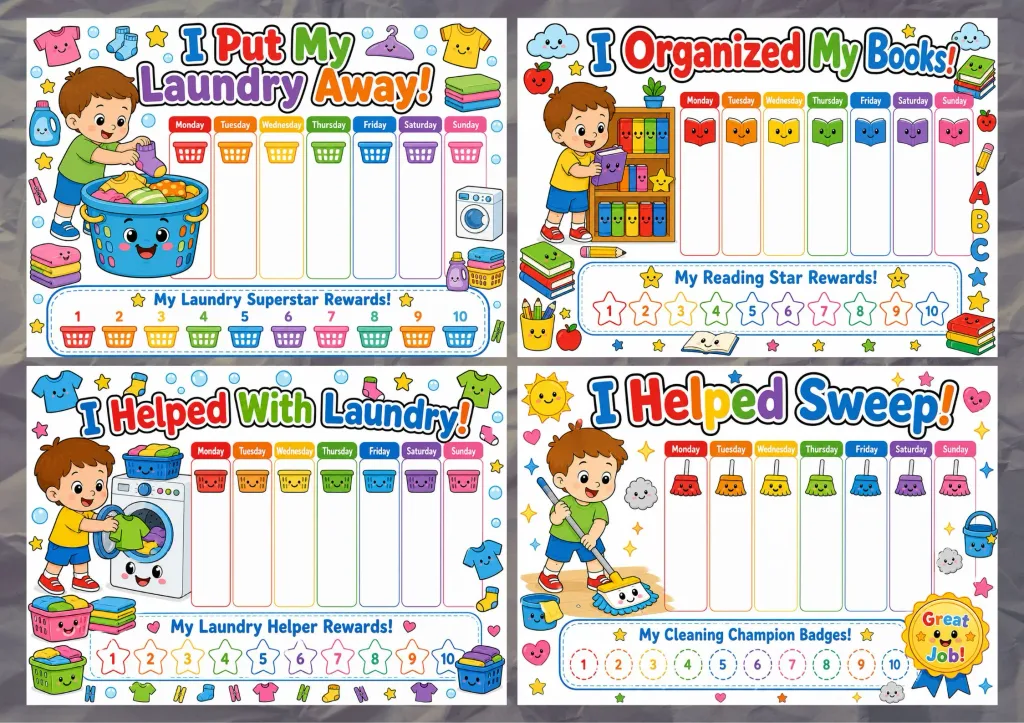
I Put My Laundry Away and I Organized My Books appear as a combined page capturing two related tidying tasks side by side, with a reading star rewards panel and day by day book icons.
I Organized My Books also appears as its own full page chart with numbered star rewards up to ten.
I Helped With Laundry shows a child loading a washing machine with illustrated laundry baskets and a laundry helper rewards tracker.
I Helped Sweep uses a mop character and cleaning champion badge circles for the reward track.
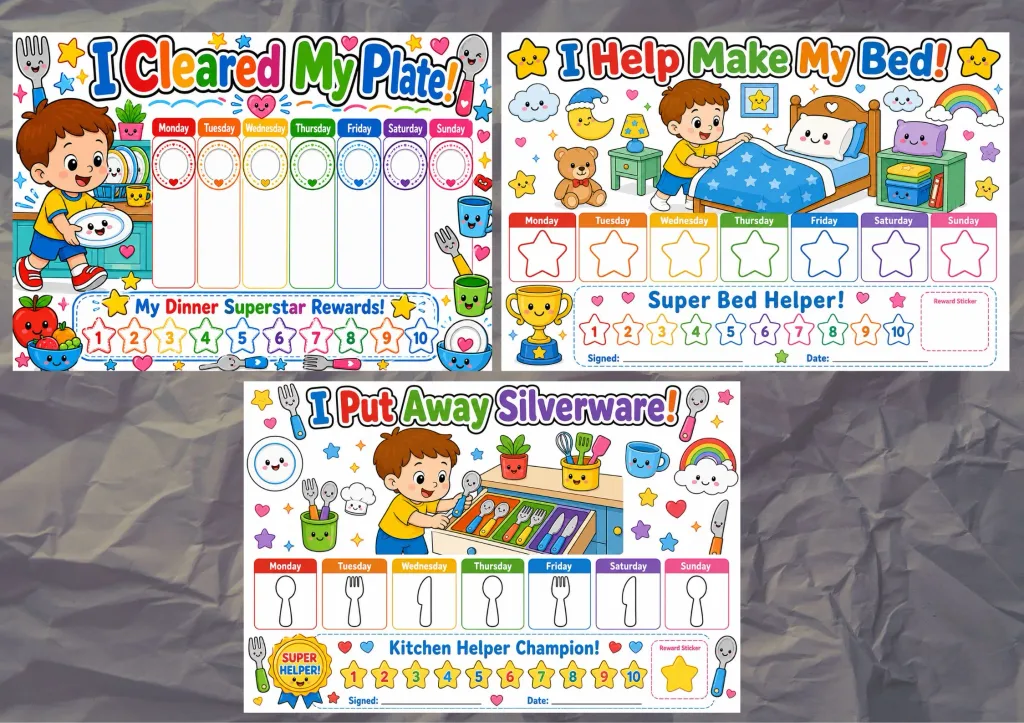
I Cleared My Plate features a smiling plate icon for each day and a dinner superstar reward panel.
I Put Away Silverware rounds out the kitchen tasks with illustrated cutlery graphics and a kitchen helper champion panel that includes a signed and dated field, making it feel like an official achievement.
I Help Make My Bed completes the collection with a super bed helper reward panel and star outlines to colour or sticker as each day is achieved.
10 Free Printable Lunch Box Notes
Stay Organized with These Family Command Center Printables
Why Single Task Charts Work Better for Toddlers
Most chore charts designed for older children present multiple tasks in a grid, which works well once a child can read and manage several competing responsibilities.
For two and three year olds, that format is cognitively overwhelming.
A toddler cannot hold a long list of expectations in mind, scan a multi column grid, or connect a small checkbox to a meaningful sense of accomplishment.
What a toddler can do is look at one big, bright picture of a task they recognise, hear the adult say the name of that task, and understand that doing the thing shown in the picture earns a star or a sticker in the row for today.
The single task format of this pack is therefore not a simplification for the sake of aesthetics.
It is the developmentally correct approach for this age group. Each chart functions as a one week visual contract between the toddler and the household:
This is the one job I am responsible for this week, and here is where I track that I did it.
The large illustration on every chart acts as a non verbal cue that tells the child what the task looks like without requiring them to read.
The colour coded day labels, red for Monday through pink for Sunday, provide a consistent weekly rhythm.
And the reward panels, whether numbered stars, rainbow segments, circles to stamp, or sticker slots, provide the immediate, tangible feedback that motivates toddlers far more effectively than verbal praise alone, though verbal praise alongside the sticker is always the most powerful combination.
How to Use the Charts: A Step by Step Guide for Parents
Getting started takes one print session and a few minutes of introduction:
Choose one or two tasks to begin with. Starting with just one chart, such as Put Away My Toys or I Cleared My Plate, prevents overwhelm and sets the child up for early success.
Add a second chart after two to three weeks once the first habit is reliably established.
Print on A4 paper and consider laminating the chart so stickers can be added and removed with velcro dots, or so a dry erase marker can be used to tick each day, making the same chart reusable week after week.
Post the chart at the child’s eye level, ideally in the room where the task takes place.
The toy chart goes in the playroom. The plate chart goes in the kitchen. The bed chart goes in the bedroom.
Proximity to the task makes the chart a natural cue rather than something the child has to remember to check.
Introduce the chart with enthusiasm. Sit at the child’s level, point to the illustration, and say the task name out loud.
Show them where the sticker goes when they do it. Let them add the first sticker together as a practice run.
Do the task together for the first week. Toddlers learn by watching and doing alongside a model, not by being instructed and left to figure it out.
Gradually step back over the following weeks as the habit takes root.
Celebrate every sticker. A big smile, a clap, a hug, and the words you did it, well done are the most powerful reward available to a toddler.
The sticker on the chart anchors the pride visually, but the adult response is what makes the behaviour stick.
[ >> DOWNLOAD THE CHORE CHART PRINTABLE FOR TODDLERS (2–3 YEARS)<< ]
Free Classroom Labels with Pictures for Easy Organization
Stay Organized with This Free Meal Planner Printable
Student Homework Planner Printables
Fruit of the Spirit Craft Pack: A Fun, Faith Based Activity for Kids