Somewhere between the toddler years and “big kid” independence sits a golden window:
Four to six years old, when children are desperate to help, physically capable of small tasks, and still young enough to think chores are a game rather than a burden.
This 17 page printable pack, sized for standard A4 paper, is built around that exact window.
Rather than a single generic checklist, it hands every chore its own illustrated, full color chart, designed less like a chore list and more like a collectible sticker reward system a child would actually want to use.
What’s Inside the Pack
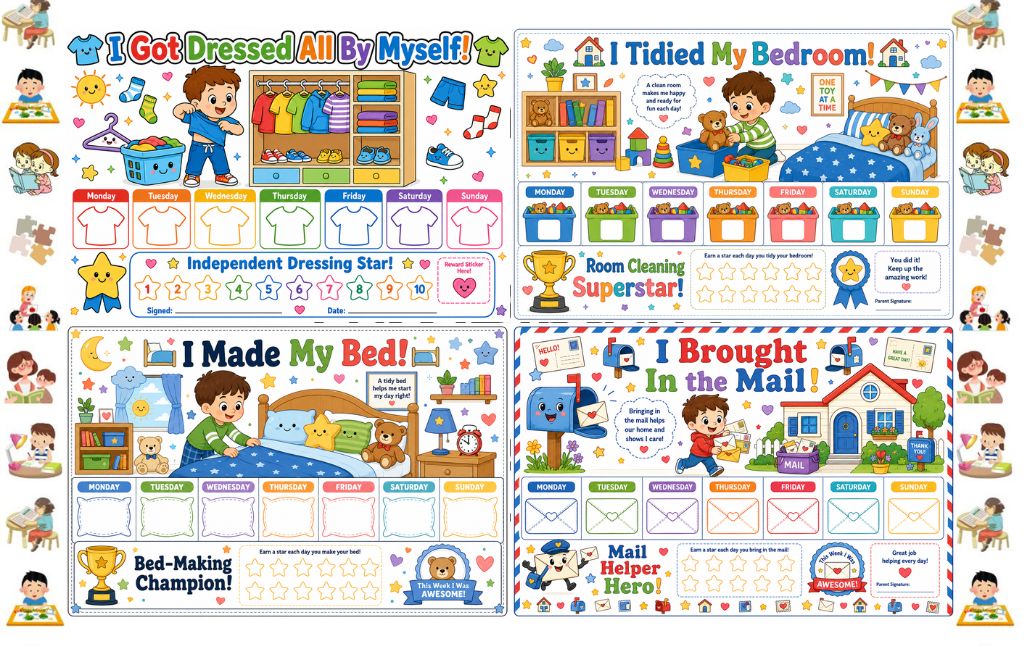
Each of the 17 sheets focuses on one specific, age appropriate task: getting dressed independently,
Tidying the bedroom, making the bed, bringing in the mail, picking out clothes for the week, clearing the dinner table, watering plants,
Wiping up crumbs, putting away groceries, matching socks, sorting laundry, dusting surfaces, setting the table, folding towels, putting away toys, vacuuming rugs, and sweeping up small messes.
Every sheet pairs a cheerful cartoon child mid task with a Monday through Sunday tracking grid, a motivational catchphrase
(“A clean room makes me happy and ready for fun each day!”), a trophy or badge graphic, and a line for a parent’s signature at the end of the week.
The trackers themselves come in two formats. Some use shape based daily boxes, a sock, a pillow, a shirt, a watering can, where a child colors in or stickers the outline each day they complete the task.
Others use a simple numbered star ladder (1 through 10) with space to sign and date, letting the chart double as a two week tracker.
Both formats end the same way: a “this week I was awesome” badge and a parent signature, turning the chart into a small ceremony rather than a silent obligation.
Chore Chart Printable for Toddlers (2–3 Years)
10 Free Printable Lunch Box Notes
Why This Structure Works for This Age Group
Children aged four to six are building three things at once: fine motor control, a sense of competence, and an early understanding of routine.
A chore chart that demands too much, multiple tasks per day, abstract instructions, no visual cue, fails on all three.
This pack avoids that by isolating one task per page and pairing it with an image that shows exactly what “done” looks like.
A child who can’t yet read fluently can still look at the picture of a folded towel and know what they’re aiming for.
The daily repetition across a single week also builds the habit loop child psychologists point to as the foundation of independence: cue, action, immediate reward, repeat.
How to Actually Use It With Kids
Start by choosing two or three charts rather than introducing all 17 at once.
Overwhelm kills motivation faster than difficulty does.
Print the chosen sheets, slide them into a clear plastic sleeve or laminate them, and let your child use a dry erase marker or small stickers to mark each completed day, this also sneaks in extra fine motor practice.
Post the charts somewhere your child passes daily: the bedroom door, the fridge, the bathroom mirror, so the cue is environmental, not something you have to remember to prompt.
Treat the end of week signature as a real moment.
Sit down together, look at the filled stars, and sign it with some ceremony.
This is where the chart earns its keep: the signature and badge give a four to six year old something a sticker alone can’t, a sense that a trusted adult noticed their effort.
As one chore becomes automatic, usually after two or three consistent weeks, retire that chart and rotate in a new one.
This keeps the system fresh and gradually expands what your child can do without help.
A few practical notes: keep the tone playful rather than transactional, avoid linking the stars directly to money or screen time at this age, since the goal is building intrinsic pride in helping, not a pay for chores habit.
And if a day gets missed, skip the guilt; an empty box is just an empty box, not a failure. The next day’s chore is a clean slate, which is exactly the kind of forgiving, low stakes system that keeps young kids willing to keep trying.
[ >> DOWNLOAD THE CHORE IDEAS FOR PRESCHOOLERS << ]
Stay Organized with These Family Command Center Printables
Free Classroom Labels with Pictures for Easy Organization
Stay Organized with This Free Meal Planner Printable
Student Homework Planner Printables
Fruit of the Spirit Craft Pack: A Fun, Faith Based Activity for Kids